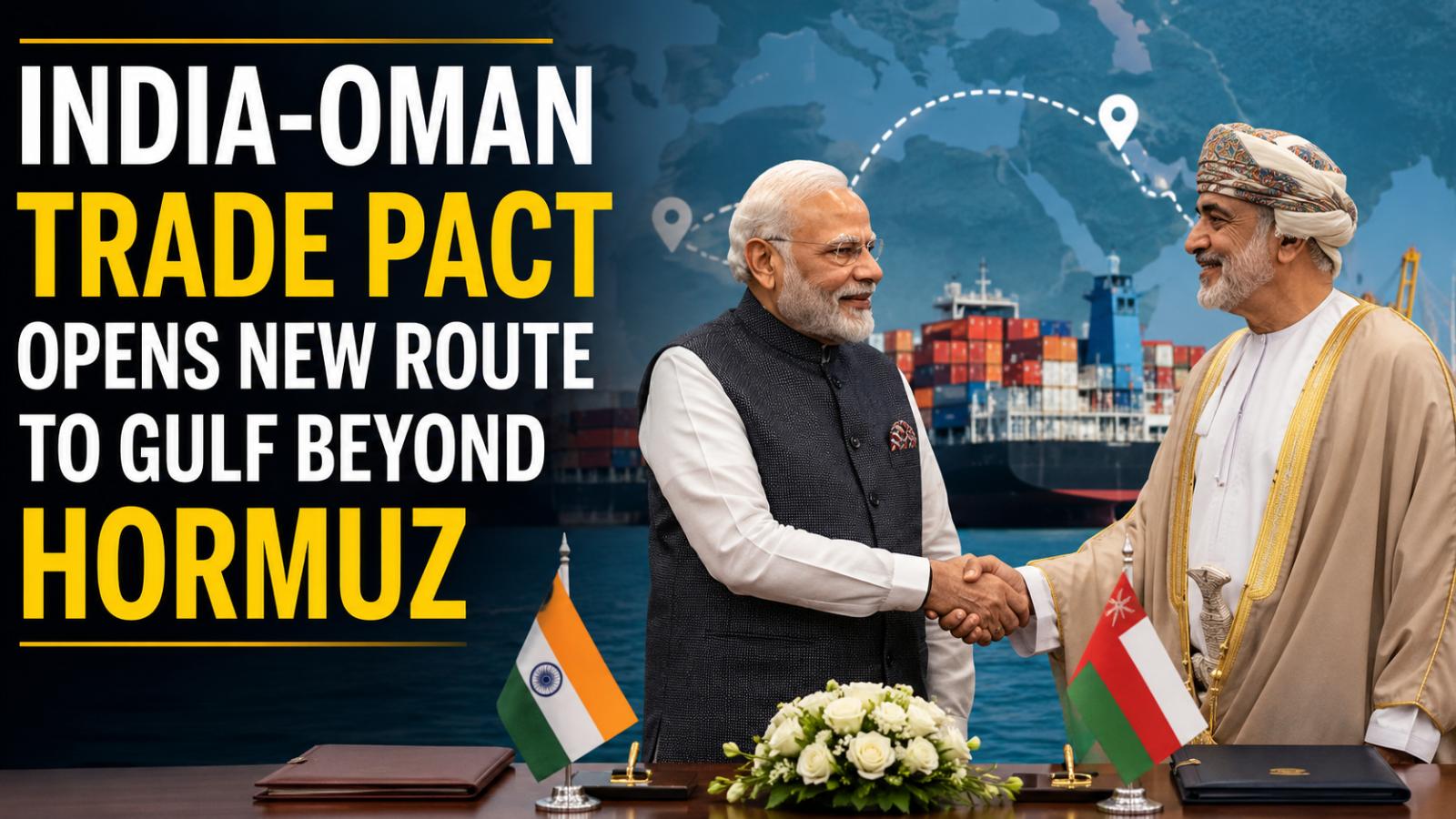
India-Oman trade pact opens new route to Gulf beyond Hormuz
01-06-2026: The India-Oman Comprehensive Economic Partnership Agreement has come into effect at a crucial time, giving India a stronger trade and energy link with the Gulf when shipping through the Strait of Hormuz is facing serious disruption. The pact, signed during Prime Minister Narendra Modi’s visit to Muscat last year, gives Indian exporters wider duty-free access to the Omani market and strengthens Oman’s role as an alternative gateway for India’s trade with West Asia.
The timing of the agreement is important. The ongoing US-Iran conflict has increased concerns over the safety of ships moving through the Strait of Hormuz, one of the world’s most critical energy chokepoints. The narrow waterway handles nearly one-fifth of global daily oil consumption and around a quarter of global seaborne oil trade. Any tension in this region directly affects countries such as India, which depend heavily on Gulf energy supplies.
Why Oman matters for India now
Oman’s geographical position gives it a strategic advantage. Unlike several Gulf countries that depend heavily on the Strait of Hormuz for maritime access, much of Oman’s coastline opens directly into the Arabian Sea and the Gulf of Oman. This makes ports such as Salalah and Duqm important for India when Hormuz becomes risky, congested or unstable.
The current disruption has already shown how vulnerable India’s Gulf trade can become during conflict. India’s imports from major Gulf economies reportedly fell from about USD 15 billion in April 2025 to USD 9.8 billion in April 2026. Exports to the region also dropped from USD 4.4 billion to USD 2.7 billion during the same period.
Oman, however, stood out as an exception. India’s imports from Oman surged by 246.4 per cent, rising from USD 430 million to nearly USD 1.5 billion. This sharp rise was mainly driven by higher purchases of crude oil and urea. India’s exports to Oman declined by only 10.3 per cent, showing that Oman remained a relatively stable trade partner even when the broader Gulf region faced stress.
Trade experts believe this proves Oman can act as a dependable alternative route for India’s trade and energy movement. Its ports can continue serving Indian businesses even during periods of conflict in the Gulf. For India, this is not just a trade benefit but also a supply-chain security advantage.
How the CEPA helps Indian exporters
Under the India-Oman CEPA, Oman is offering zero-duty access on 98.08 per cent of its tariff lines, covering 99.38 per cent of India’s exports to Oman. This is a major jump from the earlier system, where only 15.3 per cent of Indian exports received zero-duty access.
The pact is expected to benefit several labour-intensive Indian sectors. These include gems and jewellery, textiles, leather, footwear, sports goods, plastics, furniture, agricultural products, engineering goods, pharmaceuticals, medical devices and automobiles. For Indian MSMEs, artisans, farmers, fishermen and manufacturers, the agreement opens a wider and more competitive market in the Gulf.
Indian exports to Oman stood at about USD 3.64 billion in fiscal 2026. The main export items included refined petroleum products such as petrol and naphtha, along with calcined alumina, iron and steel products, machinery and rice. Although many Indian products already entered Oman at relatively low duties, some products faced tariffs as high as 100 per cent. The removal of these duties can make Indian goods more competitive in the Omani market.
At the same time, India must be realistic about the scale of opportunity. Oman has a population of around 55 lakh and a GDP of about USD 110 billion. This means Oman is not a massive consumer market like the UAE or Saudi Arabia. The real value of the pact is not only in selling more goods to Oman, but in using Oman as a stable trade, logistics and energy gateway during uncertain times.
Oman also gains from the agreement. India will eliminate or reduce tariffs on about 78 per cent of its tariff lines. Oman’s benefits are expected to come mainly from sectors where it is already a strong supplier to India, including crude oil, liquefied natural gas, fertilisers and industrial raw materials.
India imported USD 7.2 billion worth of goods from Oman in fiscal 2026. Key imports included crude oil worth USD 1.6 billion, LNG worth USD 1.2 billion and fertilisers worth USD 843 million. Oman also supplies methanol and ammonia, which are important industrial feedstocks for Indian companies.
The India-Oman CEPA therefore goes beyond a normal trade agreement. It improves market access for Indian exporters, supports job creation in labour-intensive sectors and strengthens India’s economic connection with a strategically located Gulf partner. More importantly, it gives India an additional route to manage energy and trade flows when the Strait of Hormuz becomes unstable.
For India, the lesson is clear. Depending too heavily on one maritime chokepoint is risky. Oman’s ports can help reduce that risk. The CEPA gives New Delhi a timely opportunity to build a more resilient Gulf trade strategy, protect supply chains and support Indian exporters looking for new markets in West Asia.