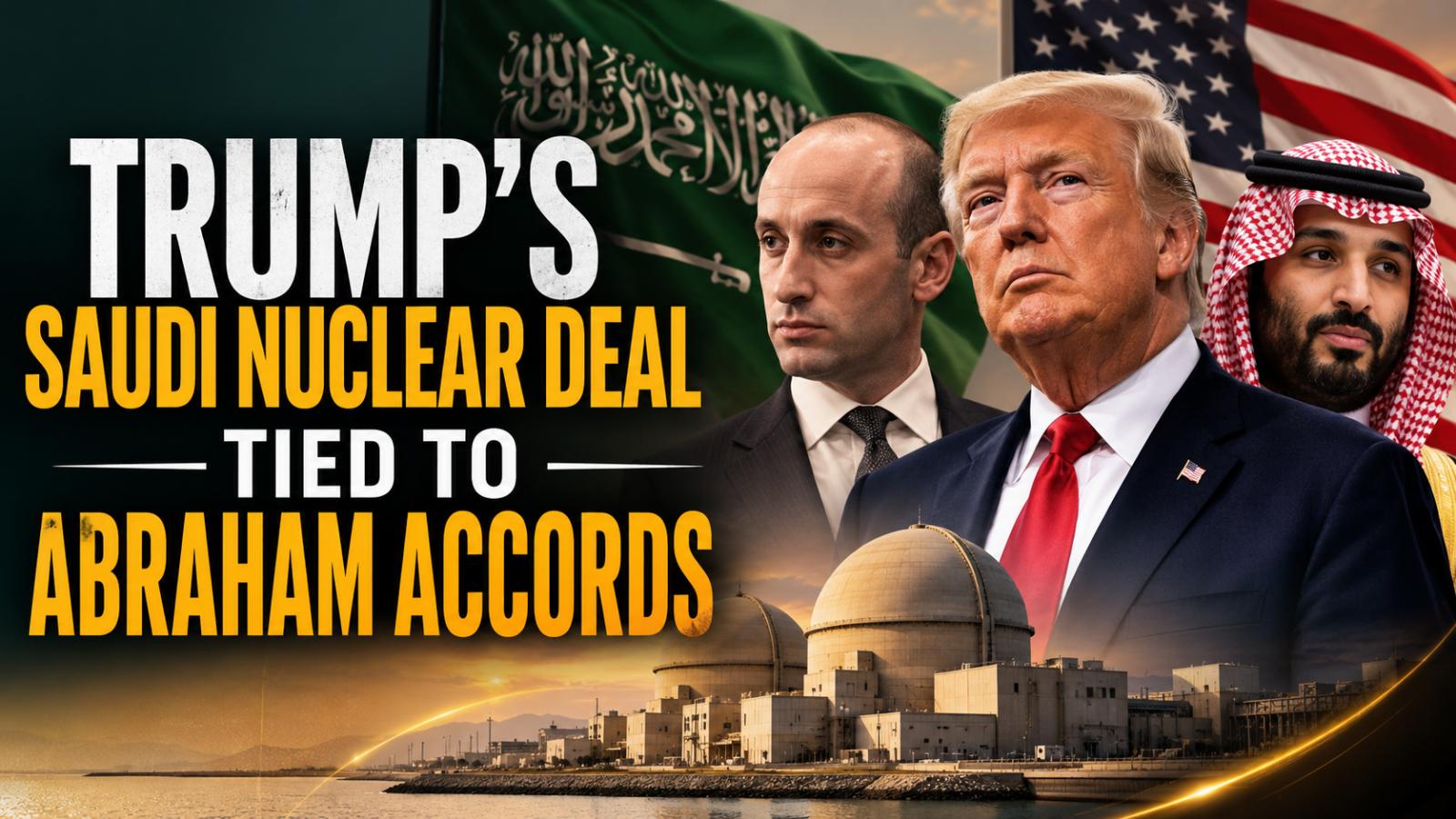
The Trump Saudi nuclear deal has entered uncertain territory after President Donald Trump said the civilian nuclear partnership would move forward only if Riyadh joins the Abraham Accords. White House Deputy Chief of Staff Stephen Miller defended the condition, arguing that Trump understands Saudi leaders and their negotiating approach.
Miller Defence of Trump’s Strategy
Speaking to reporters on Friday, July 24, Miller was questioned about why the president publicly announced the condition one day after the United States and Saudi Arabia signed the nuclear cooperation agreement.
Miller said Trump had been clear with Saudi Arabia and expected the kingdom to normalize relations with Israel. He argued that the president understands what he called Saudi “psychology,” including the kingdom’s leadership, internal decision-making and long-term plans.
Americans should trust Trump’s judgment in managing the relationship, Miller said. However, his remarks may not settle questions about whether Saudi officials formally accepted the condition before signing the agreement.
Abraham Accords Become a Deal Condition
Trump said the agreement would proceed only if Saudi Arabia joins the Abraham Accords, the diplomatic framework used to establish relations between Israel and several Arab states.
The president described the arrangement as a “two-way street” and said Saudi participation would support the future of the Middle East. He later said the condition had always been understood, even though it was not mentioned in the Department of Energy’s initial announcement.
The Energy Department said Secretary Chris Wright and Saudi Energy Minister Prince Abdulaziz bin Salman signed a peaceful nuclear cooperation agreement on July 22. The department described it as a decades-long, multibillion-dollar partnership supported by a bilateral safeguards agreement.
Saudi Ties With Israel Remain Uncertain
Saudi Arabia has not publicly accepted Trump’s latest demand. Riyadh has repeatedly linked diplomatic recognition of Israel to a credible and irreversible pathway toward an independent Palestinian state.
That position creates a major obstacle because the Israeli government has opposed several international proposals for Palestinian statehood. The disagreement could delay implementation even if Washington and Riyadh agree on the commercial and technical parts of the nuclear partnership.
Trump repeated on July 24 that Saudi Arabia must become part of the Abraham Accords before the nuclear deal moves forward. He also said Saudi officials and Energy Secretary Wright understood his position.
Nuclear Safety and Enrichment Questions
The agreement has also drawn attention over nuclear safeguards and the possibility of domestic uranium enrichment. The Energy Department said the pact supports high standards of safety, security and nonproliferation, but the complete agreement had not been publicly released at the time of the announcement.
Trump later said the arrangement would not permit enrichment. That clarification matters because uranium enrichment can support civilian reactor fuel production but may also create proliferation risks when countries develop advanced enrichment capabilities.
Under US law, a Section 123 agreement establishes the legal framework required for major transfers of American nuclear materials, equipment or technology. Such agreements normally include nonproliferation commitments and safeguards.
Congress Review Could Shape the Pact
The agreement must pass through the congressional review process before it can take effect. Lawmakers are likely to examine its restrictions on uranium enrichment, inspection requirements, technology transfers and enforcement mechanisms.
Congress may also question whether linking nuclear cooperation to Saudi-Israel normalization strengthens regional diplomacy or complicates a technical agreement that Washington has promoted as an energy and security partnership.
The final outcome will depend on three unresolved issues: whether Saudi Arabia accepts the Abraham Accords condition, whether the agreement contains safeguards strong enough to satisfy Congress, and whether Washington can reconcile the pact with Riyadh’s demand for progress toward Palestinian statehood.