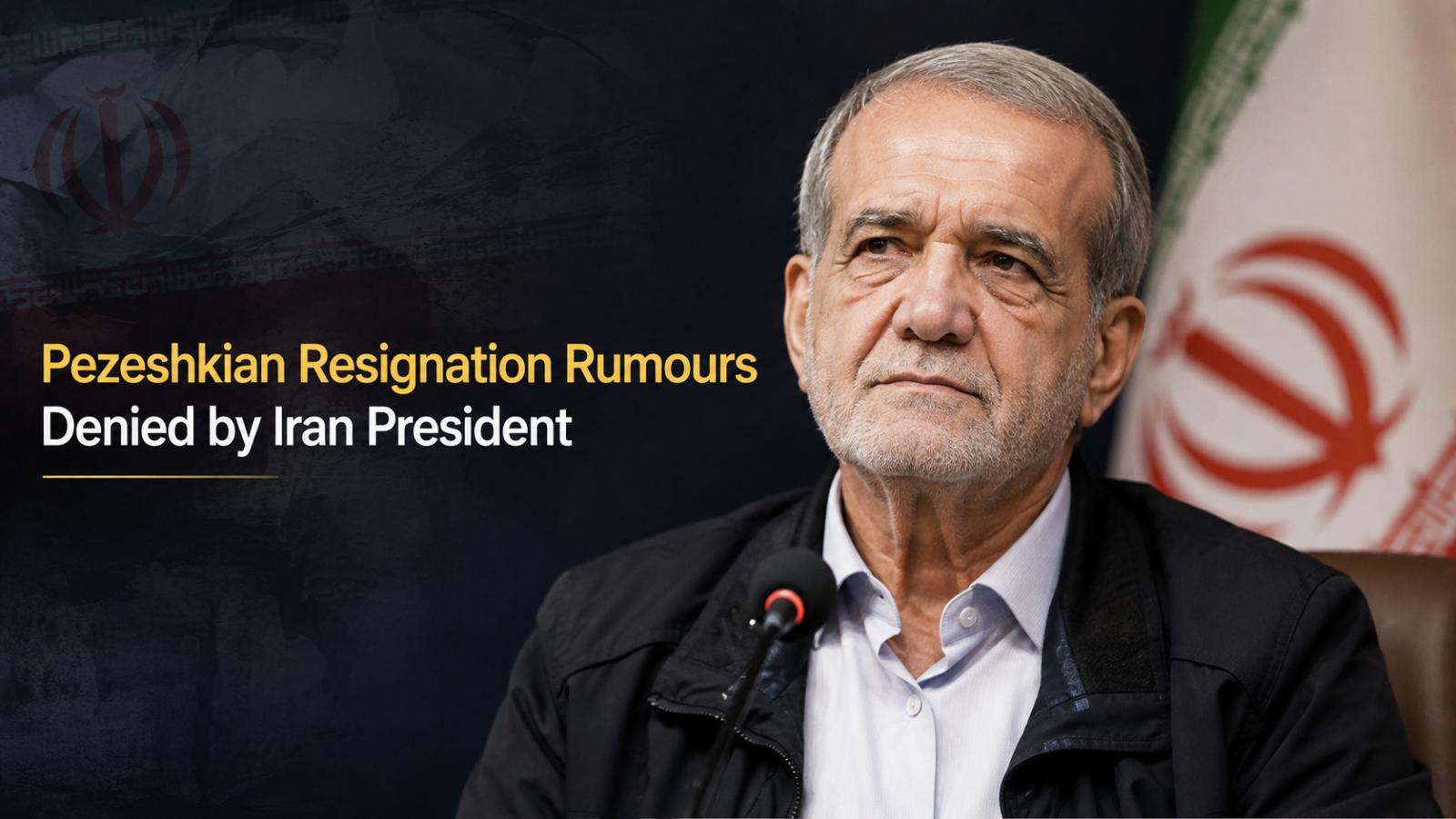
Masoud Pezeshkian resignation rumours have spread online after a senior Iranian cleric claimed the president had repeatedly considered stepping down. Pezeshkian, however, has publicly rejected the reports, while his office has described the allegation as false and politically motivated.
Pezeshkian denial
Iranian President Masoud Pezeshkian said he would remain in office and continue performing his responsibilities, directly rejecting speculation that he was preparing to resign. In a preview of an interview scheduled for broadcast on Iranian state television on August 4, Pezeshkian said his administration remained coordinated with the country’s military forces.
“I will not resign, and I will stand firm,” the president said. He added that any genuine resignation would be announced formally rather than circulated through rumours or unofficial political claims. His remarks offered the clearest public response to the resignation debate and signalled that he intended to project stability during a period of heightened political pressure.
Kharrazi claim
The controversy began after senior cleric Mohammad-Bagher Kharrazi appeared in a video released on August 3. Kharrazi, who has family connections to Iran’s senior leadership, alleged that Pezeshkian had threatened to resign 28 times.
Kharrazi claimed the president stopped making such threats after being warned that another resignation offer would be accepted. He attributed the warning to Supreme Leader Mojtaba Khamenei and suggested that Pezeshkian and other officials had subsequently backed down.
The cleric did not publicly present documents or other evidence supporting the number of alleged resignation threats. The claim has therefore remained unverified, although it quickly gained attention online and intensified debate about possible disagreements within Iran’s political establishment. Independent analysis also noted that the allegation had not been confirmed by the Iranian government.
Office response
Mehdi Tabatabaei, deputy for communications and information at the Iranian president’s office, strongly rejected Kharrazi’s account. He described the resignation story as baseless and an outright lie, making clear that the presidential office did not accept either the substance or the political framing of the cleric’s remarks.
In a statement posted on X, Tabatabaei accused extremist political groups of targeting national unity and attempting to undermine the result of the presidential election. He argued that political forces defeated at the ballot box were still seeking to challenge the public mandate received by Pezeshkian.
Pezeshkian won Iran’s 2024 presidential runoff after defeating Saeed Jalili, receiving support from voters seeking a relatively pragmatic approach to domestic governance and foreign policy.
Iran tensions
The dispute highlights continuing tensions between Pezeshkian’s administration and more conservative factions within Iran’s political system. Public disagreements do not prove that the president is preparing to leave office, but the speed at which the claim circulated shows how closely political observers are watching relations between elected officials, religious leaders and security institutions.
For now, there is no official resignation announcement or verified document showing that Pezeshkian has stepped down. The president remains in office, and both his televised comments and his communications team’s response directly contradict the resignation rumours.
Unity debate
The episode may nevertheless deepen questions about Iran’s internal political cohesion. Kharrazi’s allegation has placed private leadership discussions in the public spotlight, while the presidential office’s unusually forceful response suggests that officials view the claim as more than harmless speculation.
Until credible evidence emerges, reports that Pezeshkian is set to resign should be treated as unconfirmed. The established facts are that a cleric made the allegation, the president rejected it publicly, and his office issued a formal denial.