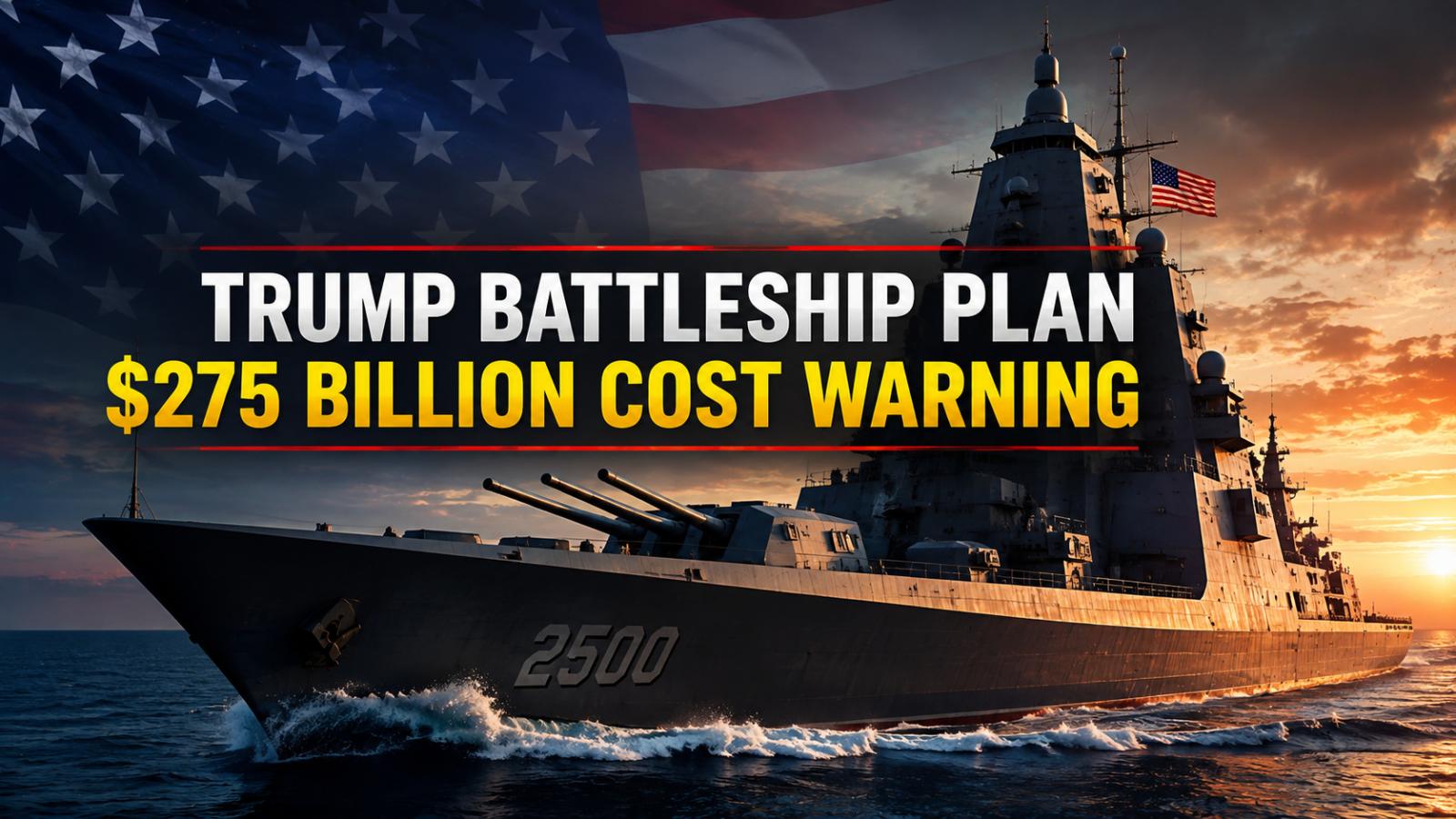
The proposed Trump-class battleship fleet could cost the United States about $275 billion and place severe pressure on an already strained shipbuilding industry, according to a new Congressional Budget Office estimate. The first nuclear-powered vessel alone could cost $23.4 billion.
President Donald Trump announced the new battleship programme on December 22, 2025, as part of what his administration calls the Navy’s Golden Fleet. Trump described the planned vessels as exceptionally powerful surface combatants equipped with advanced weapons.
Trump battleship cost reaches $275 billion
The CBO estimates that the first 35,000-ton Trump-class battleship would cost approximately $23.4 billion in 2026 dollars. Each of the remaining 14 vessels could average roughly $18 billion, bringing the estimated construction cost for the 15-ship programme to about $275 billion.
The estimate is higher than earlier Navy projections because the latest design assumes nuclear propulsion. Nuclear power could reduce conventional fuel expenses during operations, but it would significantly increase design, reactor, construction and certification costs at the beginning of the programme.
The CBO also warned that the final price could climb further if the vessels become larger. Navy documents indicate that displacement could range from 35,000 to 41,000 tons, while the CBO based its central estimate on the lower figure.
Navy plan calls for 15 nuclear warships
The Navy’s fiscal year 2027 shipbuilding plan proposes buying 15 battleships over several decades, with the first vessel expected to be ordered in 2028. The lead ship is planned as USS Defiant, with delivery currently projected for the following decade.
The ships are expected to carry a large mix of conventional and advanced weapons. Proposed systems include vertical-launch missiles, hypersonic weapons, directed-energy systems and nuclear-capable sea-launched cruise missiles.
The programme would produce surface combatants far larger than the Navy’s Arleigh Burke-class destroyers. Supporters argue that the ships could provide missile capacity, command functions and long-range firepower within a future fleet.
Shipyard strain threatens construction schedule
The CBO said the plan would force American shipbuilders to rapidly increase production of large surface warships. That goal will be difficult because major Navy programmes already face workforce shortages, delays and cost overruns.
The Navy’s fiscal year 2027 budget request includes more than $1 billion for the surface-ship industrial base, highlighting the scale of the capacity problem.
The challenge is greater because the two principal shipyards producing American surface combatants do not currently build nuclear-powered surface vessels. Developing that capability would require specialised infrastructure, trained workers, regulatory approval and a secure nuclear supply chain.
Former Navy Secretary John Phelan told Congress in 2025 that even the service’s best-performing shipbuilding programme was six months late and 57% over budget. Arleigh Burke-class destroyer deliveries have also faced years-long delays.
Drones raise questions over battleship strategy
Beyond cost and construction risks, defence analysts continue to debate whether giant battleships offer the best value in modern naval warfare. Recent conflicts have shown that inexpensive drones, unmanned boats and precision missiles can threaten much larger military platforms.
A heavily armed battleship could carry more missiles and sensors than a destroyer, but concentrating that capability in a small number of extremely expensive vessels also creates strategic risk. Losing or disabling one ship could remove billions of dollars in combat power.
The Navy therefore faces a difficult choice: invest in a limited number of large nuclear warships or distribute weapons across destroyers, submarines, unmanned vessels and smaller platforms. The CBO report does not decide that strategic debate, but its cost estimate makes clear that the Golden Fleet would demand decades of funding and a major expansion of US shipbuilding capacity.