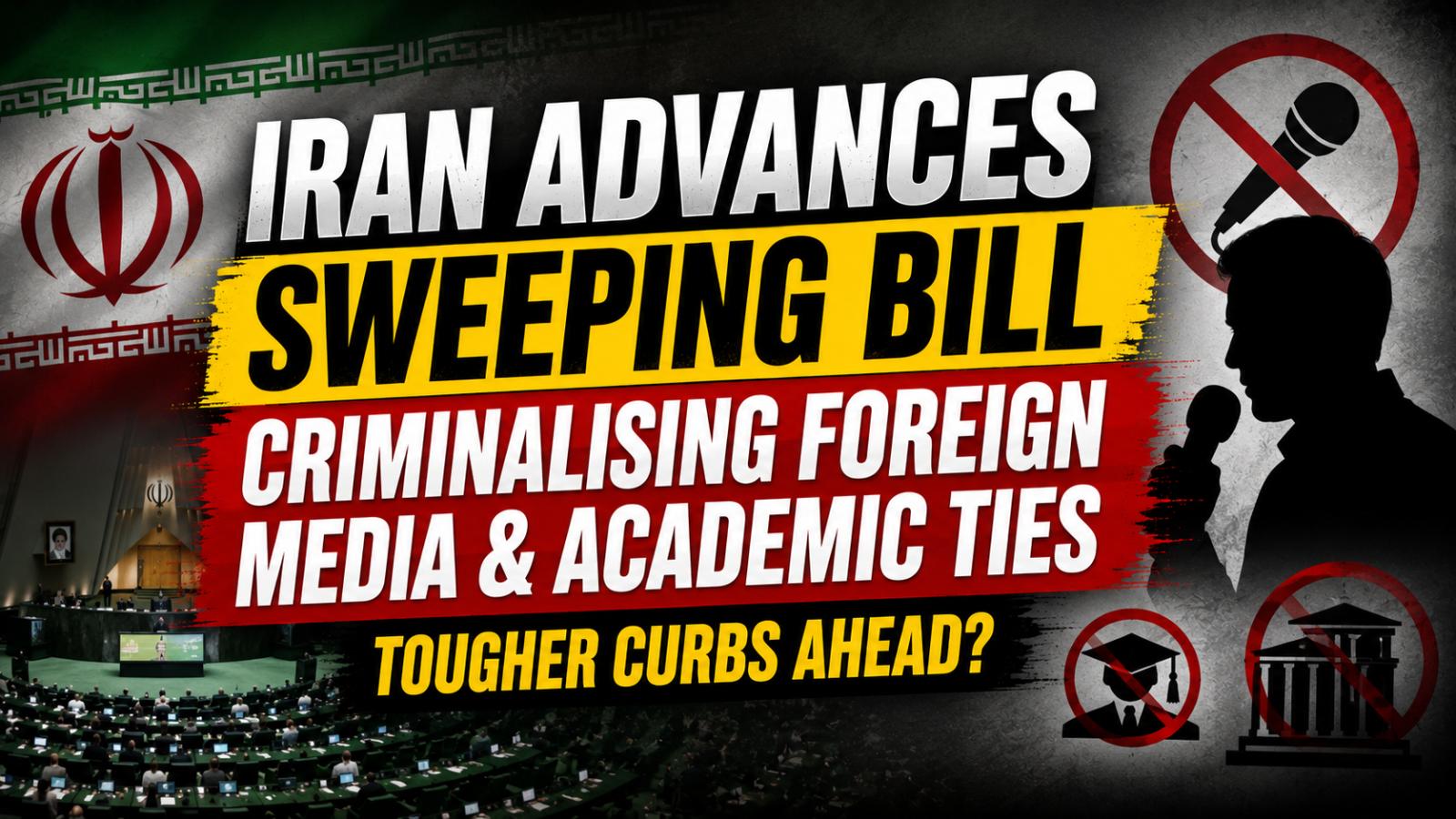
Iran's foreign influence bill has moved forward in parliament, potentially expanding criminal penalties for contacts with foreign media, universities, embassies and organisations. The proposal comes amid heightened security concerns in Tehran and could significantly affect journalists, academics and civil society.
Foreign media law could expand criminal penalties
Iran's parliament approved the general framework of legislation aimed at combating foreign influence on Sunday, August 16. The vote does not mean the measure has become law. Lawmakers must still examine its individual provisions, and the final legislation would require approval by the Guardian Council.
That distinction is particularly important because the latest text has not been publicly released. Iranian lawmaker Osman Salari, a member of parliament's judicial and legal commission, cautioned that individual articles have not yet been debated or finalized. Details based on earlier drafts could therefore change substantially.
The legislation nevertheless points toward tighter controls over communication that authorities consider connected to foreign interference or intelligence activity.
Media curbs target contact with foreign outlets
One of the most consequential areas involves interaction with overseas media.
According to reporting on the proposal, unauthorized interviews or participation with foreign media designated as hostile to the Islamic Republic could carry prison sentences ranging from six months to two years. US- and Israeli-linked media are among the outlets specifically targeted by the proposed restrictions.
Interaction with other foreign media would also face additional oversight, including requirements for advance notification to Iranian authorities.
The proposal builds on restrictions Iran has already introduced. In July, the Intelligence Ministry identified dozens of overseas media outlets, individuals and online accounts as hostile under an existing anti-espionage law.
The practical impact could extend beyond professional journalists. Ordinary citizens who provide photographs, videos or information to overseas outlets could face greater legal risk depending on how the final provisions define prohibited cooperation.
Academic ties could face tighter government controls
Earlier versions of the bill also extend the government's oversight into universities and international research.
The draft would give authorities greater control over cooperation with foreign universities and institutions, including scholarships, academic agreements, conferences and scientific projects. Cooperation with institutions outside government-approved channels could potentially trigger penalties.
Such provisions could have significant consequences for Iranian academics and researchers whose work depends on international partnerships.
The concern is not merely theoretical. Iranian universities operate in an environment where research partnerships, sanctions and national-security restrictions already intersect, particularly in fields with potential military or dual-use applications.
A broad definition of foreign influence could therefore create uncertainty even for ordinary scientific and educational exchanges.
Embassy contact also comes under scrutiny
The proposed legislation reaches beyond journalism and academia.
Reuters reported that contacts with foreign embassies and organisations could require official authorization from Iran's Foreign Ministry. Failure to comply could lead to fines and restrictions on certain social rights.
More serious provisions reportedly concern economic or legislative activities conducted under foreign direction. Conduct deemed to endanger national security could attract substantially heavier punishment, potentially reaching decades in prison.
Cases arising under parts of the legislation would reportedly fall under the jurisdiction of Iran's Revolutionary Courts
The measure comes as Iranian authorities intensify their focus on alleged foreign infiltration during a period of conflict and heightened tensions with the United States and Israel.
Iran already strengthened espionage penalties after its earlier conflict with Israel. The new proposal would potentially move further by bringing a much broader range of civilian interactions within the national-security framework.
That breadth will be the central issue as parliament begins examining the individual provisions.
Preventing espionage and covert foreign interference is a legitimate national-security function. But legislation that treats ordinary journalism, academic exchange or communications with foreign organisations as potential security offences risks extending far beyond traditional espionage.
For now, claims about specific penalties should be treated as provisional because parliament has approved only the bill's general principles. The decisive test will come when lawmakers publish and vote on the final articles, revealing exactly where Iran intends to draw the line between foreign interference and ordinary international contact.