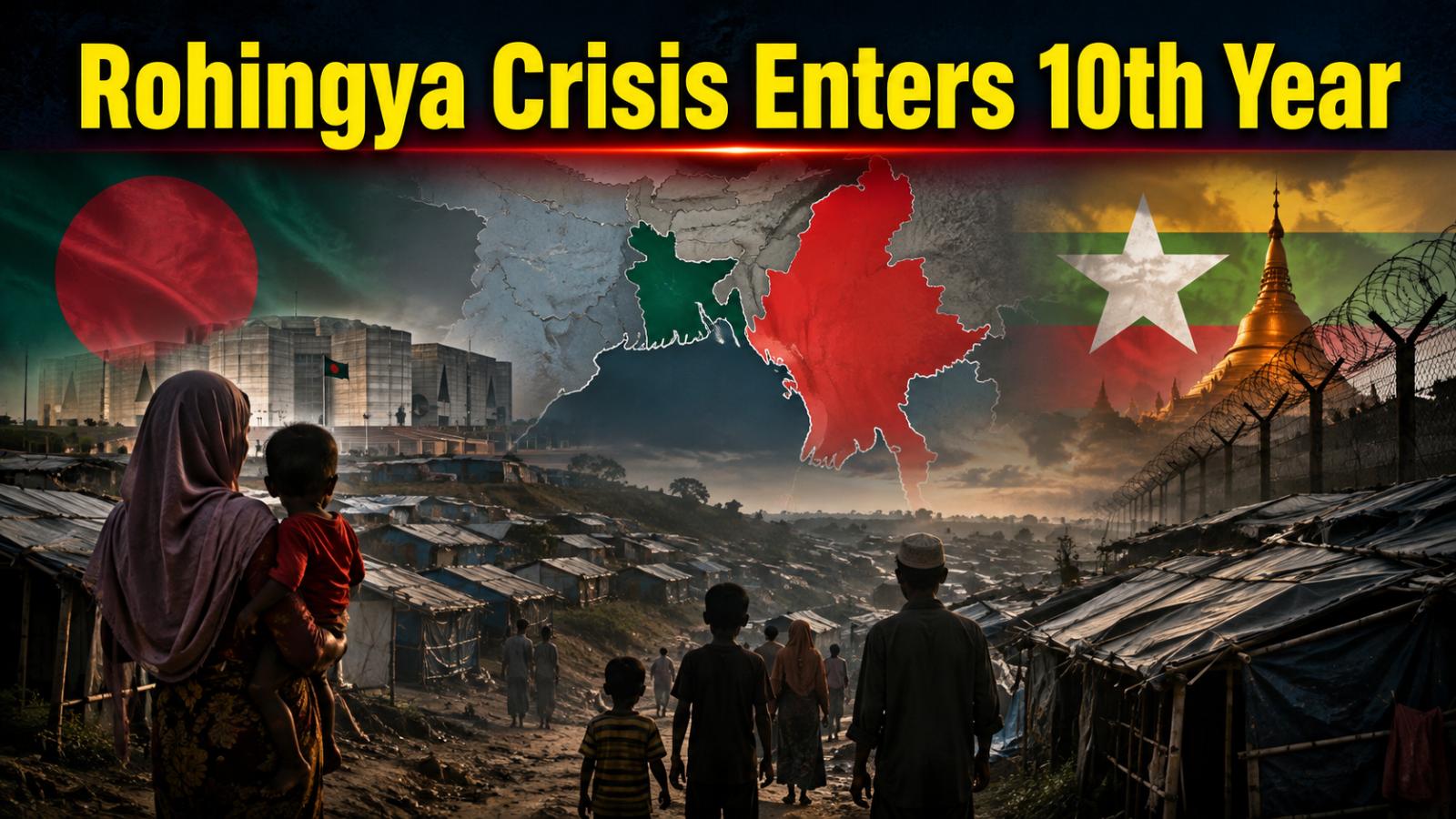
Bangladesh has renewed its Rohingya return appeal as the displacement crisis enters its tenth year, calling for sustained Myanmar pressure, stronger aid funding and conditions for safe repatriation. Dhaka says prolonged displacement cannot become a permanent solution for refugees or host communities.
Myanmar pressure central to Rohingya return
Bangladesh Foreign Secretary Asad Alam Siam said the international community must maintain meaningful political and diplomatic pressure on Myanmar to create conditions for a safe and dignified return of the Rohingya.
He spoke at “The Rohingya Exodus: Challenges and the Future of this Protracted Crisis” in Cox’s Bazar, an event organised by the Refugee Relief and Repatriation Commissioner with the Norwegian Refugee Council. Government representatives, UN agencies, donors, humanitarian groups, local leaders and Rohingya representatives attended.
Bangladesh has consistently argued that the crisis began in Myanmar and that its durable solution must also be found there. In a June statement at the United Nations, Dhaka said it was hosting about 1.2 million Rohingya and warned that the social, economic, security and environmental impact was becoming increasingly difficult to sustain.
Aid funding falls as displacement continues
Funding has become another major concern. Siam acknowledged that humanitarian financing is declining even as Bangladesh continues seeking additional support from bilateral and international partners.
Humanitarian organisations say the funding squeeze threatens food assistance, protection, education and other services in the camps. New analysis released as the crisis entered its tenth year also highlighted the need to support both Rohingya refugees and communities in Cox’s Bazar that have carried much of the long-term burden.
The challenge is no longer simply keeping emergency programmes running. After nine years, Bangladesh and humanitarian partners increasingly need policies that prevent an entire generation from growing up without education, employable skills or a realistic path home.
Safe repatriation requires preparation
Speakers at the Cox’s Bazar gathering called for an action-oriented and time-bound roadmap involving Bangladesh, the UN, donors and humanitarian organisations.
They argued that preparing refugees for eventual return requires greater investment in education, vocational training, digital learning and practical skills. Such programmes can improve conditions inside the camps while also helping Rohingya communities rebuild their lives if repatriation becomes possible.
Bangladesh continues to insist that any return must be voluntary, safe, dignified and sustainable. Previous repatriation initiatives have failed to produce a lasting return because major concerns over security, citizenship, rights and freedom of movement inside Myanmar remain unresolved.
BIMSTEC push adds regional pressure
Dhaka is also taking the Rohingya issue into regional security forums. Bangladesh participated in the fifth BIMSTEC National Security Chiefs’ Meeting in New Delhi on July 16, where member states discussed traditional and emerging security challenges. India’s National Security Adviser Ajit Doval chaired the meeting.
Bangladesh was represented by Prime Minister Tarique Rahman’s Defence Adviser, Brigadier General (Retd) A.K.M. Shamsul Islam. His participation reflected Dhaka’s effort to frame prolonged Rohingya displacement not only as a humanitarian issue but also as a regional security and development challenge.
As the crisis moves into its tenth year, Bangladesh’s message is becoming more urgent: humanitarian aid can manage displacement, but it cannot resolve it. Dhaka wants international partners to keep funding essential services while applying enough diplomatic pressure to make a credible, voluntary return to Myanmar possible.