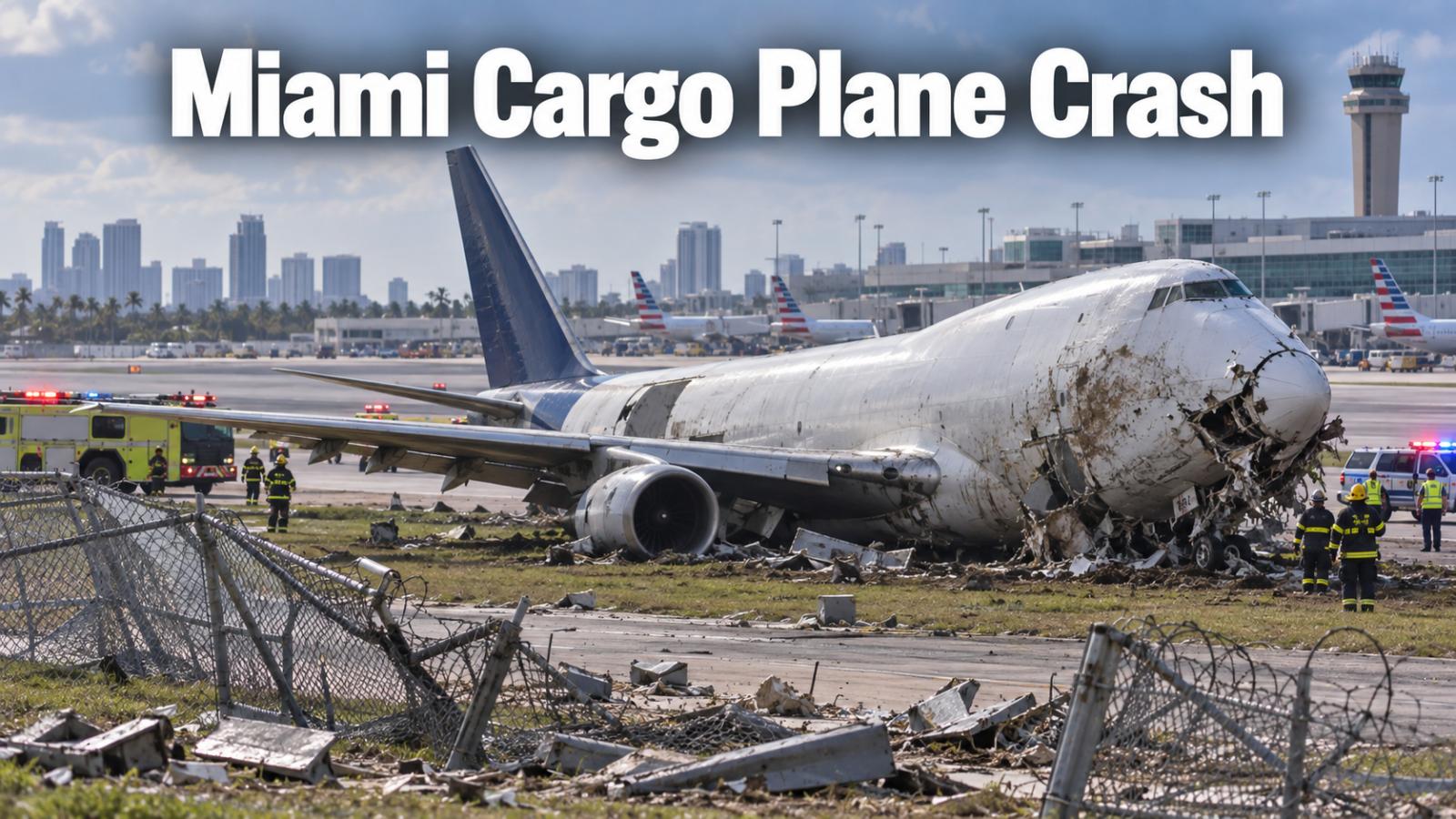
Investigators have recovered both flight recorders from the Miami cargo plane crash as federal officials examine how a Boeing 767-300 overran the runway and struck vehicles near Miami International Airport. Five people were killed and five others were seriously injured, according to information provided by the National Transportation Safety Board.
Runway Overrun
The Boeing 767-300, operated by 21 Air, arrived at Miami International Airport (MIA) from San Juan, Puerto Rico, on its third flight of the day. NTSB Chairwoman Jennifer Homendy said two crew members were aboard when the aircraft overshot the runway shortly before 2 p.m. local time.
After leaving the runway, the aircraft struck navigational aids and other airport equipment before colliding with a Ford van used by a contract cleaning company. Seven people were inside the van. The plane then broke through the airport perimeter fence and struck a Toyota Corolla carrying three passengers before stopping about 1,300 feet beyond the runway.
Victim Recovery
Homendy described the crash site as devastating, with aircraft wreckage, damaged vehicles and pieces of airport fencing spread across the area. She said recovering the victims remained the immediate priority for authorities and first responders.
The NTSB has emphasized that investigators are still gathering evidence and have not determined what caused the accident. Officials have cautioned against speculation while recovery work continues at the scene.
Flight Recorders
Investigators have recovered the cockpit voice recorder (CVR) and flight data recorder (FDR). Both devices will be examined by the NTSB for information that could help reconstruct the aircraft’s final approach, landing and runway overrun.
The investigation will review aircraft speed, system performance, cockpit communications and other recorded flight information. Investigators will also study the Boeing 767’s previous flights and operating history.
NTSB Review
Separate investigative teams will examine the aircraft’s engines and major systems. Officials will also review the crew’s experience, qualifications and training, along with radar information and operational data.
A meteorologist assigned to the investigation will assess weather conditions around the time of the landing. Investigators are expected to combine those findings with recorder data and physical evidence before reaching conclusions.
EMAS Safety
The NTSB will also examine whether the runway should have been equipped with an Engineered Materials Arresting System, or EMAS. The safety system uses crushable material beyond a runway to help slow an aircraft during an overrun.
Homendy identified the EMAS issue as an important part of the investigation. The inquiry remains in its fact-finding stage, and the NTSB says conclusions about the Miami cargo plane crash will come only after investigators evaluate the available evidence.