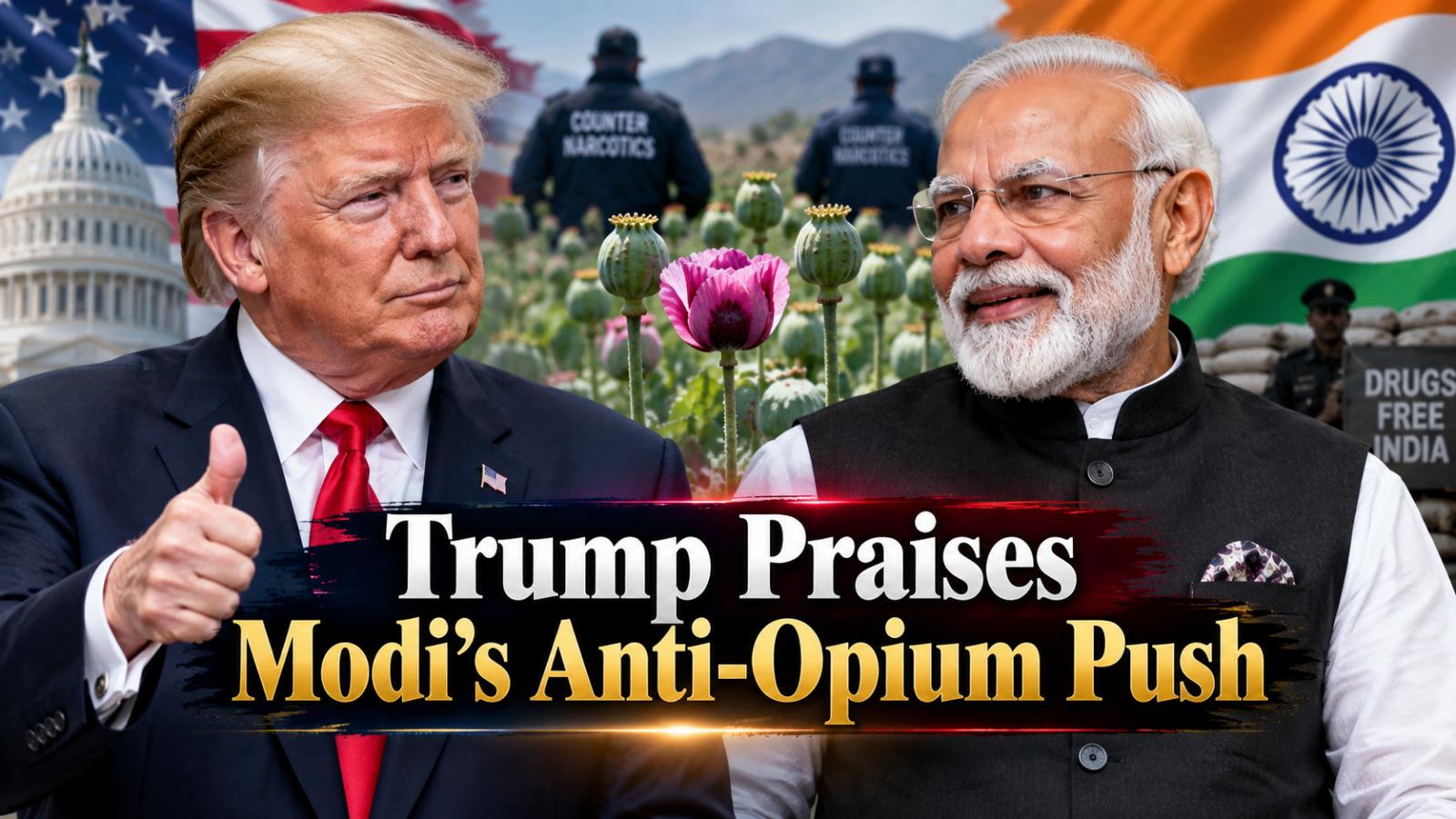
India remains on the US list of major drug transit or illicit drug-producing countries for fiscal year 2027, but President Donald Trump has also praised Prime Minister Narendra Modi’s anti-opium efforts and called for continued cooperation under the US-India Drug Policy Framework.
Trump praises Modi’s anti-opium drive
US President Donald Trump welcomed India’s efforts to curb illicit opium poppy cultivation while issuing his administration’s latest determination on major drug-producing and transit countries.
In the presidential determination made public on September 16, Trump specifically acknowledged Prime Minister Narendra Modi and the Indian government for efforts aimed at reducing illegal poppy cultivation and strengthening supply-chain integrity. He also said Washington wanted continued cooperation with New Delhi through the United States-India Drug Policy Framework.
The bilateral framework was finalized in 2024 and is designed to deepen cooperation against illicit drug production, trafficking, precursor chemicals and synthetic drugs while strengthening pharmaceutical supply chains and public-health coordination.
India included on US 2027 drug list
The White House said the FY2027 “Major’s List” identifies 23 countries considered major drug transit nations or major sources of illicit drug production. India appears alongside countries including China, Pakistan, Mexico, Afghanistan, Colombia and Venezuela.
India’s inclusion does not mean Washington has determined that the Indian government failed to combat narcotics trafficking. US rules take into account geographic, commercial and economic conditions that can allow illicit drugs or precursor chemicals to move through or originate in a country.
That distinction matters because the White House separately identified Afghanistan, Bolivia, Burma and Colombia as countries that had “failed demonstrably” during the previous 12 months to make substantial efforts to meet international counternarcotics obligations. India was not included in that group.
US-India drug policy cooperation expands
India and the United States have cooperated on narcotics enforcement for years, including efforts targeting cross-border trafficking, synthetic opioids, illegal pharmaceuticals and chemicals used in drug production.
Earlier bilateral discussions established mechanisms for sharing intelligence, enforcement practices and information on precursor chemicals. The two governments have also discussed cooperation involving dark-web trafficking, cryptocurrency-linked drug transactions and postal or courier networks.
India has an additional challenge because it legally produces opium for pharmaceutical purposes and has a large pharmaceutical and chemical manufacturing sector. Those legitimate industries require controls designed to prevent diversion into illegal markets.
Drug transit status differs from enforcement failure
The latest determination therefore presents a more nuanced picture than the phrase “drug-producing country” may suggest. Washington continues to classify India as significant within global drug-production or transit networks while simultaneously acknowledging New Delhi’s enforcement measures.
Trump’s statement places greater emphasis on bilateral drug control, secure pharmaceutical supply chains and action against illicit cultivation rather than treating India’s listing as a diplomatic rebuke.
For readers following US-India relations, this article could internally link to the World News, India News and US-India Relations sections, along with previous coverage of Modi-Trump meetings, fentanyl controls and international narcotics policy.