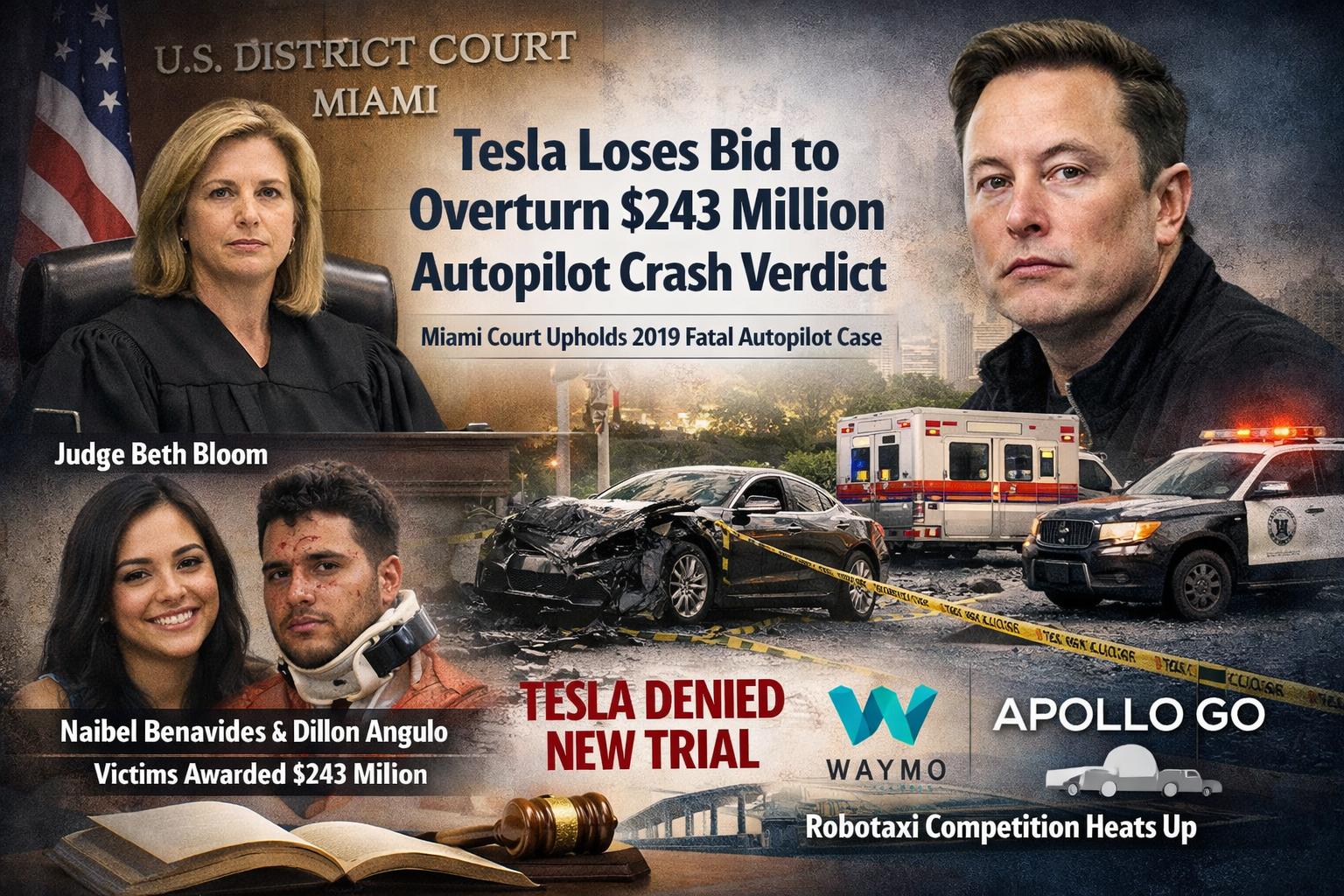
In an order published Friday, US District Judge Beth Bloom stated that the evidence presented during trial more than supported the jury’s verdict. The judge added that there was no error in the proceedings and no additional argument justifying a new trial or modification of the earlier decision. Tesla had sought to have the verdict set aside or significantly reduced.
The lawsuit centered on a 2019 crash in Key Largo, Florida, involving a Tesla Model S driven by George McGee. At the time of the incident, McGee was using Tesla’s Enhanced Autopilot, a partially automated driver-assistance system. During testimony, McGee said he dropped his phone while driving and believed the system would brake automatically if it detected an obstacle. Instead, the vehicle accelerated through an intersection at just over 60 miles per hour, striking a parked car and the individuals standing nearby. The collision killed Benavides and left Angulo with life-altering injuries.
A jury determined last year that Tesla should be held partially responsible for the crash, citing the role of Autopilot and the company’s representations about its capabilities. The panel awarded $243 million in damages, including both compensatory and punitive components. Tesla later filed motions seeking either to overturn the verdict or to secure a new trial.
Tesla’s legal team argued that compensatory damages of $129 million should be reduced to no more than $69 million, which would have significantly lowered the company’s payout. They also contended that punitive damages should be eliminated or capped at three times the compensatory award under Florida law. Judge Bloom rejected those arguments, concluding that the jury’s award was supported by the record and consistent with applicable legal standards.
Attorneys representing the plaintiffs said the ruling affirms the jury’s finding that Tesla was liable for the integral role Autopilot and the company’s statements about its capabilities played in the fatal crash. The company did not immediately issue a public response following the decision.
The outcome represents another legal and reputational challenge for the automaker led by Elon Musk, as it seeks to advance its autonomous driving ambitions. Tesla has promoted its vision of a large-scale robotaxi network in the United States by the end of 2026, but it does not yet operate a widely available fully driverless ride-hailing service.
In the competitive autonomous vehicle sector, Tesla trails rivals such as Waymo in the United States, which already provides commercial driverless ride-hailing services in select cities. In China, Apollo Go has established a commercial presence in the robotaxi market. Tesla currently operates only a limited number of robotaxis in Austin, Texas, as it continues to refine its technology.
The Miami ruling underscores the growing legal scrutiny surrounding advanced driver-assistance systems and autonomous driving technologies. As courts increasingly examine corporate accountability in cases involving partially automated systems, the decision may influence future litigation and regulatory debates over safety standards, marketing practices, and the deployment of self-driving vehicles.