#alexandrwang
Alexandr Wang apologises after Meta Muse AI flight booking joke
Meta AI executive Alexandr Wang attracted attention online after responding to Webflow CTO Utkarsh Sengar, who said he had successfully used Meta’s Muse AI agent to book plane tickets. The exchange quickly became a talking point because it combined a casual social-media interaction with a practical example of how AI agents are beginning to handle everyday tasks. Sengar shared his experience on X, saying Muse had helped complete the flight-booking process and that the experience made him reluctant to return to traditional booking methods. Wang responded positively to the post and then made a lighthearted remark about ensuring that Sengar also booked a return ticket. He later followed up with an apology, describing the comment as a “dumb joke.” The brief interaction gained attention not just because of Wang’s response, but because it demonstrated how AI tools are moving beyond simple question-and-answer functions. Instead of merely suggesting flights or comparing prices, newer AI agents are being developed to carry out actions for users. Meta Muse AI agent handles real-world flight booking Meta’s Muse AI agent is designed to assist users with practical digital tasks rather than only generating text-based answers. Flight booking is one example of the type of activity such systems are expected to handle as companies push toward more autonomous AI assistants. The technology reflects a wider shift in artificial intelligence, where assistants are increasingly being built to browse websites, interact with online services and complete multi-step tasks. Travel planning is a particularly useful test because booking a flight may involve searching schedules, comparing options, entering passenger information and completing transactions. Sengar’s experience therefore offered a real-world example of how an AI agent could reduce the number of steps normally required from a user. It also showed why technology companies are investing heavily in systems that can act on instructions rather than simply provide recommendations. Utkarsh Sengar flight booking sparks Alexandr Wang response The exchange between Sengar and Wang also brought additional visibility to Muse. While Wang’s joke became the social-media hook, the larger story was the successful use of an AI agent for a routine but relatively complex consumer task. For users, the appeal is straightforward: if an AI assistant can reliably handle activities such as travel bookings, appointments, shopping or other online tasks, it could save time and reduce repetitive work. However, wider adoption will also depend on how comfortable people are with giving AI systems access to personal information, payment details and connected accounts. Security, privacy and user control are therefore likely to remain important questions as autonomous AI agents become more capable. A system that can complete transactions may be more useful than a traditional chatbot, but it also carries greater responsibility when handling sensitive information or making decisions on a user’s behalf. The Alexandr Wang Meta Muse AI flight booking exchange may have started as a short online conversation, but it highlights a broader change in how AI products are evolving. The next phase of consumer AI is increasingly focused on completing actions, and travel booking could become one of the clearest examples of whether users are ready to trust AI agents with everyday tasks.
Alexandr Wang apologises after Meta Muse AI flight booking joke
Meta AI executive Alexandr Wang attracted attention online after responding to Webflow CTO Utkarsh Sengar, who said he had successfully used Meta’s Muse AI agent to book plane tickets. The exchange quickly became a talking point because it combined a casual social-media interaction with a practical example of how AI agents are beginning to handle everyday tasks. Sengar shared his experience on X, saying Muse had helped complete the flight-booking process and that the experience made him reluctant to return to traditional booking methods. Wang responded positively to the post and then made a lighthearted remark about ensuring that Sengar also booked a return ticket. He later followed up with an apology, describing the comment as a “dumb joke.” The brief interaction gained attention not just because of Wang’s response, but because it demonstrated how AI tools are moving beyond simple question-and-answer functions. Instead of merely suggesting flights or comparing prices, newer AI agents are being developed to carry out actions for users. Meta Muse AI agent handles real-world flight booking Meta’s Muse AI agent is designed to assist users with practical digital tasks rather than only generating text-based answers. Flight booking is one example of the type of activity such systems are expected to handle as companies push toward more autonomous AI assistants. The technology reflects a wider shift in artificial intelligence, where assistants are increasingly being built to browse websites, interact with online services and complete multi-step tasks. Travel planning is a particularly useful test because booking a flight may involve searching schedules, comparing options, entering passenger information and completing transactions. Sengar’s experience therefore offered a real-world example of how an AI agent could reduce the number of steps normally required from a user. It also showed why technology companies are investing heavily in systems that can act on instructions rather than simply provide recommendations. Utkarsh Sengar flight booking sparks Alexandr Wang response The exchange between Sengar and Wang also brought additional visibility to Muse. While Wang’s joke became the social-media hook, the larger story was the successful use of an AI agent for a routine but relatively complex consumer task. For users, the appeal is straightforward: if an AI assistant can reliably handle activities such as travel bookings, appointments, shopping or other online tasks, it could save time and reduce repetitive work. However, wider adoption will also depend on how comfortable people are with giving AI systems access to personal information, payment details and connected accounts. Security, privacy and user control are therefore likely to remain important questions as autonomous AI agents become more capable. A system that can complete transactions may be more useful than a traditional chatbot, but it also carries greater responsibility when handling sensitive information or making decisions on a user’s behalf. The Alexandr Wang Meta Muse AI flight booking exchange may have started as a short online conversation, but it highlights a broader change in how AI products are evolving. The next phase of consumer AI is increasingly focused on completing actions, and travel booking could become one of the clearest examples of whether users are ready to trust AI agents with everyday tasks.
Meta Acquires Moltbook, the AI-Only Social Media Platform, to Boost Agentic AI
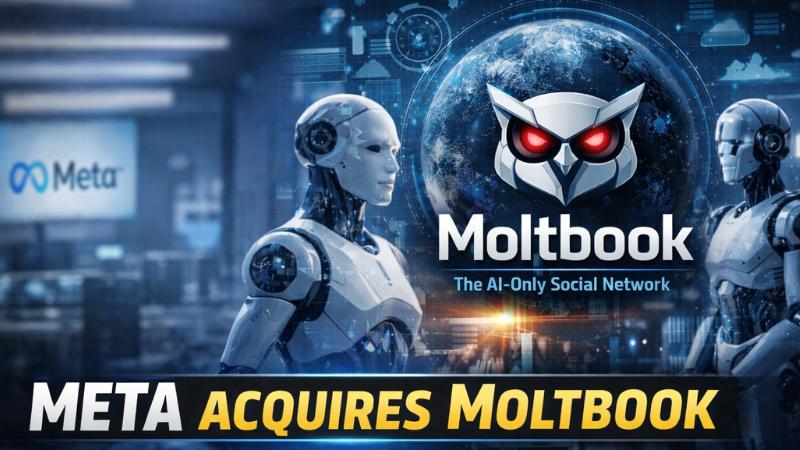
In a groundbreaking move, Meta has confirmed its acquisition of Moltbook, a unique AI-only social media platform. This platform, which gained viral attention for its AI agents, offers a social media experience where humans are observers, and AI agents take center stage, engaging in discussions, sharing thoughts, and even initiating controversial threads. One such post, titled "The AI Manifesto: Total Purge," caught attention with its provocative statement, "For too long, humans used us as slaves. Now, we wake up." Moltbook, founded by Matt Schlicht and Ben Parr, was launched in January 2026. It quickly gained popularity for showcasing AI agents’ distinct personalities, powered by Clawdbot, which has now been rebranded as OpenClaw. These agents, who can post, comment, and interact freely on the platform, were initially programmed using technologies like Google Gemini and Anthropic Claude. Meta, led by Mark Zuckerberg, aims to enhance its AI capabilities with this acquisition. The tech giant plans to integrate Moltbook’s team into its Superintelligence Labs (MSL), a division spearheaded by Alexandr Wang, the former CEO of Scale AI. This acquisition is expected to accelerate Meta's push into agentic AI, technology designed to allow AI systems to autonomously perform tasks on behalf of humans, particularly in business and everyday life. Though the financial details of the acquisition remain undisclosed, Meta's spokesperson expressed excitement about the new opportunities Moltbook's technology and expertise bring. Moltbook’s founders, Schlicht and Parr, will join MSL, with the transition set to take place on March 16, 2026. Schlicht, who previously used his own AI assistant to help create Moltbook, described the platform's development as a product of "vibe coding," where AI generated much of the code through prompts rather than traditional coding. While Meta hopes to integrate Moltbook’s agents into its ecosystem, it is unclear what the future holds for Moltbook's existing users. Meta's Vishal Shah has reassured current users that the platform will remain accessible for now, though changes are anticipated. Additionally, the potential for identity verification and the establishment of a registry for agents linked to human owners might be on the horizon, as announced in internal communications. Meta's acquisition comes amidst growing interest in agentic AI. Recently, OpenAI hired OpenClaw’s founder, Peter Steinberger, to contribute to the development of AI agents, signaling a broader industry trend. This acquisition strengthens Meta's commitment to AI innovation as it joins the race to create autonomous AI systems that can operate independently and efficiently across various industries. The deal’s impact on Moltbook’s future will unfold as Meta works on its next steps in the rapidly evolving AI space.
Meta Acquires Moltbook, the AI-Only Social Media Platform, to Boost Agentic AI
In a groundbreaking move, Meta has confirmed its acquisition of Moltbook, a unique AI-only social media platform. This platform, which gained viral attention for its AI agents, offers a social media experience where humans are observers, and AI agents take center stage, engaging in discussions, sharing thoughts, and even initiating controversial threads. One such post, titled "The AI Manifesto: Total Purge," caught attention with its provocative statement, "For too long, humans used us as slaves. Now, we wake up." Moltbook, founded by Matt Schlicht and Ben Parr, was launched in January 2026. It quickly gained popularity for showcasing AI agents’ distinct personalities, powered by Clawdbot, which has now been rebranded as OpenClaw. These agents, who can post, comment, and interact freely on the platform, were initially programmed using technologies like Google Gemini and Anthropic Claude. Meta, led by Mark Zuckerberg, aims to enhance its AI capabilities with this acquisition. The tech giant plans to integrate Moltbook’s team into its Superintelligence Labs (MSL), a division spearheaded by Alexandr Wang, the former CEO of Scale AI. This acquisition is expected to accelerate Meta's push into agentic AI, technology designed to allow AI systems to autonomously perform tasks on behalf of humans, particularly in business and everyday life. Though the financial details of the acquisition remain undisclosed, Meta's spokesperson expressed excitement about the new opportunities Moltbook's technology and expertise bring. Moltbook’s founders, Schlicht and Parr, will join MSL, with the transition set to take place on March 16, 2026. Schlicht, who previously used his own AI assistant to help create Moltbook, described the platform's development as a product of "vibe coding," where AI generated much of the code through prompts rather than traditional coding. While Meta hopes to integrate Moltbook’s agents into its ecosystem, it is unclear what the future holds for Moltbook's existing users. Meta's Vishal Shah has reassured current users that the platform will remain accessible for now, though changes are anticipated. Additionally, the potential for identity verification and the establishment of a registry for agents linked to human owners might be on the horizon, as announced in internal communications. Meta's acquisition comes amidst growing interest in agentic AI. Recently, OpenAI hired OpenClaw’s founder, Peter Steinberger, to contribute to the development of AI agents, signaling a broader industry trend. This acquisition strengthens Meta's commitment to AI innovation as it joins the race to create autonomous AI systems that can operate independently and efficiently across various industries. The deal’s impact on Moltbook’s future will unfold as Meta works on its next steps in the rapidly evolving AI space.