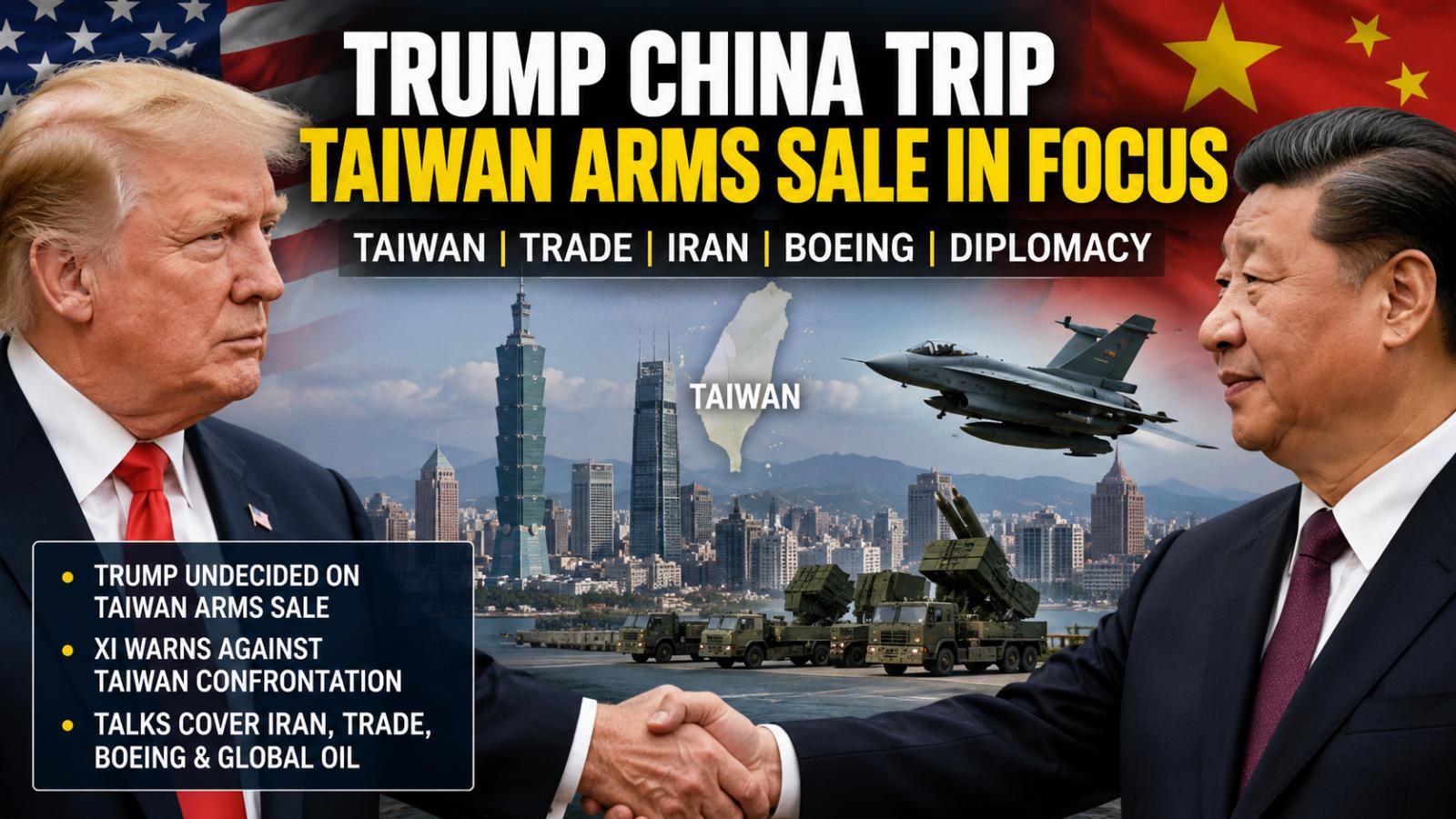
President Donald Trump left Beijing on Friday, May 15, 2026, without a final decision on a major U.S. arms sale to Taiwan, keeping one of the most sensitive issues in U.S.-China relations unresolved.
The Trump Taiwan arms sale decision became a central focus after his three-day China visit, where talks with Chinese President Xi Jinping covered Taiwan, Iran, trade, Boeing aircraft and wider efforts to stabilize relations between Washington and Beijing.
Trump-Xi Taiwan Arms Sale Talks
Trump said aboard Air Force One that he had not decided whether to move ahead with a major weapons sale to Taipei. The issue is politically sensitive because Beijing views Taiwan as part of its territory and strongly opposes U.S. arms sales to the self-governing island.
The Taiwan arms package follows earlier U.S. authorization of an $11 billion weapons package for Taipei in December and a separate $14 billion arms sale approved by lawmakers in January, though the latter still requires formal action before it can advance.
What Is Strategic Ambiguity on Taiwan?
The Taiwan question also highlighted the long-running U.S. policy known as strategic ambiguity. Under that approach, Washington supports Taiwan’s ability to defend itself but does not clearly say whether the U.S. military would intervene if China attacked the island.
Asked whether the United States would defend Taiwan in such a scenario, Trump declined to give a direct public answer. That response kept uncertainty around Trump’s Taiwan policy after the Xi meeting.
Iran, Oil and the Strait of Hormuz
Taiwan was not the only major issue during the China trip. Trump and Xi also discussed the war involving the United States and Israel in Iran, rising global oil concerns and the need to reopen the Strait of Hormuz.
Trump said Xi agreed that Iran should not obtain a nuclear weapon and suggested China could help seek an end to the conflict. Chinese officials publicly framed the issue more cautiously, emphasizing the concerns of all parties.
Trade and Boeing Deal Talks
Trade remained another major part of the visit. Trump said large deals were possible, including a potential Boeing aircraft purchase by China, but no final agreement was announced before he left Beijing.
Chinese officials described the talks as part of a broader strategic stability framework, signaling an effort to manage tensions even as sharp differences remain.
The outcome matters because a Taiwan arms sale after the China summit could test whether Trump and Xi can maintain stability while managing deep disputes over Taiwan, trade and global security. For now, Trump’s undecided position leaves Taipei, Beijing and Washington waiting for the next move.