

























#lifelessons
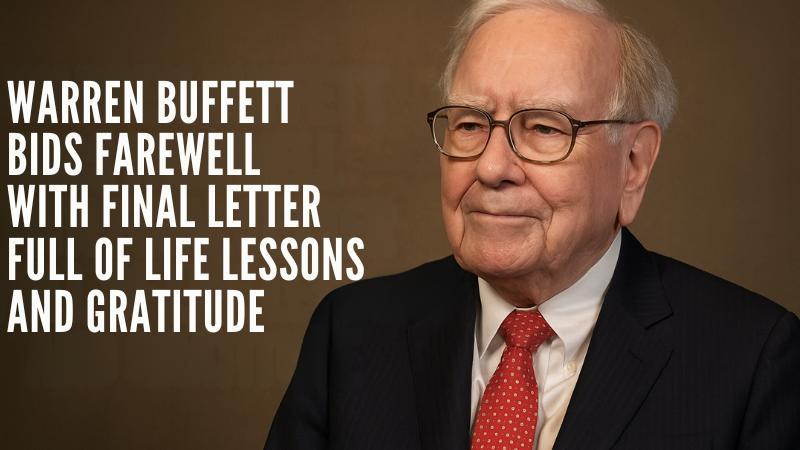
Warren Buffett bids farewell with final letter full of life lessons and gratitude
Warren Buffett, one of the most influential investors of all time, has written his final letter to shareholders, marking the close of a remarkable chapter in his career. At 95, the legendary business figure announced that he will no longer write annual shareholder letters or address investors at yearly meetings, ending nearly sixty years of consistent communication. His note, titled A Few Final Thoughts, was filled with reflection, warmth, humor, and timeless advice that extended far beyond the
Warren Buffett bids farewell with final letter full of life lessons and gratitude
Warren Buffett, one of the most influential investors of all time, has written his final letter to shareholders, marking the close of a remarkable chapter in his career. At 95, the legendary business figure announced that he will no longer write annual shareholder letters or address investors at yearly meetings, ending nearly sixty years of consistent communication. His note, titled A Few Final Thoughts, was filled with reflection, warmth, humor, and timeless advice that extended far beyond the
The power of asking what am I: a path to conscious self-growth
Across generations, people have pondered the question “Who am I?”—a timeless search for identity and meaning. Yet, before reaching that philosophical depth, there lies another, more practical and equally transformative question: “What am I?” This question, when asked sincerely, helps individuals evaluate their roles, responsibilities, and contributions at every stage of life. It transforms self-understanding into conscious action. The process of questioning “What am I?”
The power of asking what am I: a path to conscious self-growth
Across generations, people have pondered the question “Who am I?”—a timeless search for identity and meaning. Yet, before reaching that philosophical depth, there lies another, more practical and equally transformative question: “What am I?” This question, when asked sincerely, helps individuals evaluate their roles, responsibilities, and contributions at every stage of life. It transforms self-understanding into conscious action. The process of questioning “What am I?”
Understanding suffering: why wishing for an end is not true compassion
In times of suffering, both for the afflicted and those who care for them, the human mind often searches for relief. It is common to hear phrases such as “thank God they are free now” or “I pray for their suffering to end.” While these words may appear compassionate, they often reveal a deeper tension between genuine empathy and emotional convenience. Spiritual understanding shows that wishing for an end, whether for oneself or for others, can reflect attachment and impatience rather tha
Understanding suffering: why wishing for an end is not true compassion
In times of suffering, both for the afflicted and those who care for them, the human mind often searches for relief. It is common to hear phrases such as “thank God they are free now” or “I pray for their suffering to end.” While these words may appear compassionate, they often reveal a deeper tension between genuine empathy and emotional convenience. Spiritual understanding shows that wishing for an end, whether for oneself or for others, can reflect attachment and impatience rather tha
Rejection and reflection: Seeing other's choices as perspective, not judgment
Rejection is one of the most common emotional experiences shared by every human being, yet it remains one of the least understood. When a person faces rejection, whether in personal relationships, professional pursuits, or social circles, the first instinct is often to take it personally. Many interpret rejection as a sign of inadequacy or a reflection of their flaws. However, a more balanced understanding reveals that rejection is, in most cases, simply the perspective of another person and
Rejection and reflection: Seeing other's choices as perspective, not judgment
Rejection is one of the most common emotional experiences shared by every human being, yet it remains one of the least understood. When a person faces rejection, whether in personal relationships, professional pursuits, or social circles, the first instinct is often to take it personally. Many interpret rejection as a sign of inadequacy or a reflection of their flaws. However, a more balanced understanding reveals that rejection is, in most cases, simply the perspective of another person and
Smartness explained: turning cleverness into wisdom, not cunning
Smartness: the positive and negative sides Smartness is one of the most admired human qualities, but it is often misunderstood. People use the word interchangeably with intelligence, cleverness, or even cunningness. Yet, smartness by itself is neither good nor bad. It is simply a neutral ability — the quick thinking, adaptability, and resourcefulness that allows people to respond effectively i
Smartness explained: turning cleverness into wisdom, not cunning
Smartness: the positive and negative sides Smartness is one of the most admired human qualities, but it is often misunderstood. People use the word interchangeably with intelligence, cleverness, or even cunningness. Yet, smartness by itself is neither good nor bad. It is simply a neutral ability — the quick thinking, adaptability, and resourcefulness that allows people to respond effectively i
From letters to reels, why the generation gap still exists
Why elders repeat themselves Elders often repeat the same stories not because they forget they’ve told them before, but because those moments remain deeply etched in their memories. The events they narrate may have shaped their identity, values, or relationships, and retelling them is their way of reliving those precious experiences. For them, these stories are not just words but emotional anchors
From letters to reels, why the generation gap still exists
Why elders repeat themselves Elders often repeat the same stories not because they forget they’ve told them before, but because those moments remain deeply etched in their memories. The events they narrate may have shaped their identity, values, or relationships, and retelling them is their way of reliving those precious experiences. For them, these stories are not just words but emotional anchors


