#meteor
Moon mass loss and breakup: Earth impact explained
If a moon mass change effect happens, Earth will not be destroyed, but many natural systems will slowly change. In a moon mass change effect, the biggest impact would be on ocean tides, night brightness, and long-term climate stability. The Moon controls tides by its gravity, so if it becomes smaller or loses mass, ocean tides will become weaker. This means the sea will not rise and fall as strongly as it does today. Coastal areas, fishing activity, and marin
Moon mass loss and breakup: Earth impact explained
If a moon mass change effect happens, Earth will not be destroyed, but many natural systems will slowly change. In a moon mass change effect, the biggest impact would be on ocean tides, night brightness, and long-term climate stability. The Moon controls tides by its gravity, so if it becomes smaller or loses mass, ocean tides will become weaker. This means the sea will not rise and fall as strongly as it does today. Coastal areas, fishing activity, and marin
Chicago Green Fireball Boom Reports Raise Space Debris Questions
Chicago green fireball boom reports spread across the Midwest after a bright green object crossed the night sky over the Chicago area on a Monday night. The source material did not provide a calendar date or exact time, but reports described sightings from Illinois, Indiana, Michigan, Wisconsin and Ohio. Chicago Green Fireball Boom Reports Across the Midwest Hundreds of people reported seeing a bright green fireball over the Chicago area and ne
Chicago Green Fireball Boom Reports Raise Space Debris Questions
Chicago green fireball boom reports spread across the Midwest after a bright green object crossed the night sky over the Chicago area on a Monday night. The source material did not provide a calendar date or exact time, but reports described sightings from Illinois, Indiana, Michigan, Wisconsin and Ohio. Chicago Green Fireball Boom Reports Across the Midwest Hundreds of people reported seeing a bright green fireball over the Chicago area and ne
UK, Ireland, France Break Temperature Records
Record-Breaking Heat Across Europe A severe heatwave swept across Europe on Monday, May 25, with Britain, Ireland, and France experiencing unprecedented temperatures for May. Meteorologists attributed the extreme heat to a ‘heat dome’, a mass of hot air traveling from northern Africa and trapped beneath a high-pressure system over western Europe. In Spain, temperatures are forecast to reach 38 °C later
UK, Ireland, France Break Temperature Records
Record-Breaking Heat Across Europe A severe heatwave swept across Europe on Monday, May 25, with Britain, Ireland, and France experiencing unprecedented temperatures for May. Meteorologists attributed the extreme heat to a ‘heat dome’, a mass of hot air traveling from northern Africa and trapped beneath a high-pressure system over western Europe. In Spain, temperatures are forecast to reach 38 °C later
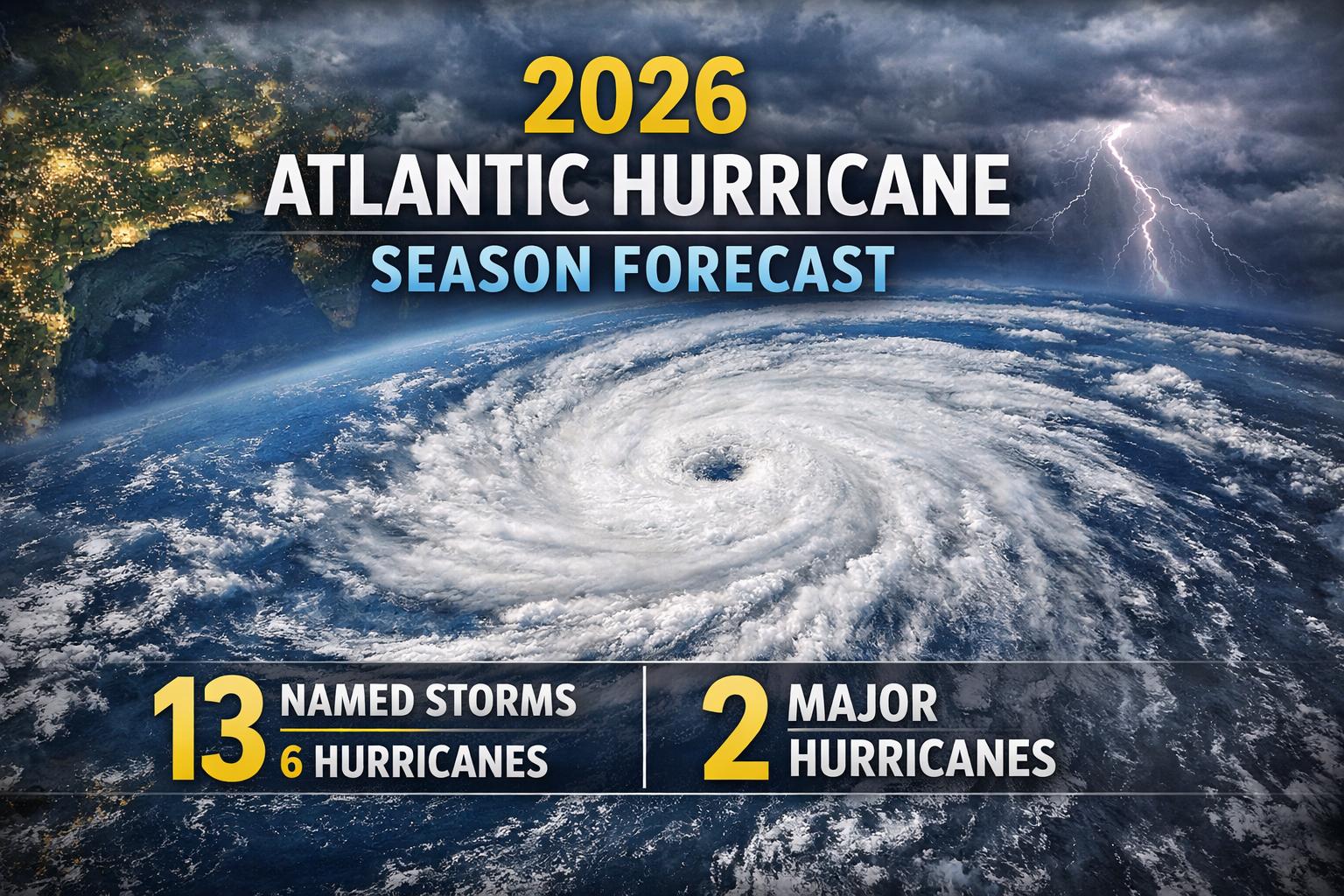
CSU forecasts below-average 2026 Atlantic hurricane season outlook
SOUTH PADRE ISLAND, Texas — Thursday, April 10, 2026 — Researchers at Colorado State University (CSU) released their first major outlook for the 2026 Atlantic hurricane season during the National Tropical Weather Conference held on South Padre Island, offering a cautiously optimistic forecast for the months ahead. According to CSU’s Department of Atmospheric Science, the upcoming season is expected to be slightly below average. The forecast projects 13 named storms, including six hurricanes and two major hurricanes classified as Category 3 or higher. By comparison, a typical Atlantic season produces approximately 14 named storms, seven hurricanes, and three major hurricanes. Forecasters attribute the subdued outlook largely to evolving global climate patterns. Current weak La Niña conditions are expected to transition into El Niño in the coming months, a shift that typically increases vertical wind shear across the tropical Atlantic. This atmospheric change can disrupt storm formation and limit the intensity of developing systems. In their analysis, CSU researchers emphasized that El Niño is likely to be the dominant influence during the peak of the season. Increased wind shear associated with this pattern generally reduces the likelihood of strong hurricanes forming and making landfall. As a result, the probability of major hurricane impacts along the continental United States coastline and across the Caribbean is expected to be lower than average. The report also highlights a reduced risk for the Gulf Coast region. CSU estimates a 20% chance of a hurricane making landfall between the Florida Panhandle and Brownsville, Texas, compared to the historical average of 27%. While this suggests a quieter season, researchers caution that even a below-average year can still produce significant and damaging storms. Phil Klotzbach, a senior research scientist at CSU and lead author of the forecast, noted that the projected 2026 season resembles patterns observed in past years such as 2006, 2009, 2015, and 2023. In those seasons, Texas experienced limited tropical activity, with no named storms in 2006 and 2009, and only minor systems recorded in 2015 and 2023. Despite the relatively lower forecast numbers, experts stress that preparedness remains critical, as hurricane activity can be unpredictable and even a single storm can have widespread impacts across coastal communities.
CSU forecasts below-average 2026 Atlantic hurricane season outlook
SOUTH PADRE ISLAND, Texas — Thursday, April 10, 2026 — Researchers at Colorado State University (CSU) released their first major outlook for the 2026 Atlantic hurricane season during the National Tropical Weather Conference held on South Padre Island, offering a cautiously optimistic forecast for the months ahead. According to CSU’s Department of Atmospheric Science, the upcoming season is expected to be slightly below average. The forecast projects 13 named storms, including six hurricanes and two major hurricanes classified as Category 3 or higher. By comparison, a typical Atlantic season produces approximately 14 named storms, seven hurricanes, and three major hurricanes. Forecasters attribute the subdued outlook largely to evolving global climate patterns. Current weak La Niña conditions are expected to transition into El Niño in the coming months, a shift that typically increases vertical wind shear across the tropical Atlantic. This atmospheric change can disrupt storm formation and limit the intensity of developing systems. In their analysis, CSU researchers emphasized that El Niño is likely to be the dominant influence during the peak of the season. Increased wind shear associated with this pattern generally reduces the likelihood of strong hurricanes forming and making landfall. As a result, the probability of major hurricane impacts along the continental United States coastline and across the Caribbean is expected to be lower than average. The report also highlights a reduced risk for the Gulf Coast region. CSU estimates a 20% chance of a hurricane making landfall between the Florida Panhandle and Brownsville, Texas, compared to the historical average of 27%. While this suggests a quieter season, researchers caution that even a below-average year can still produce significant and damaging storms. Phil Klotzbach, a senior research scientist at CSU and lead author of the forecast, noted that the projected 2026 season resembles patterns observed in past years such as 2006, 2009, 2015, and 2023. In those seasons, Texas experienced limited tropical activity, with no named storms in 2006 and 2009, and only minor systems recorded in 2015 and 2023. Despite the relatively lower forecast numbers, experts stress that preparedness remains critical, as hurricane activity can be unpredictable and even a single storm can have widespread impacts across coastal communities.
Summer Arrives in the United States With Differing Seasonal Definitions in June
As of June 19, 2025, the United States is transitioning from spring into summer, with two distinct interpretations of seasonal timing offering different start dates. Meteorologically, summer began on June 1, while astronomically, the summer season officially starts on June 20. This variation often leads to the question: what season is it in the United States right now? The answer depends on whether one is looking through the lens of astronomy or meteorology. Both systems are valid and widely
Summer Arrives in the United States With Differing Seasonal Definitions in June
As of June 19, 2025, the United States is transitioning from spring into summer, with two distinct interpretations of seasonal timing offering different start dates. Meteorologically, summer began on June 1, while astronomically, the summer season officially starts on June 20. This variation often leads to the question: what season is it in the United States right now? The answer depends on whether one is looking through the lens of astronomy or meteorology. Both systems are valid and widely
India Invites Neighbors to Seminar for IMD’s 150th Anniversary
India has extended invitations to Pakistan, Bangladesh, and other neighboring countries to participate in a unique seminar marking 150 years of the India Meteorological Department (IMD). This initiative aims to set aside political differences and highlight the shared history of the Indian subcontinent. The seminar is being hailed as a first-of-its-kind effort by the Indian government to foster regional cooperation. Invitations have been sent to Pakistan, Bangladesh, Bhutan, Afghanis
India Invites Neighbors to Seminar for IMD’s 150th Anniversary
India has extended invitations to Pakistan, Bangladesh, and other neighboring countries to participate in a unique seminar marking 150 years of the India Meteorological Department (IMD). This initiative aims to set aside political differences and highlight the shared history of the Indian subcontinent. The seminar is being hailed as a first-of-its-kind effort by the Indian government to foster regional cooperation. Invitations have been sent to Pakistan, Bangladesh, Bhutan, Afghanis
2024 Monsoon Season Ends with 7.6% Above Average Rainfall in India
The India Meteorological Department (IMD) has announced that the 2024 monsoon season concluded with a notable 7.6% above average rainfall across the country. Key regions including Rajasthan, Gujarat, western Madhya Pradesh, Maharashtra, Telangana, and Andhra Pradesh experienced significant excess rainfall, highlighting a surplus compared to typical seasonal patterns. The withdrawal of the South West monsoon began on September 23, which is six days later than the usual date of Septem
2024 Monsoon Season Ends with 7.6% Above Average Rainfall in India
The India Meteorological Department (IMD) has announced that the 2024 monsoon season concluded with a notable 7.6% above average rainfall across the country. Key regions including Rajasthan, Gujarat, western Madhya Pradesh, Maharashtra, Telangana, and Andhra Pradesh experienced significant excess rainfall, highlighting a surplus compared to typical seasonal patterns. The withdrawal of the South West monsoon began on September 23, which is six days later than the usual date of Septem