Shares of Nvidia hit a record $208.27 on Friday, April 24, 2026, pushing its value past $5 trillion amid strong AI demand. Gains followed upbeat results from Intel, lifting chipmakers broadly, even as Alphabet
Shares of Nvidia hit a record $208.27 on Friday, April 24, 2026, pushing its value past $5 trillion amid strong AI demand. Gains followed upbeat results from Intel, lifting chipmakers broadly, even as Alphabet
Strong market reaction to earnings and AI momentum
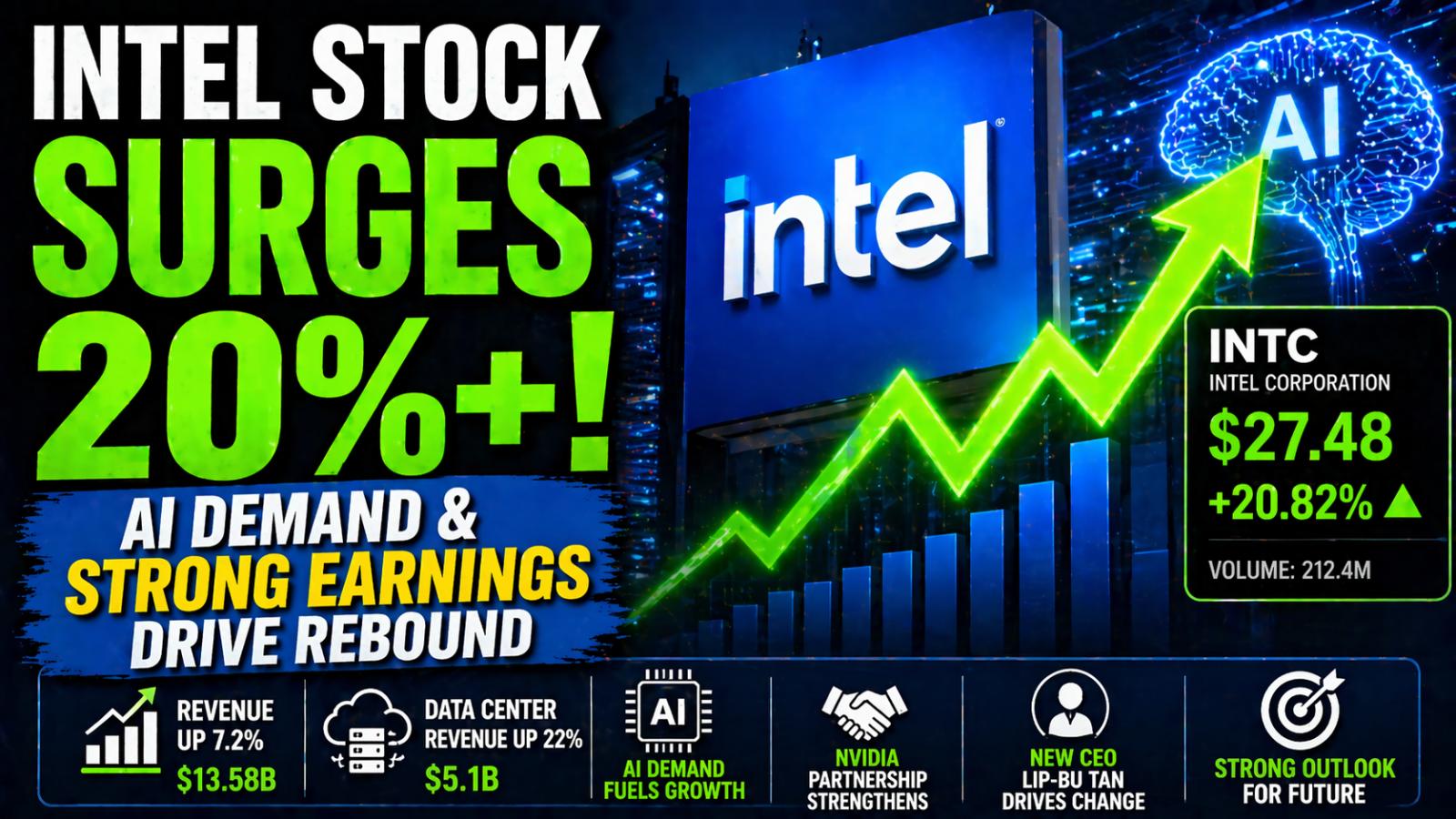
Shares of Intel surged more than 20% during trading hours on Friday, reflecting renewed investor confidence driven by rising artificial intelligence demand and stronger-than-expected financial results. By early afternoon, the stock had climbed approximately 22%, putting it on track for its best single-day performance in d
Strong market reaction to earnings and AI momentum
Shares of Intel surged more than 20% during trading hours on Friday, reflecting renewed investor confidence driven by rising artificial intelligence demand and stronger-than-expected financial results. By early afternoon, the stock had climbed approximately 22%, putting it on track for its best single-day performance in d
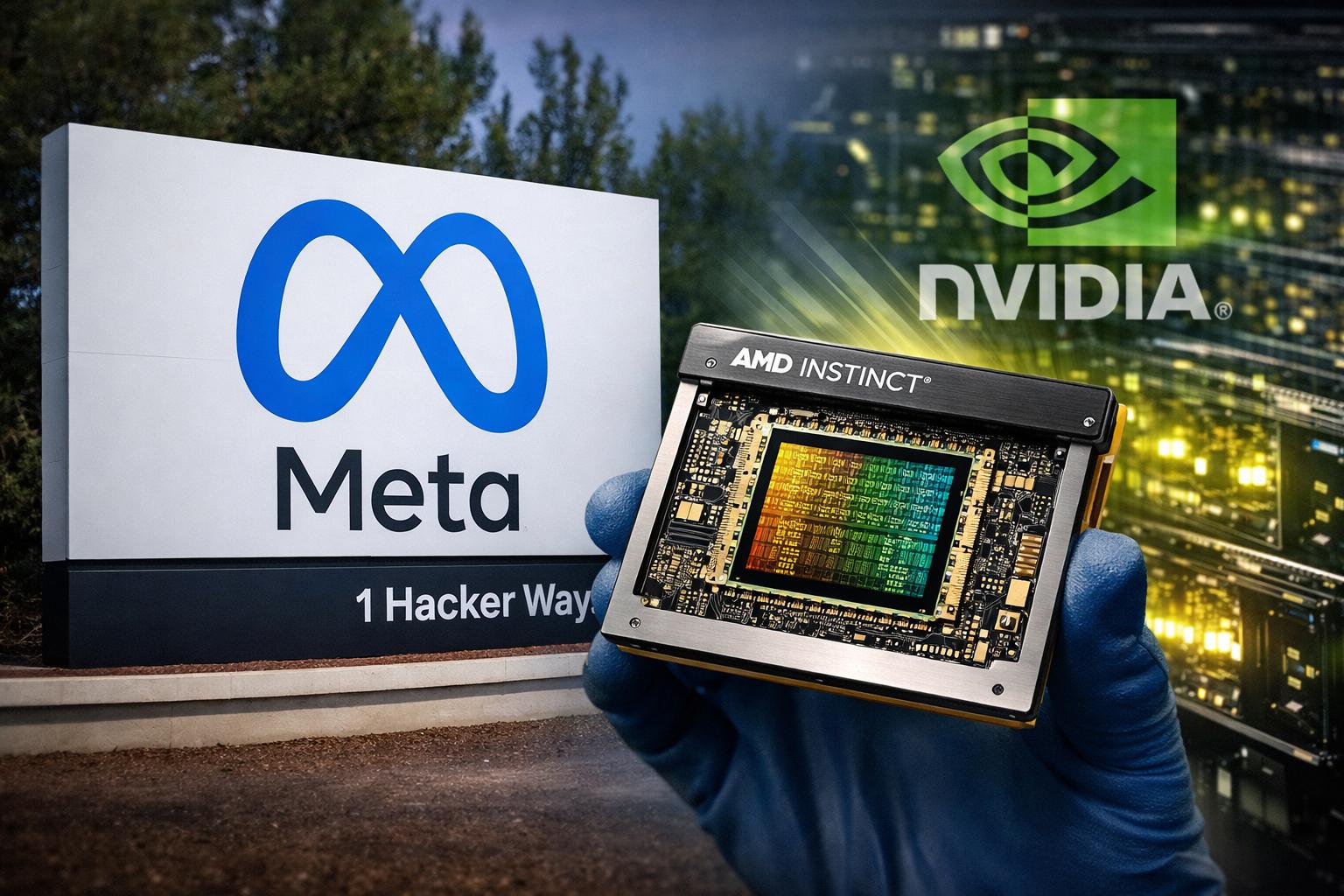
Meta has announced a significant multiyear agreement with Advanced Micro Devices (AMD) to accelerate its artificial intelligence expansion, marking another major investment in computing infrastructure just days after committing to large-scale purchases of Nvidia processors. The social media giant said Tuesday that the deal will involve deploying up to 6 gigawatts of AMD’s graphics processing units across its AI data centers, along with AI-optimized central processing units designed to suppo
Meta has announced a significant multiyear agreement with Advanced Micro Devices (AMD) to accelerate its artificial intelligence expansion, marking another major investment in computing infrastructure just days after committing to large-scale purchases of Nvidia processors. The social media giant said Tuesday that the deal will involve deploying up to 6 gigawatts of AMD’s graphics processing units across its AI data centers, along with AI-optimized central processing units designed to suppo
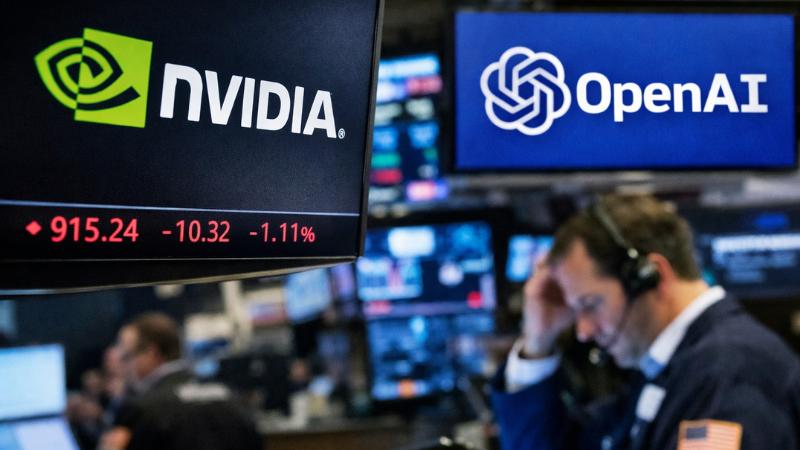
Nvidia shares declined on Monday as uncertainty surrounding the chipmaker’s potential investment in OpenAI weighed on investor sentiment. The stock slipped in early trading after reports suggested that previously announced plans involving a massive financial commitment to the artificial intelligence company may not yet be finalized. The market reaction underscored growing sensitivity around large-scale AI investments and the evolving relationships among major technology players.
T
Nvidia shares declined on Monday as uncertainty surrounding the chipmaker’s potential investment in OpenAI weighed on investor sentiment. The stock slipped in early trading after reports suggested that previously announced plans involving a massive financial commitment to the artificial intelligence company may not yet be finalized. The market reaction underscored growing sensitivity around large-scale AI investments and the evolving relationships among major technology players.
T
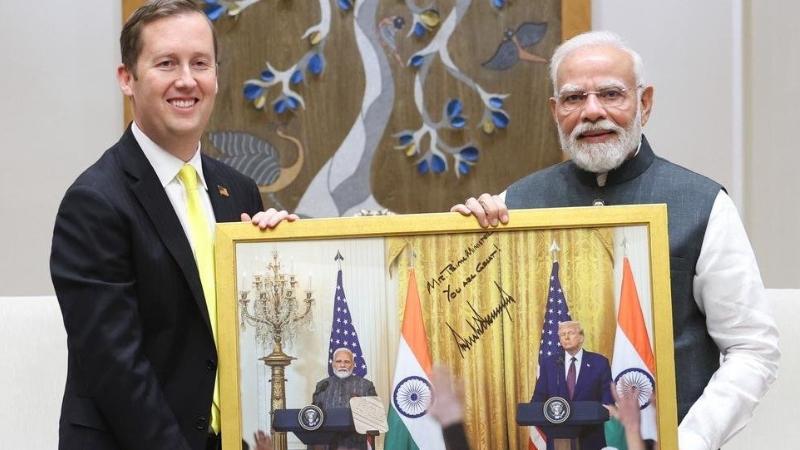
Sergio Gor formally assumed charge as the United States Ambassador to India on Monday, marking the beginning of a new diplomatic chapter between the two countries. Speaking shortly after taking office, Gor described the relationship between India and the United States as the most consequential global partnership of the century, underlining its growing importance across economic, strategic, and technological domains. He confirmed that fresh trade negotiations between the two sides are schedule
Sergio Gor formally assumed charge as the United States Ambassador to India on Monday, marking the beginning of a new diplomatic chapter between the two countries. Speaking shortly after taking office, Gor described the relationship between India and the United States as the most consequential global partnership of the century, underlining its growing importance across economic, strategic, and technological domains. He confirmed that fresh trade negotiations between the two sides are schedule
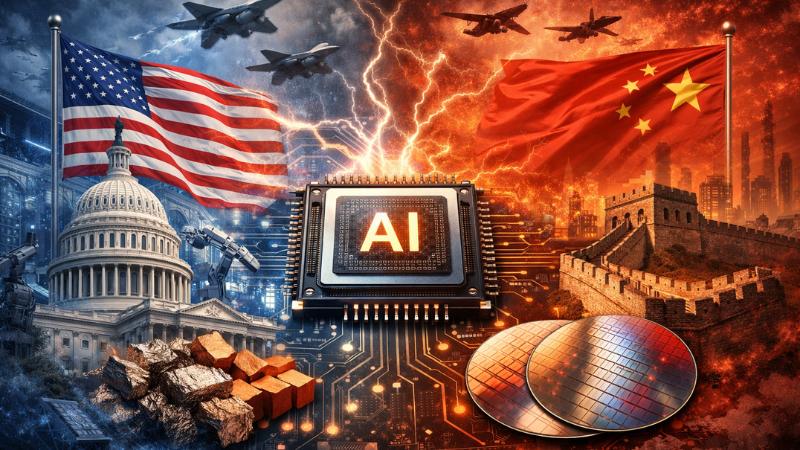
The strategic rivalry between the United States and China in the semiconductor sector continued to intensify throughout 2025, with export controls remaining a central instrument in what has come to be known as the global chip war. The dispute, rooted in concerns over national security, technological leadership and economic influence, significantly affected the semiconductor industry, global supply chains and investment decisions during the year.
At the start of 2025, the United States maintained restrictions on the export of advanced artificial intelligence chips and related technologies to China. These controls were designed to limit Beijing’s access to cutting-edge computing capabilities that could be applied to military and surveillance technologies. US officials defended the measures as necessary to protect national security interests, but the restrictions had immediate commercial consequences for American chipmakers with strong exposure to the Chinese market.
Companies producing high-performance AI chips, including industry leaders such as Nvidia, reported revenue pressures linked to reduced access to Chinese customers. The curbs also led to higher compliance costs and uncertainty over long-term market strategies. Industry executives warned that prolonged restrictions could weaken the global competitiveness of US firms while accelerating China’s efforts to develop independent semiconductor capabilities.
Policy signals shifted after Donald Trump assumed the US presidency in January. His administration moved to ease certain export controls on advanced AI chips for what were described as approved customers in China. Under the revised framework, sales of Nvidia’s H200 chip were permitted, subject to conditions that included profit-sharing arrangements with the US government. The adjustments were widely interpreted as an attempt to balance national security concerns with the commercial interests of American technology companies.
China responded to the US measures by criticising what it described as discriminatory semiconductor policies and urging Washington to reverse the controls. Beijing argued that the restrictions were disrupting global supply chains and undermining fair competition in the semiconductor industry. At the same time, Chinese authorities accelerated domestic initiatives aimed at strengthening the country’s chip manufacturing ecosystem and reducing reliance on foreign suppliers.
As part of its response, China imposed export controls on several rare earth elements, materials that are essential for semiconductor production and advanced electronics. China holds a dominant position in the global rare earth supply, making these measures a powerful lever in the broader technology competition. The restrictions heightened concerns among manufacturers worldwide about material availability and supply chain resilience.
The prolonged US-China chip war had ripple effects across global markets. American and allied semiconductor firms experienced volatility in revenues and share prices as companies reassessed exposure to geopolitical risk. Investment patterns shifted as manufacturers sought to diversify production and sourcing to reduce dependence on any single market. Chinese technology firms increasingly turned to domestic suppliers, accelerating efforts to replace restricted foreign components with locally developed alternatives.
In parallel, the United States expanded its focus on strengthening domestic semiconductor production through subsidy programmes under the CHIPS Act. The initiative supported the construction of new fabrication plants and aimed to secure long-term technological leadership by rebuilding advanced manufacturing capacity within the country.
By late 2025, both Washington and Beijing took limited steps to ease tensions, agreeing to suspend certain rare earth export controls. While the move signalled a willingness to manage escalation, the underlying competition in advanced chip technologies remained unresolved. The year underscored how deeply the semiconductor rivalry has become embedded in global trade, industrial policy and national security calculations, with lasting implications for the future of the technology sector.
The strategic rivalry between the United States and China in the semiconductor sector continued to intensify throughout 2025, with export controls remaining a central instrument in what has come to be known as the global chip war. The dispute, rooted in concerns over national security, technological leadership and economic influence, significantly affected the semiconductor industry, global supply chains and investment decisions during the year.
At the start of 2025, the United States maintained restrictions on the export of advanced artificial intelligence chips and related technologies to China. These controls were designed to limit Beijing’s access to cutting-edge computing capabilities that could be applied to military and surveillance technologies. US officials defended the measures as necessary to protect national security interests, but the restrictions had immediate commercial consequences for American chipmakers with strong exposure to the Chinese market.
Companies producing high-performance AI chips, including industry leaders such as Nvidia, reported revenue pressures linked to reduced access to Chinese customers. The curbs also led to higher compliance costs and uncertainty over long-term market strategies. Industry executives warned that prolonged restrictions could weaken the global competitiveness of US firms while accelerating China’s efforts to develop independent semiconductor capabilities.
Policy signals shifted after Donald Trump assumed the US presidency in January. His administration moved to ease certain export controls on advanced AI chips for what were described as approved customers in China. Under the revised framework, sales of Nvidia’s H200 chip were permitted, subject to conditions that included profit-sharing arrangements with the US government. The adjustments were widely interpreted as an attempt to balance national security concerns with the commercial interests of American technology companies.
China responded to the US measures by criticising what it described as discriminatory semiconductor policies and urging Washington to reverse the controls. Beijing argued that the restrictions were disrupting global supply chains and undermining fair competition in the semiconductor industry. At the same time, Chinese authorities accelerated domestic initiatives aimed at strengthening the country’s chip manufacturing ecosystem and reducing reliance on foreign suppliers.
As part of its response, China imposed export controls on several rare earth elements, materials that are essential for semiconductor production and advanced electronics. China holds a dominant position in the global rare earth supply, making these measures a powerful lever in the broader technology competition. The restrictions heightened concerns among manufacturers worldwide about material availability and supply chain resilience.
The prolonged US-China chip war had ripple effects across global markets. American and allied semiconductor firms experienced volatility in revenues and share prices as companies reassessed exposure to geopolitical risk. Investment patterns shifted as manufacturers sought to diversify production and sourcing to reduce dependence on any single market. Chinese technology firms increasingly turned to domestic suppliers, accelerating efforts to replace restricted foreign components with locally developed alternatives.
In parallel, the United States expanded its focus on strengthening domestic semiconductor production through subsidy programmes under the CHIPS Act. The initiative supported the construction of new fabrication plants and aimed to secure long-term technological leadership by rebuilding advanced manufacturing capacity within the country.
By late 2025, both Washington and Beijing took limited steps to ease tensions, agreeing to suspend certain rare earth export controls. While the move signalled a willingness to manage escalation, the underlying competition in advanced chip technologies remained unresolved. The year underscored how deeply the semiconductor rivalry has become embedded in global trade, industrial policy and national security calculations, with lasting implications for the future of the technology sector.
Tata Electronics has announced a milestone partnership with Intel to manufacture advanced semiconductor chips and AI-powered laptops in India. The collaboration marks a major leap in India’s semiconductor ambitions as the country seeks to become a global chip production hub. Tata is building two large semiconductor facilities worth nearly $14 billion, including a fabrication plant in Gujarat and an assembly-testing and packaging facility in Assam. The agreement brings Intel on board as Tata
Tata Electronics has announced a milestone partnership with Intel to manufacture advanced semiconductor chips and AI-powered laptops in India. The collaboration marks a major leap in India’s semiconductor ambitions as the country seeks to become a global chip production hub. Tata is building two large semiconductor facilities worth nearly $14 billion, including a fabrication plant in Gujarat and an assembly-testing and packaging facility in Assam. The agreement brings Intel on board as Tata
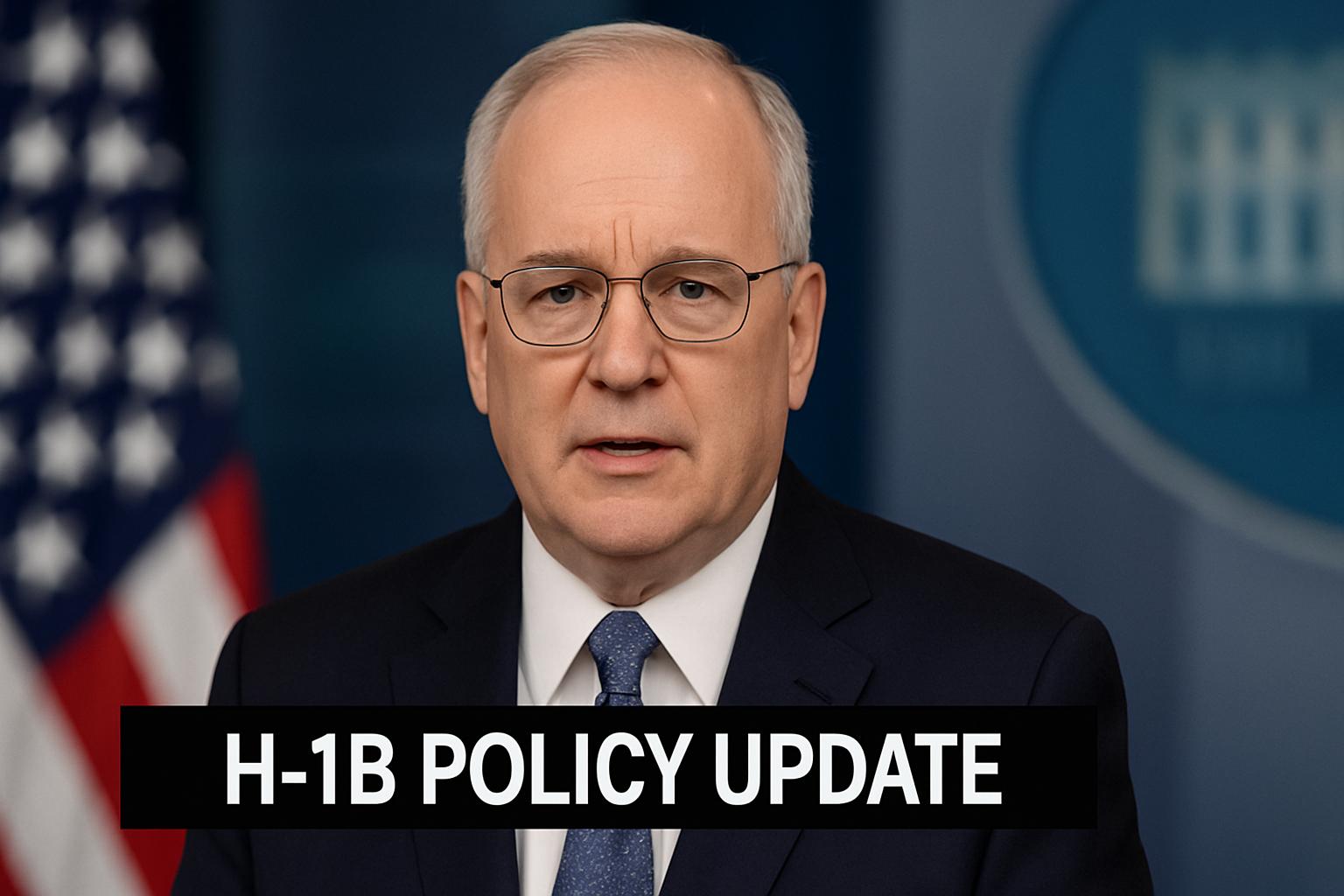
Treasury Secretary Scott Bessent has outlined the administration’s new approach to the H-1B visa programme, describing it as a targeted effort to bring in temporary foreign specialists who will train American workers rather than replace them. His remarks came during a televised interview in which he emphasised that the policy is intended to support the rebuilding of domestic manufacturing, shipbuilding capability, and semiconductor production after years of industrial decline.
Bessent said the redesigned system is centred on the idea of “knowledge transfer,” where overseas experts are invited to the United States for a limited period to help restore technical capacity in critical sectors. According to him, the administration views this model as essential to equipping American workers with advanced skills that have diminished as supply chains and production moved abroad. He explained that the visa structure is meant to ensure that expertise flows into the country long enough for domestic workers to learn the required competencies before the foreign specialists return home.
Addressing recurring concerns that increased reliance on foreign talent could displace American employees, Bessent maintained that the policy does not threaten domestic job opportunities. Instead, he argued that the United States currently lacks specialized talent in areas that have not been active on American soil for many years. He noted that industries such as shipbuilding and semiconductor fabrication require highly technical knowledge, which is more readily available in countries that have continued to develop those sectors. In his view, bringing in experts to train Americans is necessary for rebuilding industrial strength, not a means of outsourcing jobs.
The comments followed President Donald Trump’s recent statements explaining that the country needs temporary foreign experts to accelerate the transfer of technical skills. The president said the United States does not currently have enough workers with the precision training required for advanced manufacturing, adding that it would be unrealistic to expect individuals without experience to instantly take on tasks such as missile production or microchip engineering. Both Trump and Bessent described the policy as a practical step toward reducing long-term dependence on imports by cultivating a stronger domestic workforce.
Bessent also discussed broader elements of the administration’s economic agenda, including ongoing talks about a potential USD 2,000 tariff rebate for families earning less than USD 100,000 annually. He said the proposal is part of an effort to ensure that households directly benefit from trade policies designed to strengthen national competitiveness. The rebate, he added, is one component of the administration’s push to align the interests of Wall Street and Main Street, a vision he referred to as “Parallel Prosperity.”
Looking ahead, the Treasury secretary predicted that 2026 could become a milestone year for the United States economy if the administration’s policy framework succeeds in restoring industrial capacity and stabilizing financial markets. He emphasized the importance of maintaining a deep and liquid Treasury market, suggesting that economic growth will depend on strong foundations that support both investment and employment. Throughout the interview, Bessent portrayed the H-1B reform as a crucial part of that broader plan, arguing that rebuilding the nation’s industrial base requires a temporary infusion of global expertise to ensure Americans can take full ownership of high-skilled jobs in the future.
Treasury Secretary Scott Bessent has outlined the administration’s new approach to the H-1B visa programme, describing it as a targeted effort to bring in temporary foreign specialists who will train American workers rather than replace them. His remarks came during a televised interview in which he emphasised that the policy is intended to support the rebuilding of domestic manufacturing, shipbuilding capability, and semiconductor production after years of industrial decline.
Bessent said the redesigned system is centred on the idea of “knowledge transfer,” where overseas experts are invited to the United States for a limited period to help restore technical capacity in critical sectors. According to him, the administration views this model as essential to equipping American workers with advanced skills that have diminished as supply chains and production moved abroad. He explained that the visa structure is meant to ensure that expertise flows into the country long enough for domestic workers to learn the required competencies before the foreign specialists return home.
Addressing recurring concerns that increased reliance on foreign talent could displace American employees, Bessent maintained that the policy does not threaten domestic job opportunities. Instead, he argued that the United States currently lacks specialized talent in areas that have not been active on American soil for many years. He noted that industries such as shipbuilding and semiconductor fabrication require highly technical knowledge, which is more readily available in countries that have continued to develop those sectors. In his view, bringing in experts to train Americans is necessary for rebuilding industrial strength, not a means of outsourcing jobs.
The comments followed President Donald Trump’s recent statements explaining that the country needs temporary foreign experts to accelerate the transfer of technical skills. The president said the United States does not currently have enough workers with the precision training required for advanced manufacturing, adding that it would be unrealistic to expect individuals without experience to instantly take on tasks such as missile production or microchip engineering. Both Trump and Bessent described the policy as a practical step toward reducing long-term dependence on imports by cultivating a stronger domestic workforce.
Bessent also discussed broader elements of the administration’s economic agenda, including ongoing talks about a potential USD 2,000 tariff rebate for families earning less than USD 100,000 annually. He said the proposal is part of an effort to ensure that households directly benefit from trade policies designed to strengthen national competitiveness. The rebate, he added, is one component of the administration’s push to align the interests of Wall Street and Main Street, a vision he referred to as “Parallel Prosperity.”
Looking ahead, the Treasury secretary predicted that 2026 could become a milestone year for the United States economy if the administration’s policy framework succeeds in restoring industrial capacity and stabilizing financial markets. He emphasized the importance of maintaining a deep and liquid Treasury market, suggesting that economic growth will depend on strong foundations that support both investment and employment. Throughout the interview, Bessent portrayed the H-1B reform as a crucial part of that broader plan, arguing that rebuilding the nation’s industrial base requires a temporary infusion of global expertise to ensure Americans can take full ownership of high-skilled jobs in the future.
Nvidia made history on Wednesday by becoming the first publicly traded company to achieve a market capitalization of $5 trillion, marking a defining moment in the global technology and artificial intelligence landscape. The milestone underscores the company’s rapid evolution from a graphics chip producer into the backbone of the worldwide AI revolution, firmly establishing its leadership in a sector reshaping economies and industries.
The Santa Clara, California-based firm’s sto
Nvidia made history on Wednesday by becoming the first publicly traded company to achieve a market capitalization of $5 trillion, marking a defining moment in the global technology and artificial intelligence landscape. The milestone underscores the company’s rapid evolution from a graphics chip producer into the backbone of the worldwide AI revolution, firmly establishing its leadership in a sector reshaping economies and industries.
The Santa Clara, California-based firm’s sto
Intel Corp. is reportedly in preliminary talks with Apple Inc. over a potential investment, according to Bloomberg. The chipmaker, which has struggled in recent years against rivals AMD and Nvidia, is seeking new partnerships to strengthen its global position. While the discussions are still in early stages and no agreement is confirmed, the possibility of Apple joining Intel’s revival plan has already stirred investor interest.
Intel Corp. is reportedly in preliminary talks with Apple Inc. over a potential investment, according to Bloomberg. The chipmaker, which has struggled in recent years against rivals AMD and Nvidia, is seeking new partnerships to strengthen its global position. While the discussions are still in early stages and no agreement is confirmed, the possibility of Apple joining Intel’s revival plan has already stirred investor interest.
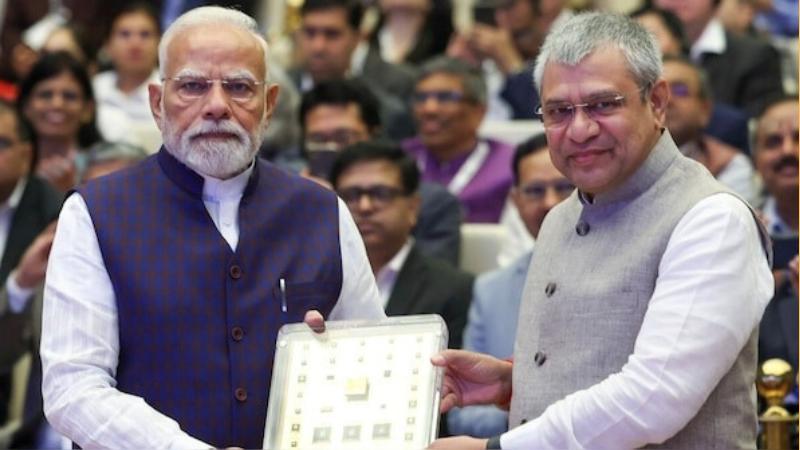
At the prestigious Semicon India 2025 conference, Prime Minister Narendra Modi was presented with India's first indigenously developed 32-bit microprocessor – the Vikram-32 chip. This groundbreaking achievement, showcased by Electronics and IT Minister Ashwini Vaishnaw, marks a monumental step in India's journey towards semiconductor self-reliance.
Developed by the Indian Space Research Organisation&rsq
At the prestigious Semicon India 2025 conference, Prime Minister Narendra Modi was presented with India's first indigenously developed 32-bit microprocessor – the Vikram-32 chip. This groundbreaking achievement, showcased by Electronics and IT Minister Ashwini Vaishnaw, marks a monumental step in India's journey towards semiconductor self-reliance.
Developed by the Indian Space Research Organisation&rsq
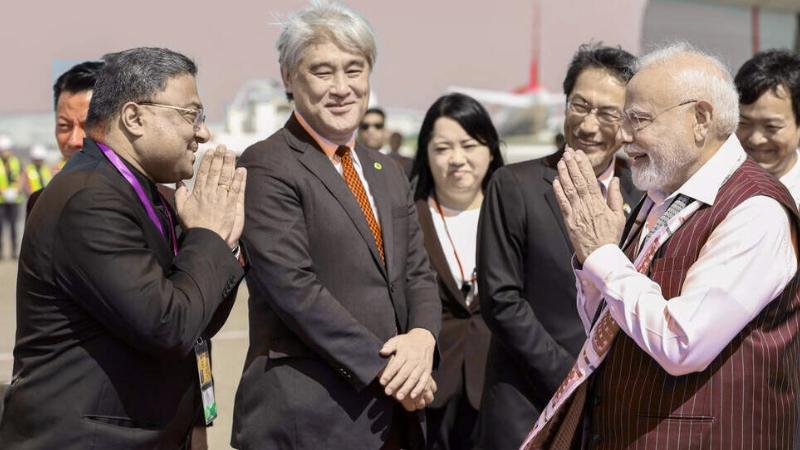
Prime Minister Narendra Modi has begun his two-day Japan visit with a packed agenda that includes strengthening economic ties, advancing technology partnerships, and reinforcing India’s role in the Quad grouping. The visit comes at a time of rising trade tensions with the United States following President Donald Trump’s imposition of a 50 per cent tariff on Indian goods. Against this backdrop, Tokyo is positioning itself as a stronger ally for New
Prime Minister Narendra Modi has begun his two-day Japan visit with a packed agenda that includes strengthening economic ties, advancing technology partnerships, and reinforcing India’s role in the Quad grouping. The visit comes at a time of rising trade tensions with the United States following President Donald Trump’s imposition of a 50 per cent tariff on Indian goods. Against this backdrop, Tokyo is positioning itself as a stronger ally for New
Nvidia and AMD have agreed to provide the United States government with 15% of their revenue from specific chip sales to China as part of an unusual export license arrangement. The decision comes after earlier restrictions halted the sale of advanced semiconductors to China due to national security concerns.
The administration stopped exports of certain high-performance chips in April, citing risks related to their potential use in military and artificial intelligence applications
Nvidia and AMD have agreed to provide the United States government with 15% of their revenue from specific chip sales to China as part of an unusual export license arrangement. The decision comes after earlier restrictions halted the sale of advanced semiconductors to China due to national security concerns.
The administration stopped exports of certain high-performance chips in April, citing risks related to their potential use in military and artificial intelligence applications
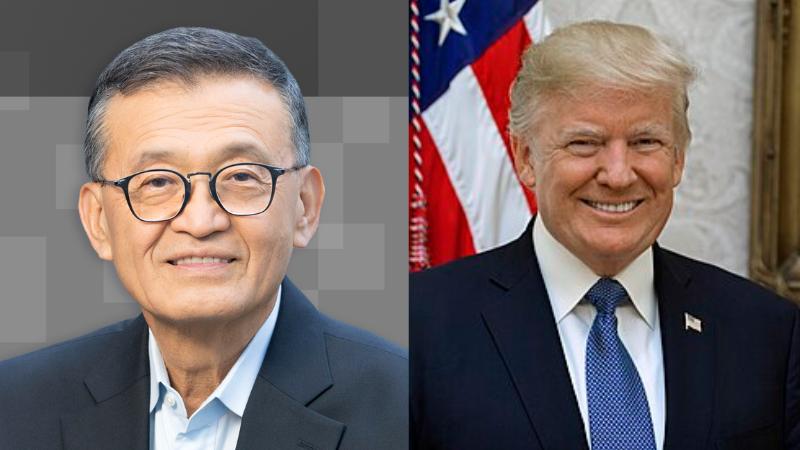
Intel’s stock took a notable hit on Thursday after President Donald Trump publicly called for the resignation of Intel’s CEO, Lip-Bu Tan. The statement has intensified the spotlight on Intel’s leadership and its potential ties to foreign entities, particularly Chinese technology firms, as the U.S. continues to grapple with rising national security concerns surrounding global tech investments.
In a social media post, President Trump declared that “The CEO of
Intel’s stock took a notable hit on Thursday after President Donald Trump publicly called for the resignation of Intel’s CEO, Lip-Bu Tan. The statement has intensified the spotlight on Intel’s leadership and its potential ties to foreign entities, particularly Chinese technology firms, as the U.S. continues to grapple with rising national security concerns surrounding global tech investments.
In a social media post, President Trump declared that “The CEO of
In a major economic policy move, United States President Donald Trump announced on Wednesday, August 6 (local time), a new plan to impose a sweeping 100 percent tariff on imported computer chips and semiconductors, while providing full exemption for companies that manufacture them within the United States. The decision is seen as a strategic attempt to force global chipmakers to relocate or expand operations within American borders, even at the cost of short-term disruptions and potential inf
In a major economic policy move, United States President Donald Trump announced on Wednesday, August 6 (local time), a new plan to impose a sweeping 100 percent tariff on imported computer chips and semiconductors, while providing full exemption for companies that manufacture them within the United States. The decision is seen as a strategic attempt to force global chipmakers to relocate or expand operations within American borders, even at the cost of short-term disruptions and potential inf
President Donald Trump has announced what he described as the largest trade agreement ever signed between the United States and the European Union. This comprehensive pact includes the imposition of a 15% tariff on European Union imports to the United States. The agreement was reached following a high-level meeting with European Commission President Ursula von der Leyen at the President’s private resort in Scotland. It was finalized just ahead of a looming deadline that could have
President Donald Trump has announced what he described as the largest trade agreement ever signed between the United States and the European Union. This comprehensive pact includes the imposition of a 15% tariff on European Union imports to the United States. The agreement was reached following a high-level meeting with European Commission President Ursula von der Leyen at the President’s private resort in Scotland. It was finalized just ahead of a looming deadline that could have
Intel has confirmed that it will be laying off more than 5,000 employees across the United States this week, a significant increase from the initial estimate of 4,000 job cuts. This revision comes after the company filed updated reports under the Worker Adjustment and Retraining Notification (WARN) Act. The majority of the layoffs will occur in Oregon and California, with significant cuts in Intel's operations across these states. In California alone, the
Intel has confirmed that it will be laying off more than 5,000 employees across the United States this week, a significant increase from the initial estimate of 4,000 job cuts. This revision comes after the company filed updated reports under the Worker Adjustment and Retraining Notification (WARN) Act. The majority of the layoffs will occur in Oregon and California, with significant cuts in Intel's operations across these states. In California alone, the
Nvidia has secured a crucial win in its ongoing negotiations with the U.S. government over AI chip exports to China. The Trump administration has decided to allow the tech giant to resume sales of its H20 chips to Chinese clients, following a reversal of earlier restrictions. According to Commerce Secretary Howard Lutnick, the green light for sales was granted on the condition that Nvidia would not export its most advanced chips, ensuring that national security interests remain protected whil
Nvidia has secured a crucial win in its ongoing negotiations with the U.S. government over AI chip exports to China. The Trump administration has decided to allow the tech giant to resume sales of its H20 chips to Chinese clients, following a reversal of earlier restrictions. According to Commerce Secretary Howard Lutnick, the green light for sales was granted on the condition that Nvidia would not export its most advanced chips, ensuring that national security interests remain protected whil
Nvidia, the global leader in advanced computing and artificial intelligence hardware, has confirmed that it has received approval from the United States government to sell its H20 AI chips to customers in China. The announcement was made by Nvidia CEO Jensen Huang during a trip to Beijing, where he is attending a major supply chain conference. According to the company’s official blog, the US government has given clearance to begin filing license applications for shipments of the H20 chi
Nvidia, the global leader in advanced computing and artificial intelligence hardware, has confirmed that it has received approval from the United States government to sell its H20 AI chips to customers in China. The announcement was made by Nvidia CEO Jensen Huang during a trip to Beijing, where he is attending a major supply chain conference. According to the company’s official blog, the US government has given clearance to begin filing license applications for shipments of the H20 chi
Nvidia has reached an unprecedented milestone by becoming the first publicly traded company in history to surpass a $4 trillion market valuation. This historic achievement, reached on Wednesday, showcases the company’s rapid ascent in the global technology landscape, driven largely by the surging demand for its artificial intelligence-focused chips.
Shares of Nvidia rose by 2.5% in early trading on Wednesday, climbing by $3.97 to exceed $164 per share. This marks a staggerin
Nvidia has reached an unprecedented milestone by becoming the first publicly traded company in history to surpass a $4 trillion market valuation. This historic achievement, reached on Wednesday, showcases the company’s rapid ascent in the global technology landscape, driven largely by the surging demand for its artificial intelligence-focused chips.
Shares of Nvidia rose by 2.5% in early trading on Wednesday, climbing by $3.97 to exceed $164 per share. This marks a staggerin