The March 3, 2026 Lunar Eclipse will be a Total Lunar Eclipse, often called a Blood Moon because the Moon turns deep red during totality. This happens when the Earth moves directly between the Sun and the Moon, casting its shadow completely over the Moon. According to NASA, the red color appears because Earth’s atmosphere filters sunligh
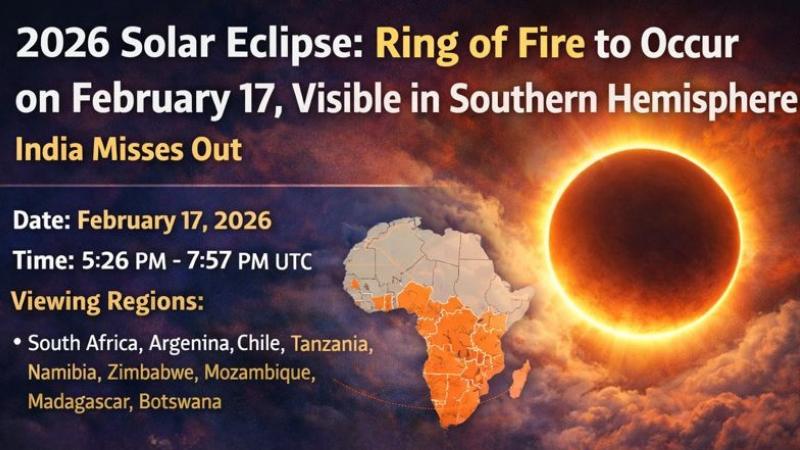
The 2026 Solar Eclipse will occur on February 17, and it is set to be a remarkable celestial event. This eclipse will be an annular solar eclipse, often referred to as the Ring of Fire eclipse. Here's everything you need to know about this rare event: Eclipse Type: The eclipse will be an annular solar eclipse. In this type of eclipse, the Moon will cover about 96% of the Sun, but due to the Moon being farther from Earth, it will appear slightly smaller than the Sun. As a
India’s space journey reached another landmark moment as Indian Space Research Organisation successfully launched the heaviest foreign satellite ever placed into orbit from Indian soil. The mission was carried out using the powerful LVM3 launch vehicle from the Satish Dhawan Space Centre in Sriharikota, reinforcing India’s growing reputation as a reliable and competitive space launch destination
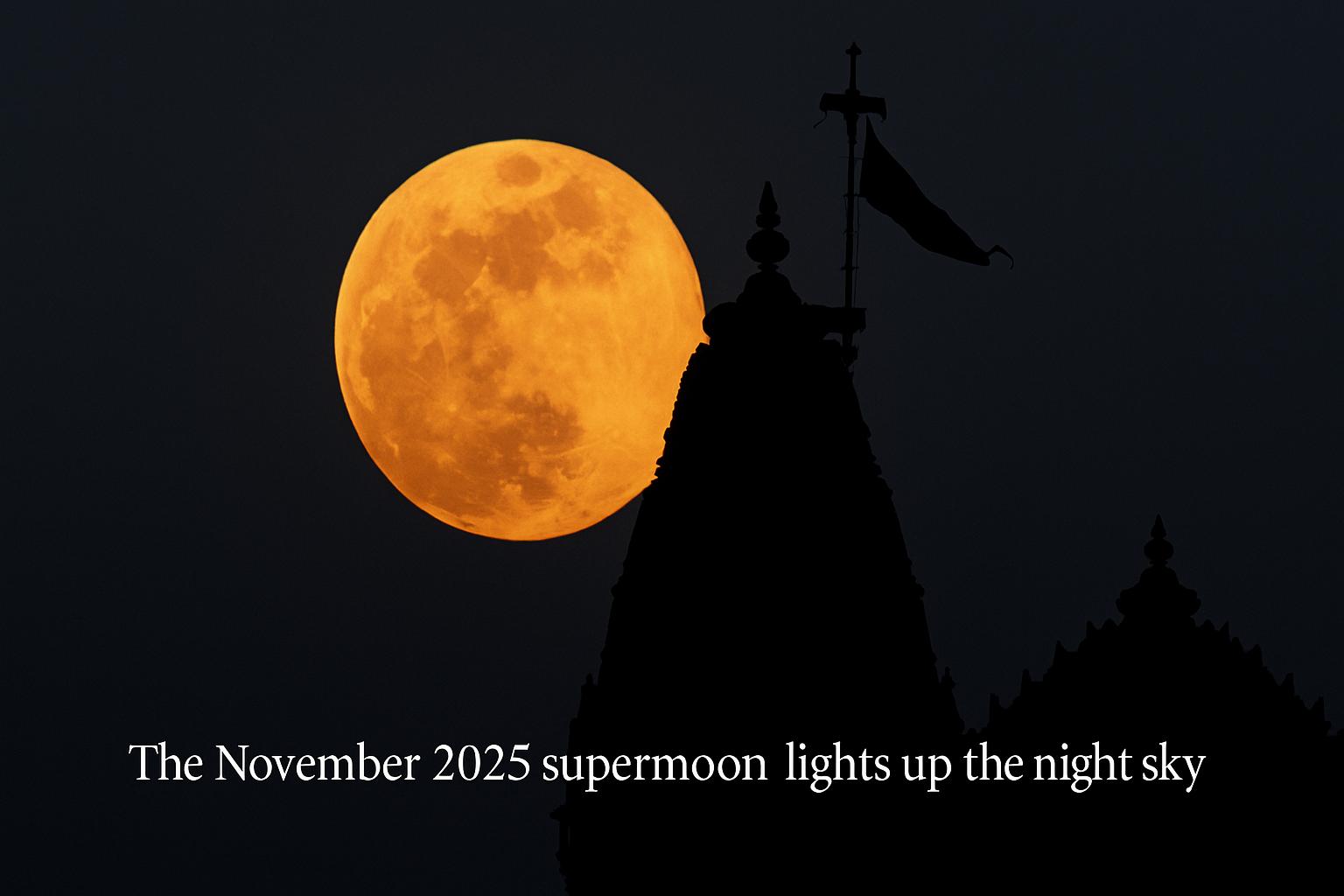
The night sky turned into a spectacular display on Wednesday as the November 2025 supermoon — also known as the Beaver Moon — rose in its full brilliance, becoming the largest and brightest full moon of the year. This remarkable celestial event, visible across much of the world, drew stargazers and sky enthusiasts to open fields, terraces, and observatories to witness its glowing beauty. The November supermoon is the second in a sequence of three supermoons occurring in 2025, an
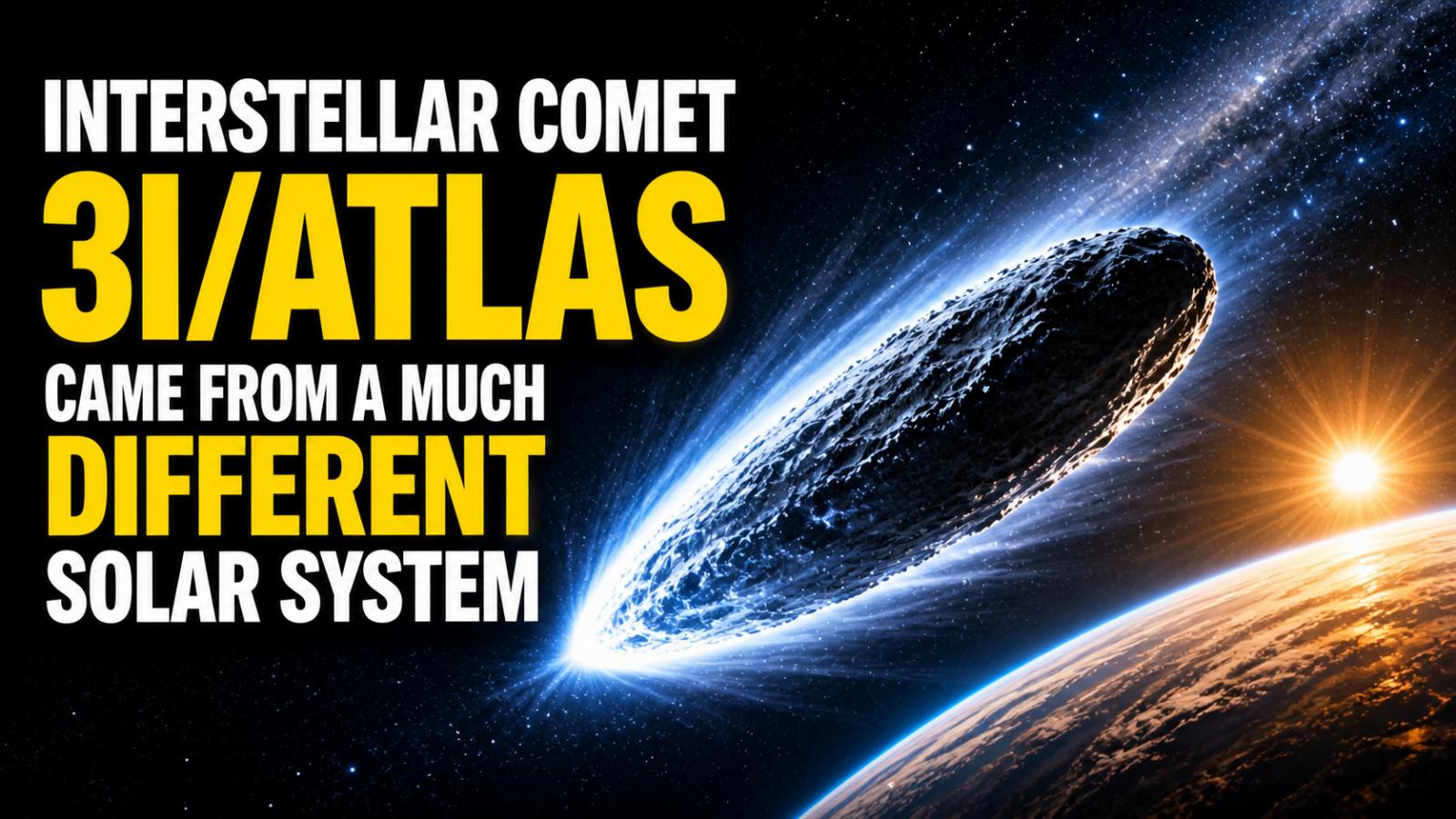
NASA’s discovery of interstellar comet 3I/ATLAS has sparked global interest after Harvard astrophysicist Avi Loeb suggested it could be a form of alien technology. Detected on July 1, 2025, the comet is only the third known interstellar object to pass through our solar system. While NASA confirmed that 3I/ATLAS poses no threat to Earth, Loeb and other researchers argue that its unique chemical and physical properties set it apart from natural space objects, warranting a deeper investigation
A remarkable celestial event is set to unfold on the night of September 7-8, 2025. The total lunar eclipse, commonly known as the "Blood Moon," will provide an awe-inspiring display for skywatchers across the globe. As Earth positions itself perfectly between the Sun and the Moon, it will cast its shadow on the lunar surface, creating a striking reddish-orange glow that has fascinated observers for centuries. This type of lunar eclipse, known for its e
Skywatchers across the globe are eagerly preparing for a rare celestial spectacle on the night of September 7–8, 2025, when a total lunar eclipse will transform the Moon into a glowing copper-red orb, famously known as the Blood Moon. The event will last for approximately 82 minutes, marking the second and final total lunar eclipse of the year. Nearly 77 percent of the world’s population will be able to witness the eclipse, making it one of the most widely visible
Asteroid 2025 QY4 is drawing the attention of both scientists and astronomy enthusiasts as it prepares to make a close approach to Earth this week. The asteroid, which belongs to the Aten group of space rocks known for orbiting across Earth’s path, measures nearly 180 feet in diameter and is travelling at an astonishing speed of more than 39,000 miles per hour. Its size and velocity make it an object worth monitoring, even though experts have already conf
India has achieved a historic milestone by winning four gold medals and one silver at the 18th International Olympiad on Astronomy and Astrophysics (IOAA), earning an overall Rank 1. The prestigious event, hosted for the first time in India, took place in Mumbai from August 12 to 21 and witnessed participation from nearly 300 students representing 64 countries. With twelve nations competing for the very first time, India’s success was celebrated as a sig
AI is everywhere right now — writing emails, powering chatbots, predicting your shopping habits… and maybe even taking your job. But here's the real question: What’s next? What comes after AI? What’s the next big thing that could be bigger, bolder, and more life-changing than artificial intelligence? You’re about to find out. Let’s dive into 5 f
Austin has just surpassed Houston in height, securing its spot as the home of the tallest building in Texas. The Waterline Tower, located at 98 Red River Street, stands at an impressive 74 stories and reaches a height of 1,025 feet. This new landmark in the Texas skyline is now 23 feet taller than the Chase Tower in Houston, which had held the title of Texas' tallest building since 1981. Waterline Tower:
India marked a major milestone in space collaboration today with the successful launch of the NISAR mission, a joint project between ISRO and NASA. Lifted into orbit aboard the GSLV-F16 from Sriharikota, NISAR is set to become the world’s most advanced Earth observation satellite. With a unique dual-frequency Synthetic Aperture Radar that combines NASA’s L-band and ISRO’s S-band systems, the satellite can penetrate clouds, forests, and even d
On June 21, 2025, countries across the Northern Hemisphere will witness the longest day and shortest night of the year, a phenomenon known as the summer solstice. This astronomical event occurs when the Earth's axial tilt leans most directly toward the Sun, causing it to reach its highest point in the sky above the Tropic of Cancer. As a result, regions from India to Europe and the United States will enjoy extended hours of daylight.
India is preparing for a historic milestone as Group Captain Shubhanshu Shukla, a highly accomplished pilot of the Indian Air Force, readies himself to become the second Indian ever to venture into space. Slated for launch on June 10 aboard the Axiom-4 mission, his journey to the International Space Station (ISS) comes nearly 41 years after Wing Commander Rakesh Sharma made his mark in 1984. As the designated mission pilot, Shukla will fly aboard SpaceX’s Falcon 9 Crew Drago
Sunita Williams and Butch Wilmore, the two American astronauts who spent an unexpected nine months aboard the International Space Station following issues with Boeing's Starliner capsule, are gradually transitioning back to life on Earth. After their return in March, the duo has been undergoing a rigorous rehabilitation phase to recover from the physical toll of extended microgravity exposure. Now, they’re emerging stronger, participating in post-mission responsibilities with both N
In a momentous development for India's space program, Indian astronaut Shubhanshu Shukla is all set for his maiden journey to the International Space Station (ISS) as part of the Axiom Mission 4 (Ax-4). The mission, a private endeavor organized by Axiom Space in collaboration with NASA, SpaceX, and the Indian Space Research Organisation (ISRO), will see Shukla take flight aboard a SpaceX Falcon 9 rocket. The launch is scheduled for 10:33 pm IST on May 29, 2025, from NASA’s Kennedy S
In a spectacular display of cosmic alignment, NASA’s Solar Dynamics Observatory (SDO) captured rare and stunning images of a solar eclipse visible only from space. This event, known as a "lunar transit," took place on Sunday, April 27, 2025. Unlike solar eclipses witnessed from Earth, this particular event was not visible to ground-based observers. The moon passed between the SDO and the sun, covering approximately 23% of the sun’s surface, creating a dramatic yet serene
The first solar eclipse of 2025 is scheduled for March 29 and will be a partial solar eclipse. During this event, the Moon will partially obscure the Sun, casting a shadow over various parts of the Northern Hemisphere. The eclipse will begin at 2:20 PM IST in the Atlantic Ocean and end around 6:13 PM IST over northern Siberia. Key areas that will witness this stunning event include northeastern Canada, parts of the northeastern United States (including New York City and Boston)
NASA astronauts Sunita Williams and Barry "Butch" Wilmore have returned safely to Earth after spending over nine months aboard the International Space Station (ISS). Their mission, originally scheduled for just eight days, extended unexpectedly due to technical issues, subjecting them to prolonged exposure to microgravity and other space-related conditions. The Crew-9 capsule successfully splashed down near the coast of Florida, USA, concluding their extended stay. The mission, whic
NASA has confirmed that astronauts Sunita Williams and Butch Wilmore, who have been stranded aboard the International Space Station (ISS) for over nine months, are finally set to return to Earth. The two astronauts initially embarked on a 10-day mission but remained in space far longer than planned due to propulsion malfunctions in their Boeing Starliner spacecraft. The much-anticipated return journey will now be carried out using the SpaceX Crew Dragon spacecraft, which successfully docked a