Cosmic Origins Written in Ice
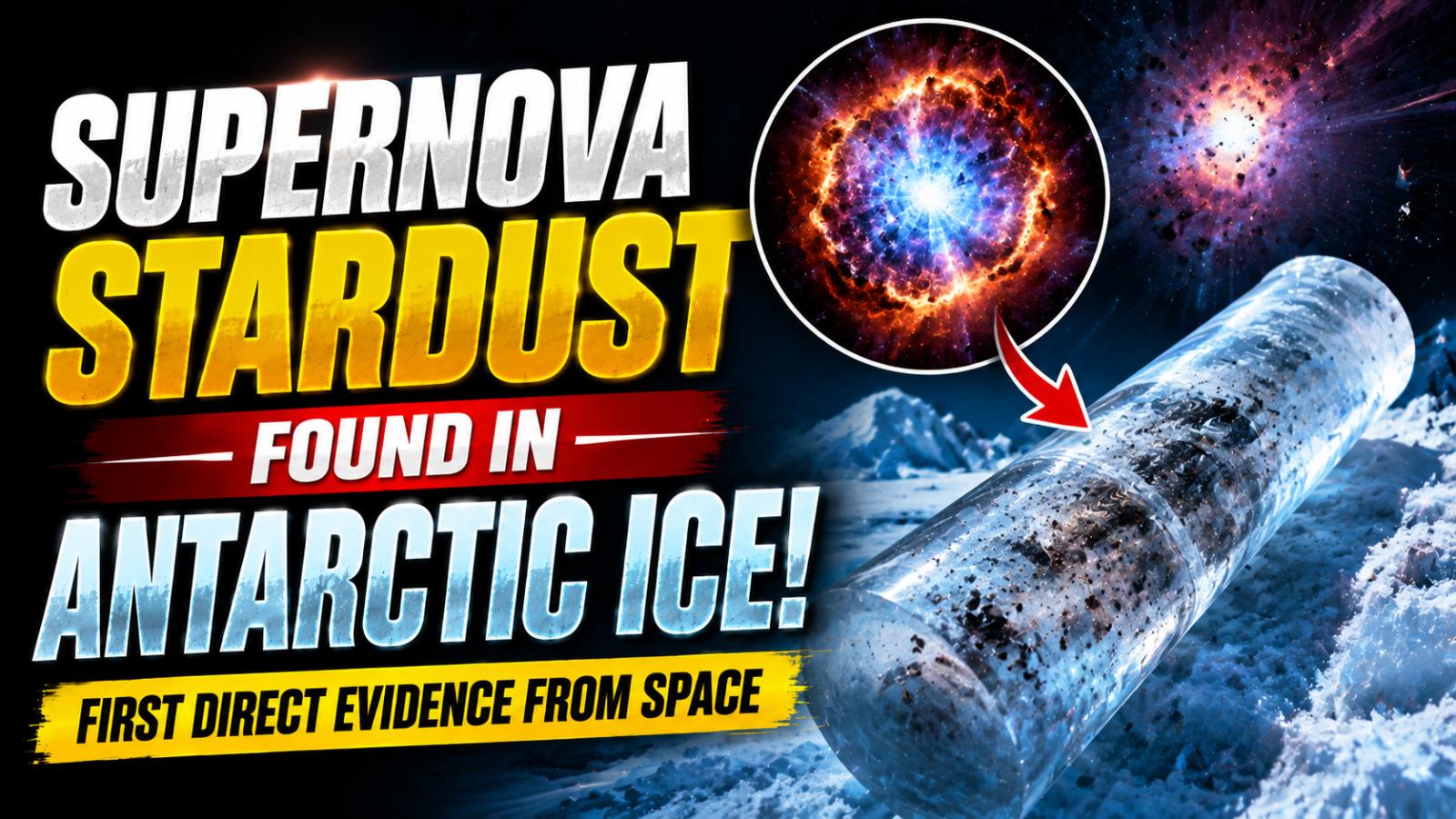
Scientists have identified direct physical traces of stardust preserved in Antarctic ice, offering rare confirmation that material forged in supernova explosions has reached Earth in measurable quantities. The discovery provides new insight into how elements created in distant stellar deaths are distributed across interstellar space and eventually incorporated into planetary environments.
Supernova Dust and the Building Blocks of Matter
Stardust refers to microscopic particles formed in stars and expelled into space through stellar winds or violent supernova explosions. These particles carry isotopic signatures that distinguish them from terrestrial material. One of the most important markers is iron-60, a radioactive isotope produced almost exclusively during supernova events. Because it does not form naturally on Earth and has a half-life of 2.6 million years, its presence provides clear evidence of relatively recent cosmic deposition.
Antarctic Ice as a Cosmic Archive
Antarctica offers a uniquely stable environment for preserving extraterrestrial particles. Layers of ice accumulate over hundreds of thousands of years, trapping atmospheric and cosmic material in sequential records. By extracting deep ice cores, scientists can reconstruct a timeline of incoming interstellar dust and identify variations in its composition over time without contamination from human activity or major geological disruption.
Evidence of Supernova Material on Earth
A research team led by nuclear astrophysicists has detected iron-60 within Antarctic ice layers, confirming that supernova-derived particles have been steadily reaching Earth. The study reveals fluctuations in concentration over tens of thousands of years, suggesting changes in the density of interstellar material surrounding the solar system. These variations provide a rare physical record of how cosmic environments evolve on human and geological timescales.
Mapping the Solar System’s Galactic Path
The findings also relate to the solar system’s movement through the Local Interstellar Cloud, a region of space filled with diffuse gas and dust shaped by ancient stellar explosions. Scientists estimate that the solar system has been traveling through this region for tens of thousands of years. The iron-60 signatures in Antarctic ice act as a natural record of this passage, showing how interstellar material filters through the heliosphere before settling on Earth.
A New Way to Read the Universe
Researchers describe the ice record as a form of cosmic archive, recording changes in the interstellar environment over time. Variations in stardust concentration may reflect shifts in the structure of surrounding space, offering clues about past supernova activity and the solar system’s trajectory through the galaxy. As more samples are analyzed, scientists hope to build a clearer picture of how cosmic dust cycles through space and influences planetary systems.