- devara
- 29 Apr 2025
- #Science #NASA #solar eclipse #lunar transit #Blood Moon #space news
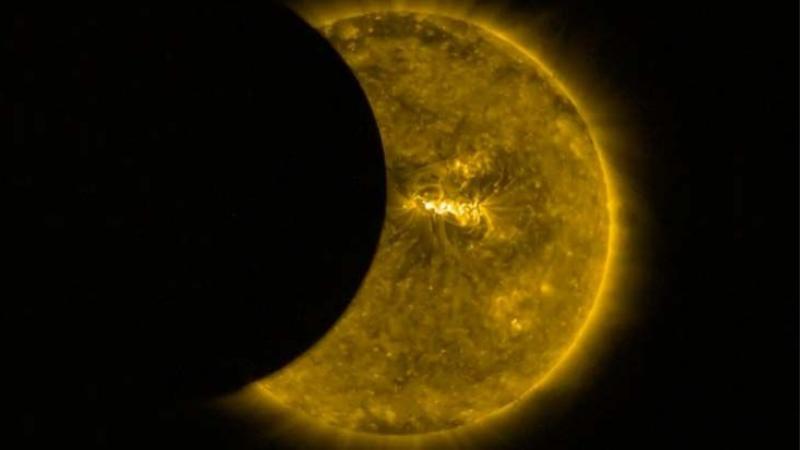
In a spectacular display of cosmic alignment, NASA’s Solar Dynamics Observatory (SDO) captured rare and stunning images of a solar eclipse visible only from space. This event, known as a "lunar transit," took place on Sunday, April 27, 2025. Unlike solar eclipses witnessed from Earth, this particular event was not visible to ground-based observers. The moon passed between the SDO and the sun, covering approximately 23% of the sun’s surface, creating a dramatic yet serene celestial moment.
The images recorded show the progression of the lunar transit in remarkable detail. Initially, the bright, radiant surface of the sun is fully visible, and then a large, dark sphere, the moon, slowly moves across, blocking nearly a quarter of the star's view. Although invisible to those on Earth, the event showcases the intricate ballet of celestial bodies as seen from space. Launched in February 2010, NASA’s Solar Dynamics Observatory is a semi-autonomous spacecraft designed to point directly at the sun for nearly continuous observation. Over the years, it has documented multiple lunar transits, allowing scientists and the public alike to witness eclipses that are otherwise hidden from earthly eyes. These space-based observations provide critical insights into solar activity, solar flares, and the dynamics of the sun’s surface and atmosphere.
According to NASA and reports by Forbes, the next similar event will occur on May 25, when the moon will cover around four percent of the sun. While less dramatic than the recent lunar transit, it remains an important event for scientists monitoring solar behavior. A more significant event is anticipated on July 25, when a larger eclipse will occur, obscuring 62% of the sun’s visible disk. These upcoming eclipses, though invisible from Earth, are valuable for ongoing solar research. The SDO’s ability to capture these events highlights how technology allows humanity to see beyond natural limitations. It offers a constant watchful eye on the sun, contributing crucial data on solar storms and space weather, which can have profound effects on Earth’s satellites, communication systems, and power grids.
This is not the first time such an eclipse has been seen from space. Historical accounts reveal that astronauts during the Apollo missions also witnessed solar eclipses while en route to the moon. These rare sightings from space provide a unique perspective that differs greatly from the experience of viewing an eclipse from the ground. In a related astronomical event earlier this year, a total lunar eclipse visible from Earth turned the moon a deep, reddish color. Known commonly as a "Blood Moon," this phenomenon occurs due to the same atmospheric scattering effects that cause sunsets to appear red. During a total lunar eclipse, the sun, Earth, and moon align in such a way that the Earth casts its shadow over the moon, bathing it in a reddish hue as described by NASA.
Upcoming Eclipses Visible From Earth and Around the Globe
Looking ahead, skywatchers have several opportunities to experience more celestial wonders. The next solar eclipse visible from Earth will occur on September 21, 2025. It will be visible from select regions including New Zealand, the South Pacific, and Antarctica. Although partial in nature, this eclipse will provide a beautiful sight for those in the path of visibility.
Even more anticipated is the total solar eclipse scheduled for August 12, 2026. This event promises to be a major spectacle, as the moon will completely block out the sun for a brief period. The path of totality will stretch through eastern Greenland, western Iceland, and northern Spain. For observers located within this narrow path, totality will last just over two minutes. During this phase, the sun’s outer atmosphere, or corona, becomes visible, creating a breathtaking sight best viewed with the naked eye under proper protective measures.
Total solar eclipses are highly sought after because of the rare and awe-inspiring sight they offer. Unlike partial eclipses, where only part of the sun is obscured, a total eclipse briefly turns day into night, offering a surreal experience. Travelers and astronomers often plan years in advance to be within the path of totality to witness this natural marvel. NASA and astronomers worldwide continue to emphasize the importance of proper eye protection during all solar eclipses. Observing a solar eclipse without certified protective glasses can cause severe eye damage. Special eclipse glasses or indirect viewing methods are strongly recommended.
The new images captured by SDO once again remind humanity of the grandeur of space and our growing ability to observe and understand it. As technology continues to advance, so too will the opportunities to witness extraordinary cosmic events, whether from Earth or from the silent observatories orbiting far above. The fascination with eclipses, whether lunar or solar, Earth-based or space-based, endures because they symbolize the intricate dance of celestial mechanics. These events offer not just scientific value but also a profound reminder of our place in the vast universe.