Elon Musk Predicts Robots Will Surpass Human Surgeons Within 5 Years as AI Revolutionizes Healthcare
The age of artificial intelligence is not just transforming industries like coding, data analysis, and manufacturing — it is rapidly making its way into the highly specialized world of healthcare. According to tech visionary Elon Musk, the next major disruption AI will bring is in the field of surgery, where robots will soon outperform even the most skilled human surgeons.
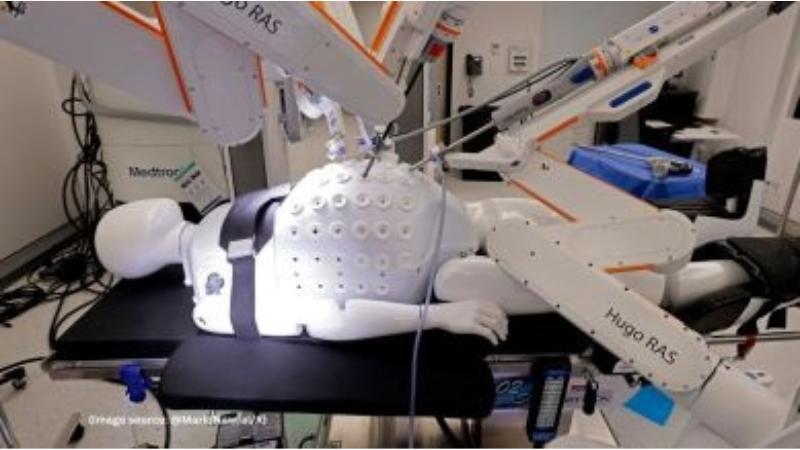
Responding to a post on X (formerly Twitter) by entrepreneur Mario Nawfal, Musk said, “Robots will surpass good human surgeons within a few years and the best human surgeons within 5 years.” His bold prediction came as a reaction to a report highlighting the impressive success of Medtronic’s Hugo robotic-assisted surgery (RAS) system. Medtronic’s Hugo system recently completed 137 urological surgeries, including procedures on the prostate, kidneys, and bladder. The system achieved a remarkable 98.5 percent success rate, far exceeding the initial benchmark target of 85 percent. Only two surgeries had to revert to traditional methods, one due to a robot malfunction and another because of a particularly complicated patient case.
The Rise of Robotic Precision in Healthcare
The achievements of the Hugo robotic system suggest that robotic assistance in operating rooms is not only becoming more common but is proving to be highly reliable. "This doesn’t mean robots are replacing surgeons tomorrow," Mario Nawfal wrote, "but it does mean your next doctor might have a very expensive metal sidekick." Musk, however, envisions a future where this "metal sidekick" takes the lead role in surgeries. Drawing from his experiences at Neuralink, his brain-implant company, Musk emphasized how critical robotic precision is in complex surgical procedures. "At Neuralink, we had to use a robot for brain-computer electrode insertion, as it was impossible for a human to achieve the required speed and precision," Musk explained.
Neuralink is currently testing brain-computer interfaces (BCIs) in human patients with paralysis, utilizing their R1 surgical robot. The robot inserts 64 ultra-thin threads into the brain’s cortex within just 15 minutes, avoiding blood vessels with micron-level precision. These threads, thinner than a human hair, are essential for recording and transmitting brain signals wirelessly through Neuralink’s chip. The sheer level of precision required to safely and efficiently insert these electrodes into delicate brain tissue underscores the capabilities of advanced robotics over human hands in surgical environments.
Elon Musk is not the only tech leader forecasting a future where AI reshapes healthcare. Microsoft co-founder Bill Gates also recently shared his perspective during an appearance on entrepreneur Nikhil Kamath’s podcast "People By WTF." Gates suggested that AI could dramatically alleviate chronic shortages of skilled professionals such as doctors and teachers. "We’ve always had a shortage doctors, teachers, people who work in factories. Those shortages won’t exist," Gates said. "AI will come in and provide medical IQ, and there won’t be a shortage."
According to Gates, with advancements in robotics and AI-driven medical intelligence, even rural clinics that have long struggled to attract qualified physicians could soon have access to world-class diagnostic and surgical support systems. The integration of AI and robotics into healthcare could fundamentally change the way society views access to medical care, ensuring that quality treatment is no longer a privilege limited to urban or affluent areas.
While AI-driven surgical robots like Medtronic’s Hugo or Neuralink’s R1 are not yet poised to fully replace human surgeons, their successes so far strongly indicate that the future of medicine will involve far more collaboration between human expertise and robotic precision. In Musk’s view, it is only a matter of a few years before robots surpass the best surgeons not just as assistants, but as leaders in the operating room. As AI continues to evolve at a rapid pace, the healthcare sector may soon find itself undergoing one of the most profound transformations in its history, delivering better outcomes, expanding access, and redefining the human role in medicine.