More than a century after its discovery transformed the study of ancient Egypt, the tomb of Pharaoh Tutankhamun is facing its most serious threat yet. Archaeologists and geological experts have issued urgent warnings that the 3,300-year-old burial site in Luxor’s Valley of the Kings is showing signs of severe structural instability.
The tomb, officially catalogued as KV62, was discovered by British archaeologist Howard Carter in 1922 and remains one of the most celebrated finds in Egyptology. However, recent assessments by Cairo University scientists reveal that it is now at its weakest state since excavation, with cracks, humidity damage, and biological growth posing grave risks to its preservation.
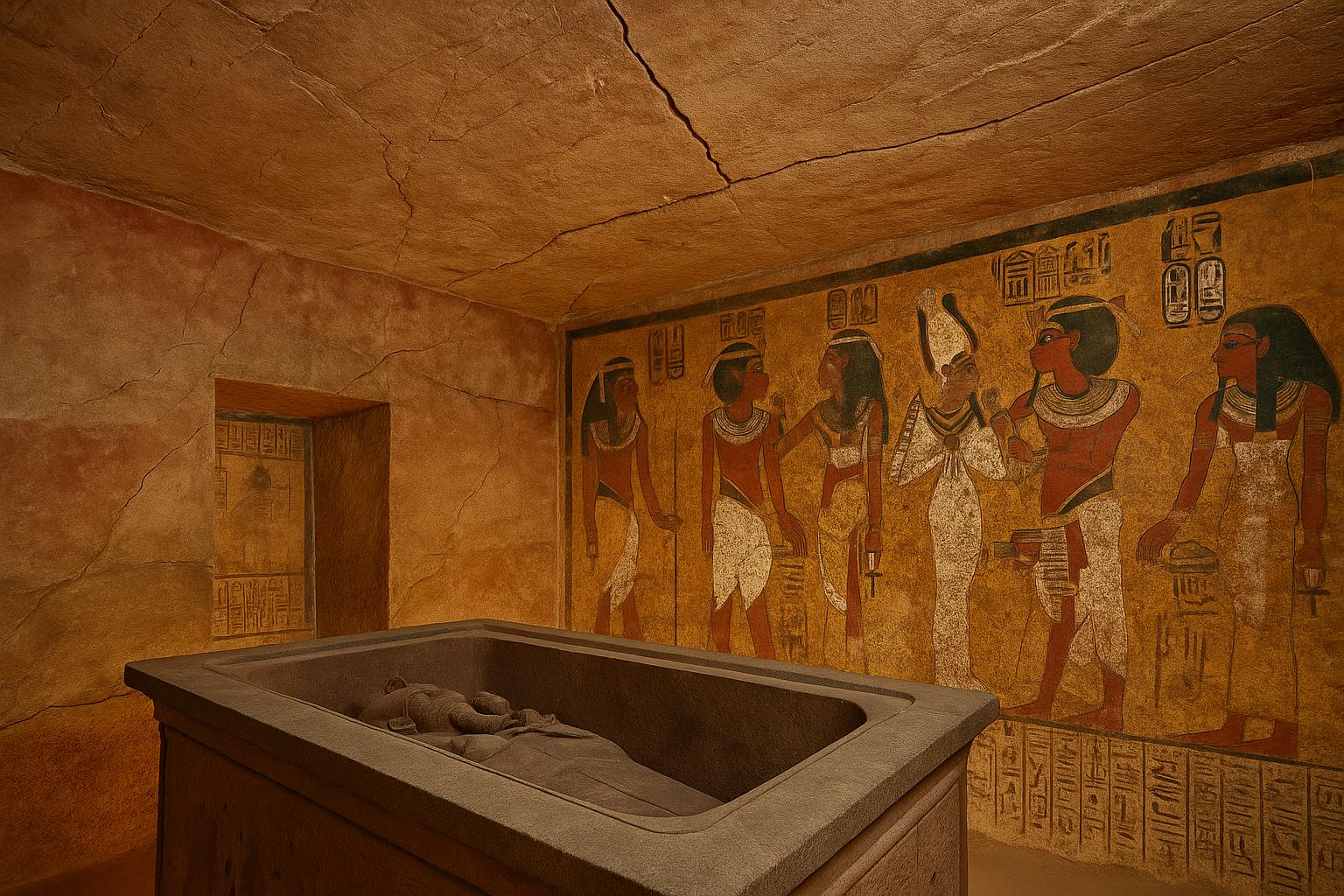
According to a new study published in npj Heritage Science, the tomb’s structure has been compromised by fissures running through its ceiling and entrance passage. Professor Sayed Hemeda, one of the study’s authors, described the situation as “alarming,” noting that “current and future risks could undermine the tomb’s integrity.” The most dangerous of these fissures, a deep crack stretching across both the burial chamber and corridor, has enabled rainwater to seep into the Esna shale — the fragile sedimentary rock from which the tomb is carved.
When the shale absorbs moisture, it swells; when it dries, it contracts. These constant cycles of expansion and contraction are slowly tearing the tomb apart. Hemeda explained that the ceiling is now bearing stress levels that exceed the natural capacity of the rock, causing further fragmentation and deformation. The geological makeup of the valley, primarily composed of shale and limestone, was never ideal for sustaining large underground structures. What once provided concealment for royal burials has become a source of weakness threatening Egypt’s most famous archaeological treasure.
The tomb’s fragility can also be traced to a natural disaster more than thirty years ago. In 1994, a rare desert flash flood swept through the Valley of the Kings, inundating subterranean tombs, including Tutankhamun’s. The water permeated the shale walls, trapping moisture that has continued to destabilize the rock over time. This increase in humidity encouraged the growth of fungi and bacteria, which began eating away at the painted murals depicting the young pharaoh’s journey to the afterlife. Today, many of those once-vivid images are marred by dark blotches and fading pigments.
Professor Mohamed Atia Hawash from Cairo University’s Faculty of Archaeology has warned that the geological damage extends far beyond Tutankhamun’s tomb. Cracks have appeared in the cliffs that form the valley’s boundaries, and similar fissures have been observed at Deir el-Bahari, home to the mortuary temple of Queen Hatshepsut. Hawash cautioned that these fractures could lead to rockfalls capable of burying multiple tombs beneath tonnes of debris. “A disaster could strike at any moment,” he said. “If the Valley of the Kings is to be preserved, action must be taken before it is too late.”
The compact design of Tutankhamun’s tomb, once praised for its near-perfect preservation, now contributes to its vulnerability. Unlike the sprawling burial complexes of earlier pharaohs, KV62 consists of only four chambers: the entrance corridor, antechamber, burial chamber, and treasury. Archaeologists believe the modest scale was due to Tutankhamun’s untimely death at about 19 years old, forcing officials to adapt a smaller, unfinished tomb. The Esna shale used in its construction was not intended to support elaborate wall paintings or ornate carvings. As a result, even minor shifts in the rock can cause serious deformation to its surfaces.
Experts note that Tutankhamun’s tomb is part of a larger geological system under strain. The Valley of the Kings, a UNESCO World Heritage site, contains more than sixty royal burials carved into soft rock layers. Repeated flash floods, temperature fluctuations, and humidity variations have steadily eroded the valley’s structure. While scientists have the technology to monitor environmental risks, preservation efforts remain largely reactive rather than preventive.
Hawash emphasized this gap, stating, “We have the ability to track changes scientifically, but the absence of a culture of prevention means we act only after damage occurs.” This reactive approach, he warned, leaves Egypt’s ancient heritage in constant danger.
The growing instability of the rock has prompted calls for an emergency preservation plan. Emad Mahdi of the Egyptian Archaeologists’ Union has urged the formation of a high-level committee to study the tomb’s geological and structural condition. He recommends that experts conduct an immediate assessment of how the cracks and moisture are affecting the murals and wall inscriptions, then deliver a detailed report to Egypt’s Supreme Council of Antiquities to guide restoration work.
Tutankhamun’s tomb, once hailed as the best-preserved relic of the New Kingdom, now stands at a crossroads between preservation and decay. Without immediate intervention, experts warn that the damage could become irreversible, endangering not just one tomb but the entire Valley of the Kings.
As Egypt marks more than a hundred years since the discovery that captivated the world, the message from archaeologists is clear: the boy king’s final resting place may not survive another century unless urgent, coordinated conservation efforts begin now.