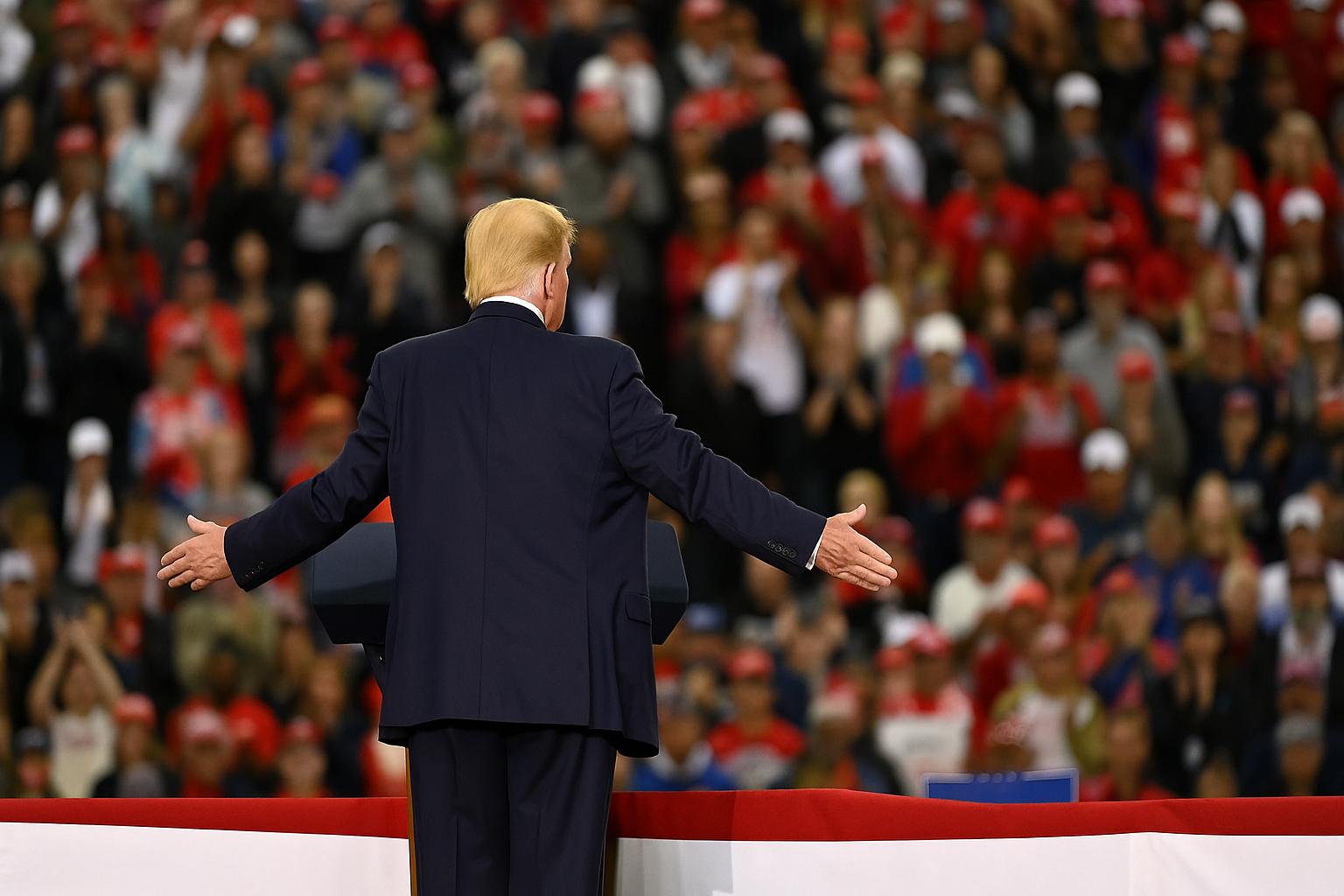
WASHINGTON — One year after President Donald Trump returned to the White House and began a far-reaching expansion of executive power, his influence is again being tested — this time through state and local elections held across the United States on Tuesday. These contests, marking the first general election of Trump’s second term, are viewed as a critical measure of how voters perceive his leadership and political agenda.
With more than half of U.S. states holding elections, the results will be closely scrutinized by both parties. Victories in key races could serve as either an endorsement or a rejection of the Trump administration’s policies, particularly in high-profile gubernatorial and mayoral contests and in ballot measures that could reshape political boundaries and judicial influence.
In New Jersey, the race to replace term-limited Democratic Governor Phil Murphy features Democratic candidate Mikie Sherrill, a four-term congresswoman and former Navy helicopter pilot, facing Republican Jack Ciattarelli, a former state Assemblyman who narrowly lost to Murphy in 2021. Ciattarelli, now backed by Trump, is campaigning on conservative fiscal and education reforms. Polls suggest the race remains competitive, with national attention focused on whether Trump’s endorsement can flip the traditionally Democratic state.
Virginia’s gubernatorial race presents another significant test of political momentum. Republican Lt. Gov. Winsome Earle-Sears faces Democrat Abigail Spanberger, a former U.S. Representative, to succeed outgoing Governor Glenn Youngkin. While Spanberger has attempted to steer campaign discussions toward state issues, Trump’s policies and influence have dominated the conversation. Earle-Sears, an outspoken Trump ally, has supported controversial measures such as the “One Big Beautiful Bill,” a sweeping tax and spending reduction proposal, and Trump’s initiative to dismiss thousands of federal workers. Trump’s participation in virtual rallies on the eve of the election underscored the importance he places on the race.
Historically, gubernatorial contests in Virginia and New Jersey have served as early indicators of voter sentiment toward the party in power. Since 1973, at least one of the two states has elected a governor from the opposing party in the first year following a presidential election. Whether that trend continues could offer insight into the broader political climate leading into the 2026 midterms.
In New York City, the race to succeed Mayor Eric Adams has emerged as a focal point for Democrats. The candidates include state legislator Zohran Mamdani, independent and former Governor Andrew Cuomo, and Republican Curtis Sliwa. Mamdani, a self-described democratic socialist, gained national attention after defeating Cuomo in the June Democratic primary — a victory celebrated by progressives but viewed with unease by centrist party members. Cuomo later re-entered the race as an independent before Adams dropped out and endorsed him. Trump’s Justice Department also intervened earlier this year, asking a court to dismiss corruption charges against Adams, citing the case’s potential to hinder immigration policies.
Meanwhile, California voters are set to decide on Proposition 50, a ballot measure that could significantly alter congressional boundaries. The proposal, supported by Governor Gavin Newsom, aims to implement a new redistricting map that could shift up to five U.S. House seats from Republican to Democratic control. The measure is seen as a direct response to Texas’s recent map revisions, which were designed to bolster Republican strength in the House under Trump’s leadership.
Control of the Pennsylvania Supreme Court also hangs in the balance, with voters deciding whether to retain three Democratic justices from the current 5–2 majority. The outcome could influence future rulings on election disputes, particularly during the 2028 presidential race. Both parties have poured millions into the race, with spending expected to exceed $15 million by Election Day.
Beyond the marquee contests, several other important races are unfolding nationwide. Virginia’s Attorney General Jason Miyares, a Republican, seeks re-election against Democrat Jay Jones, whose campaign has been overshadowed by controversy over past text messages suggesting violence against political rivals. In Texas, sixteen candidates are competing for the open congressional seat previously held by the late Democratic Representative Sylvester Turner.
At the state level, control of legislative chambers is also at stake. Democrats in New Jersey are defending their 52–28 Assembly majority, while Republicans aim to reclaim seats in Virginia’s House of Delegates and the Minnesota Senate. Several states are also considering ballot measures, including Maine’s “red flag” law to prevent gun violence and Texas’s constitutional amendments on parental rights and voter eligibility.
Mayoral elections are being held in major cities such as Detroit, Pittsburgh, Jersey City, and Buffalo, while incumbents in Atlanta, Minneapolis, and Cincinnati are seeking re-election.
Tuesday’s results will not only determine local leadership but also signal the direction of national politics under Trump’s renewed presidency. Analysts say the outcomes could shape party strategies heading into the 2026 midterms and reveal whether Trump’s influence continues to energize voters or begins to fade after his return to power.