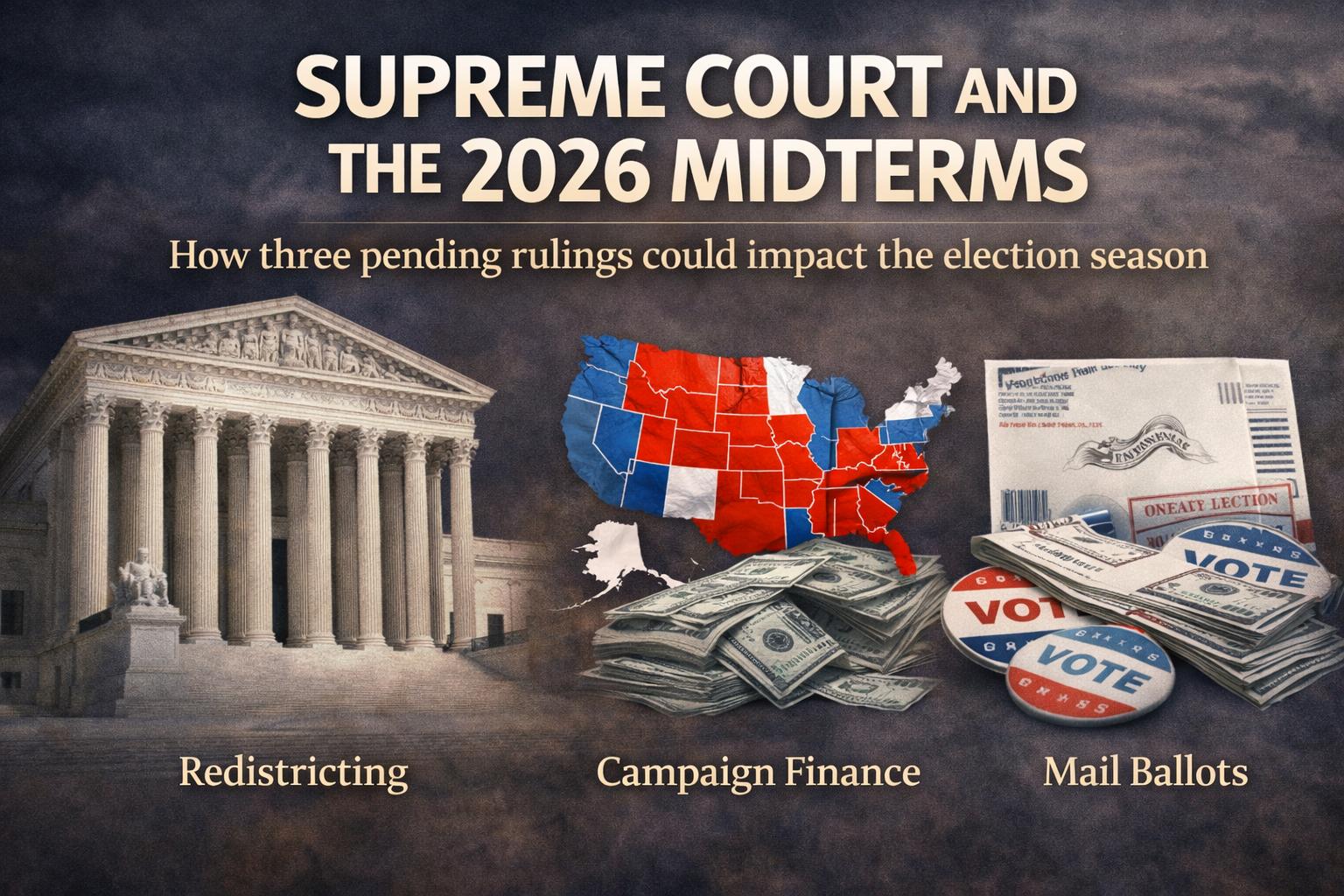
Three pending cases before the Supreme Court of the United States could significantly alter the framework of the 2026 midterm elections, with potential changes to redistricting, campaign finance, and mail-in ballot rules. Legal analysts warn that decisions issued close to the election season may create confusion for voters, strain election systems, and disrupt campaign strategies nationwide.
The court has already influenced congressional redistricting for 2026, allowing revised maps in Texas and California, while intervening in a district dispute in New York. These rulings have intensified debates over gerrymandering and representation, setting the stage for further legal and political challenges.
Among the upcoming decisions, Louisiana v. Callais could limit how race is considered in districting, potentially weakening protections under the Voting Rights Act. Such a ruling may prompt states to redraw district lines, potentially reducing minority voting influence and triggering new legal battles during an active election cycle.
Another case, National Republican Senatorial Committee v. Federal Election Commission, may expand the ability of political parties to coordinate spending with candidates. A decision in favor of broader coordination could reshape campaign strategies and alter how advertising resources are used during competitive races.
The third case, Watson v. Republican National Committee, addresses whether mail-in ballots received after Election Day but postmarked on time should be counted. If the court restricts such ballots, states including Mississippi may be forced to change election procedures quickly, potentially causing voter confusion and administrative challenges.
Because such rulings may apply differently across federal, state, and local elections, states could face complex decisions on ballot handling and deadlines. The timing of these decisions, expected by June, adds to concerns that changes may occur too close to the election, increasing uncertainty and raising questions about consistency in the U.S. electoral process.