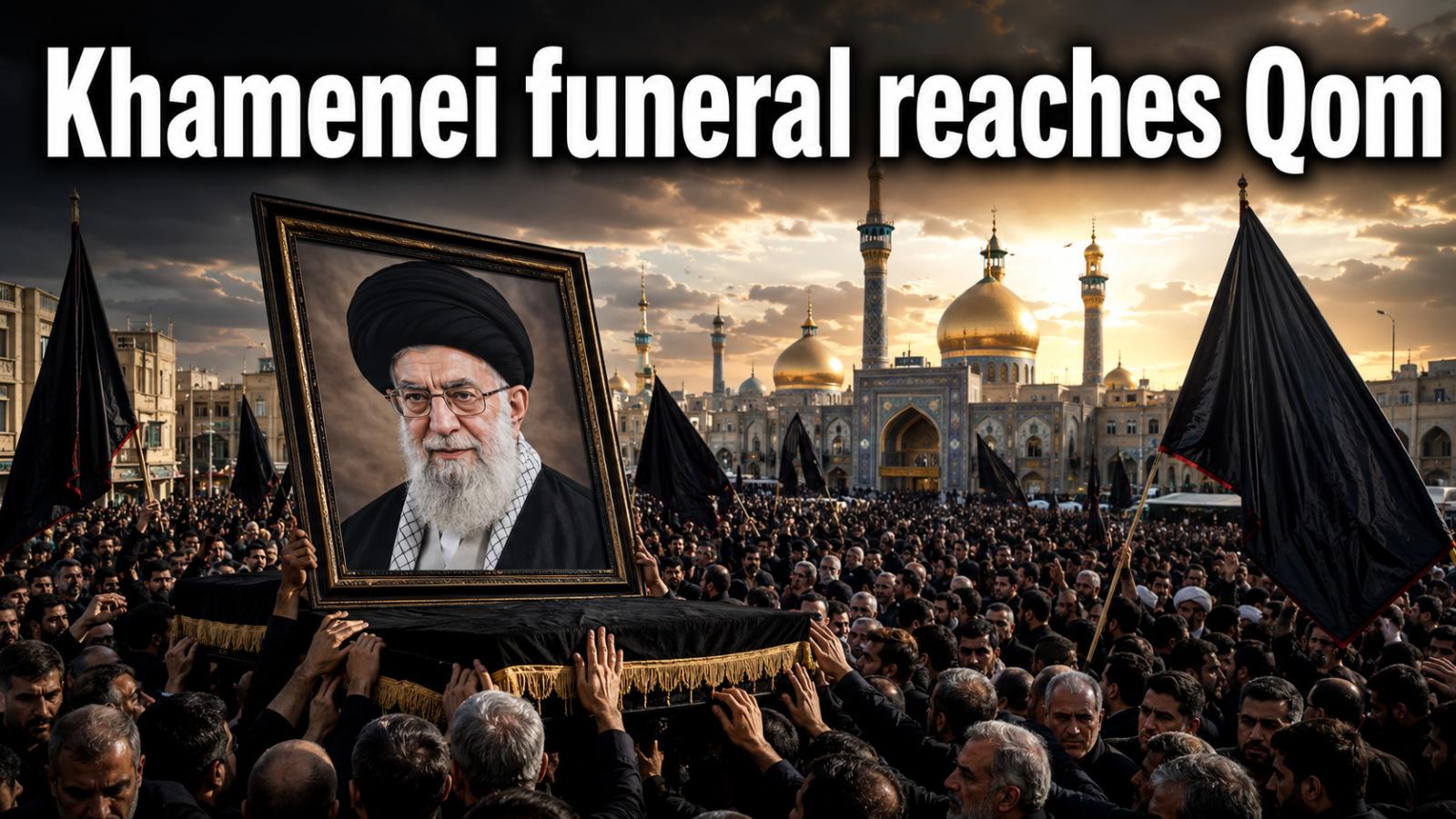
Funeral ceremonies for Iran’s late supreme leader Ayatollah Ali Khamenei moved into the holy city of Qom on Tuesday, July 7, as mourners gathered for another major stage of the official farewell. The funeral route has been planned across several religiously significant locations, beginning in Tehran and moving through Qom before expected ceremonies in Najaf and Karbala in Iraq, followed by burial in Mashhad on July 9. The route reflects both state symbolism and Shia religious identity, making the event more than a domestic funeral.
Tehran procession sets political tone
The farewell began in Tehran with public mourning at the Grand Mosalla, a major prayer and state ceremony site. Large crowds later joined a procession through the capital, with the route passing through areas tied to national memory and revolutionary symbolism. The Tehran stage projected Khamenei as both a religious authority and a central political figure in Iran’s modern history. Mourners carried flags, banners and slogans as officials used the event to present unity at a tense moment for the country.
Why Qom matters in the funeral route
Qom holds deep importance in Iran’s religious life because it is one of the main centres of Shia scholarship and clerical authority. The stop at Jamkaran Mosque added another layer of meaning, as the site is closely associated by many Shia believers with the awaited Mahdi. By bringing the funeral ceremonies to Qom, Iranian authorities placed Khamenei’s legacy within the country’s religious heartland and linked the farewell to wider Shia belief, not only to state power.
Najaf and Karbala expand the message
The expected movement of the coffin to Najaf and Karbala on July 8 gives the funeral a broader regional character. Najaf is closely connected with Imam Ali, while Karbala is central to the memory of Imam Hussein and the Shia idea of sacrifice and resistance. These stops turn the farewell into a cross-border Shia event and underline Iran’s influence across religious networks in the region.
Mashhad burial planned for July 9
Khamenei is expected to be buried in Mashhad, his hometown and one of the most important Shia pilgrimage centres. Mashhad is home to the Imam Reza Shrine and carries strong religious and emotional value for many Iranians. Ending the funeral route there gives the final burial a personal, spiritual and national meaning. For Iran, the Mashhad burial is likely to be presented as a closing moment of grief, remembrance and political continuity.