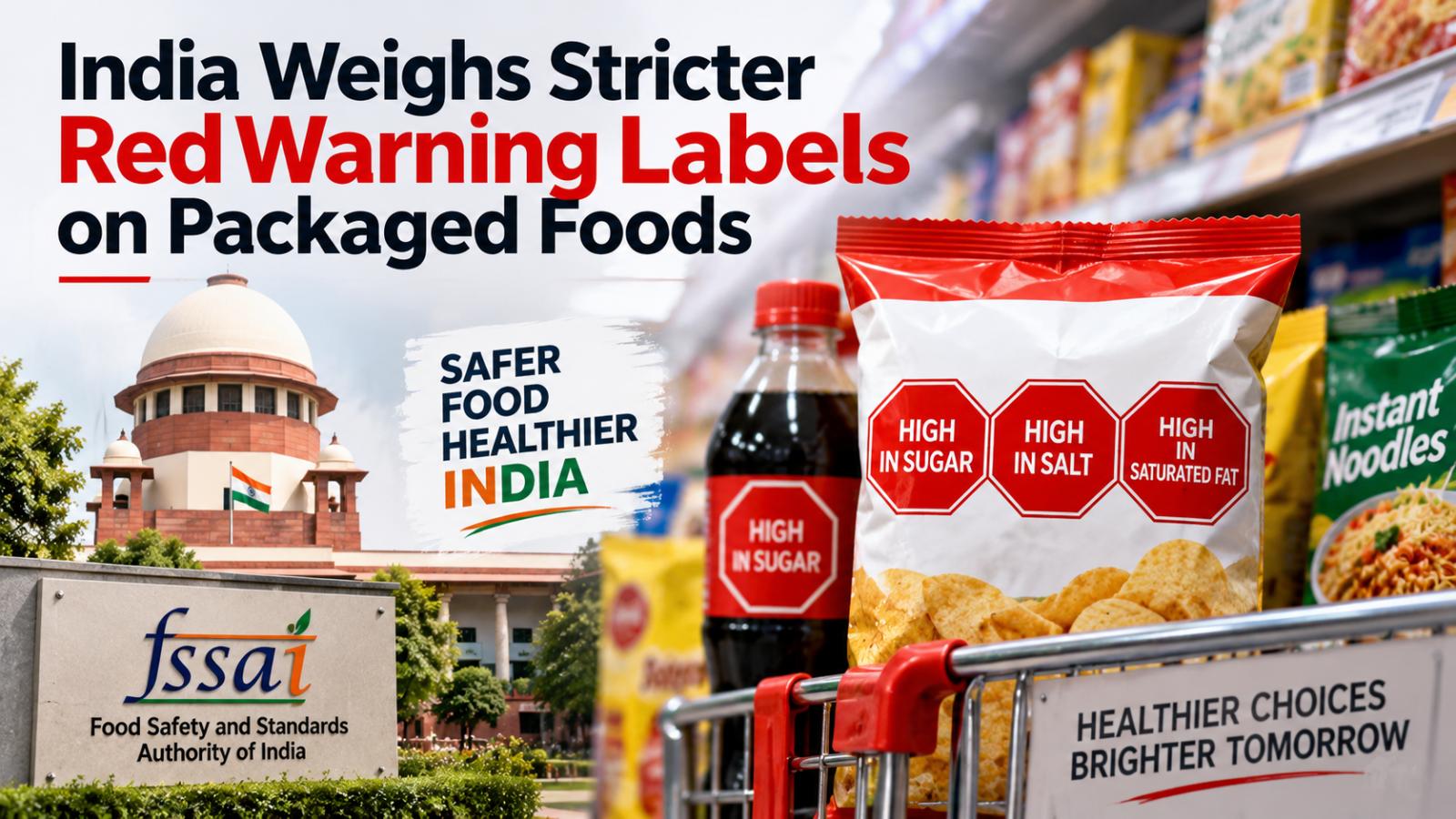
India is considering stricter front-of-pack red warning labels for packaged foods after the Supreme Court questioned whether the Food Safety and Standards Authority of India’s proposed system could allow too many products to avoid health warnings.
The FSSAI had proposed a two-phase system in which a red hexagonal warning would initially appear only when a product exceeded limits in at least two of three categories — added sugar, salt or saturated fat. A stricter second phase was planned later.
Health advocates criticised the proposal, saying foods high in even one unhealthy nutrient could escape a warning. During court proceedings, the government indicated that both phases could be introduced together, which could mean products exceeding the limit in any one category may carry a red warning.
Food safety rules face Supreme Court scrutiny
The Supreme Court has questioned the phased rollout and asked regulators to clarify how quickly stronger food labelling rules can be implemented.
The court has also sought a clear timeline as concerns grow over delays in front-of-pack warnings. The debate comes amid a wider food safety enforcement drive across India, including inspections and action against eateries over hygiene violations.
Health experts say clearer labels could help consumers quickly identify foods high in sugar, salt or saturated fat, especially when shoppers do not closely study detailed nutrition panels.
The issue has gained urgency as obesity and diet-related diseases rise in India. Public health advocates say visible warnings could help consumers make better choices and encourage manufacturers to reformulate products.
Food industry raises concerns over warning thresholds
Food companies and industry groups have raised concerns over how nutrient limits would be calculated. A key dispute is whether warnings should be based on nutrient content per 100 grams or on a typical serving size.
Industry representatives argue that a 100-gram benchmark could unfairly affect products such as pickles, sauces and snacks that are usually consumed in smaller quantities. They favour a serving-based approach.
Health campaigners argue that serving sizes can vary and may weaken the effectiveness of warnings. They support clearer, standardised thresholds that make products easier to compare.
The debate could affect India’s large packaged food market, including multinational companies such as Nestlé, Mondelez and Mars, Indian firms such as ITC and Dabur, and thousands of smaller snack and sweets businesses.
Earlier industry opposition had already slowed efforts to introduce stronger packaging rules, with companies arguing that warning labels may not be the most effective way to guide consumers.
With the Supreme Court seeking greater clarity, India could move toward a stricter system in which foods high in added sugar, salt or saturated fat carry more visible red warnings. The final structure will depend on FSSAI’s next steps and the court’s written directions.