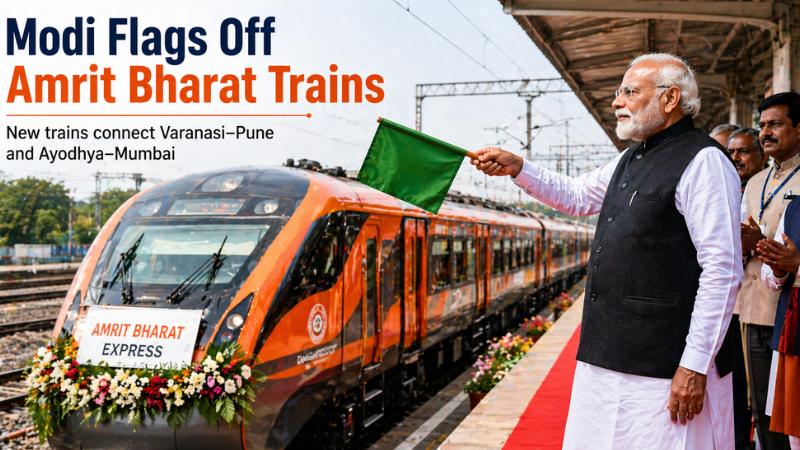
PM Narendra Modi launches new Amrit Bharat Express trains, providing direct rail connectivity between Varanasi–Pune and Ayodhya–Mumbai to boost travel and tourism.
Marking a major boost to India’s rail infrastructure, Prime Minister Narendra Modi on Tuesday, April 28, 2026, flagged off two new Amrit Bharat Express trains from Varanasi, Uttar Pradesh, strengthening direct connectivity between Uttar Pradesh and Maharashtra and improving long-distance travel convenience.
Bringing relief to passengers seeking seamless travel, the newly introduced services include the Varanasi to Hadapsar (Pune) route and the Ayodhya to Lokmanya Tilak Terminus (Mumbai) route. These trains provide direct connectivity, removing the need for multiple train changes and benefiting daily commuters, migrant workers, and pilgrims.
Highlighting the importance of the move, the Railway Ministry noted that cities like Varanasi and Ayodhya in Uttar Pradesh attract millions of devotees every year. Improved connectivity with metropolitan hubs such as Mumbai and Pune is expected to boost tourism, with easier access to the Kashi Vishwanath Dham and the Shri Ram Mandir Teerth Kshetra.
Detailing the journey schedule, the inaugural Varanasi to Hadapsar Amrit Bharat Express will depart from Banaras in the evening and reach Hadapsar late the following night, completing the trip in approximately 30 hours. The train will halt at 18 stations, including Prayagraj, Jhansi, Bhopal, Itarsi, Bhusaval, Jalgaon, Manmad, and Kopargaon before reaching Pune’s rapidly growing suburb.
Explaining the second route, the Ayodhya to Mumbai (Lokmanya Tilak Terminus) Amrit Bharat Express will begin its journey from Ayodhya Cantt in the evening and arrive in Mumbai late the next evening, taking around 28 hours. The train will stop at 12 key stations, including Sultanpur, Prayagraj Junction, Satna, Jabalpur, Itarsi, Bhusaval, Nasik Road, Kalyan, and Thane before reaching its destination.
Emphasising passenger-focused design, officials stated that Amrit Bharat Express trains are developed for the common man, offering a balance of comfort, convenience, and affordability. Fares are expected to be around 15 to 17 percent higher than regular Mail and Express trains, while regular schedules for both services will be announced soon after the inaugural runs.