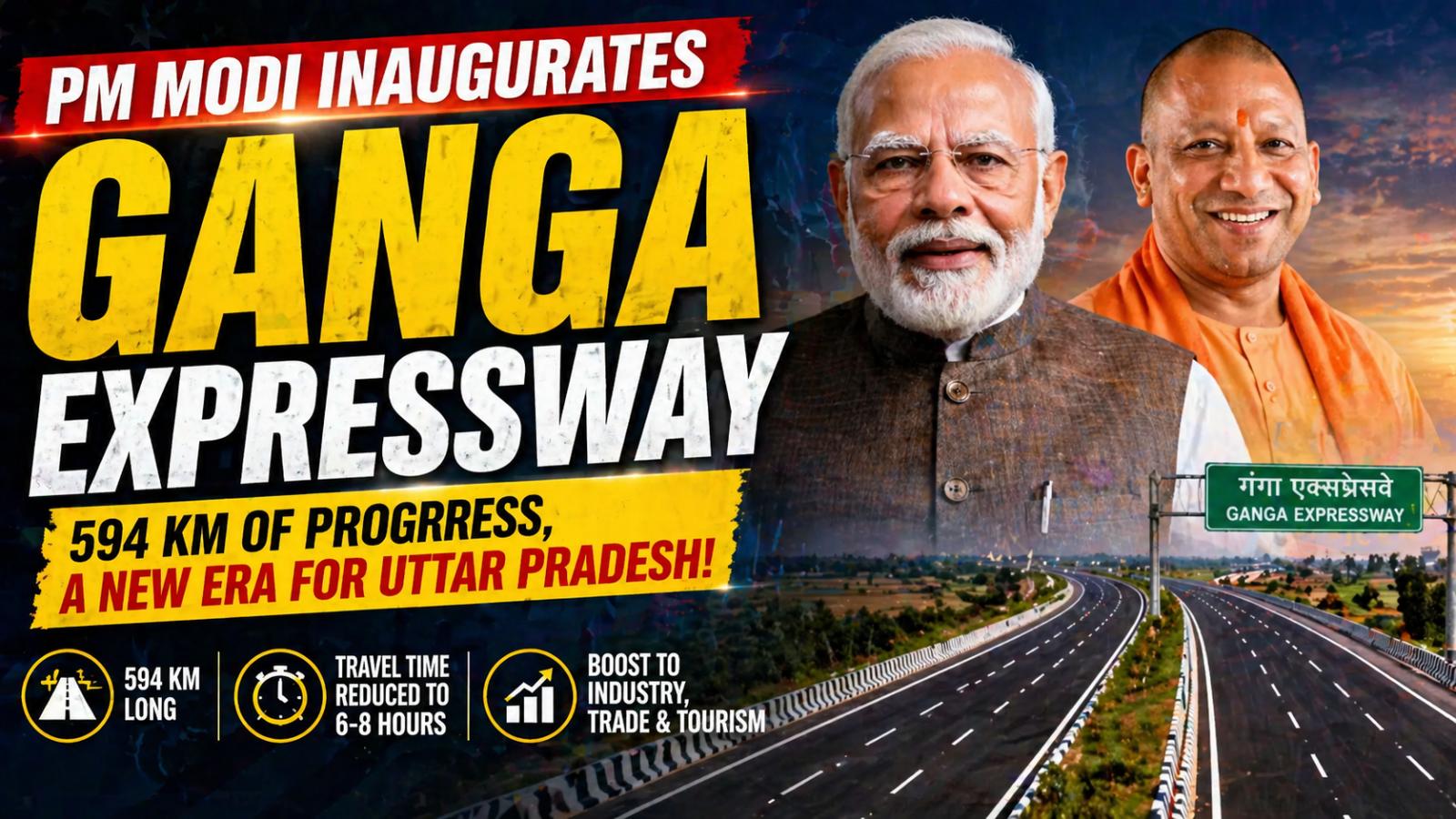
Prime Minister Narendra Modi inaugurated the 594-km-long Ganga Expressway on April 29, 2026, marking a major milestone in India’s infrastructure development. Uttar Pradesh Chief Minister Yogi Adityanath was also present at the event, which highlighted the state’s push toward becoming an infrastructure-driven economic hub.
Built at an estimated cost of ₹36,230 crore, the Ganga Expressway is the longest expressway in Uttar Pradesh and one of the country’s largest greenfield road projects. The six-lane, access-controlled highway, expandable to eight lanes, connects Meerut in western Uttar Pradesh to Prayagraj in the east, passing through 12 districts. The project is designed not only to improve connectivity but also to function as a broader industrial and logistics corridor.
A significant portion of the construction was carried out by Adani Group, which developed around 464 km of the total stretch. The expressway is expected to reduce travel time between Meerut and Prayagraj from nearly 10–12 hours to approximately 6–8 hours, improving efficiency for both passenger and freight movement.
Beyond transport, the corridor is being positioned as a catalyst for economic growth. The state government has identified thousands of acres along the route for Integrated Manufacturing and Logistics Clusters, aiming to attract investments across sectors such as manufacturing, warehousing, agriculture, and e-commerce. The project also includes strategic features like a 3.5-km airstrip in Shahjahanpur for emergency aircraft landings.
By linking western, central, and eastern Uttar Pradesh, the Ganga Expressway is expected to support balanced regional development. Officials believe it will enhance logistics efficiency, boost real estate demand, and create new opportunities for industrial expansion. The project reflects a broader strategy of using large-scale infrastructure to drive long-term economic growth and connectivity across the state.