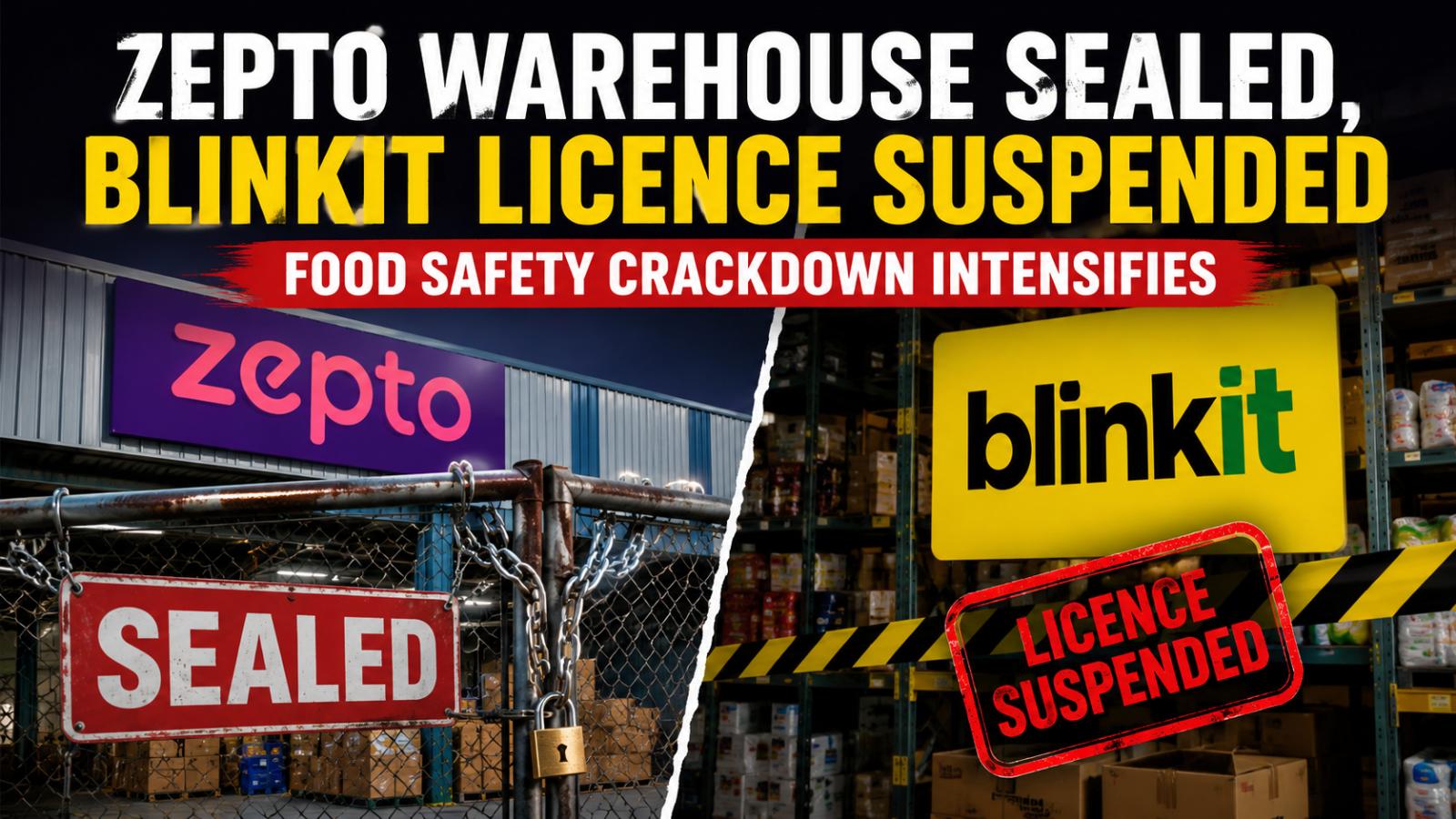
Zepto food safety Bengaluru action and the Blinkit licence suspension in Mumbai have put quick-commerce hygiene under sharper scrutiny. Karnataka officials sealed a Hoskote warehouse, while Maharashtra authorities acted against a Malad West facility after reporting serious food safety violations.
Zepto warehouse sealed after Bengaluru inspection
Karnataka’s Food Safety and Drug Administration inspected a Zepto warehouse operated from a Nippon Express facility in Hoskote taluk as part of a special enforcement campaign. Officials examined food quality, storage, labels and handling practices under the Food Safety and Standards Act, 2006.
According to the department, inspectors found unhygienic handling and storage conditions along with improper labelling and misbranding. Authorities sealed the warehouse, issued a notice and recommended further proceedings before the concerned Adjudicating Officer. Reports on the August 11 action also confirm that the Hoskote facility was sealed following food safety violations.
Blinkit licence suspended in Mumbai
The action was not limited to Karnataka. Maharashtra’s Food and Drug Administration suspended the food licence of a Blinkit facility in Malad West after an August 7 inspection found serious hygiene and storage deficiencies.
Officials reported cockroach infestation, food kept directly on the floor, expired or damaged products, poorly maintained storage areas and inadequate pest-control measures. The facility was ordered to stop food operations after its licence was suspended under the Food Safety and Standards Act.
The cases involving two major quick-commerce brands raise a broader concern for the sector: rapid delivery depends heavily on darkstore networks where groceries, packaged foods and fresh products may remain outside public view before reaching customers.
Canteens included in Karnataka inspections
Karnataka officials also inspected Indira Canteens in Gottigere, Singasandra and Lingarajapuram. Authorities reported issues involving labelling, misbranding and compliance with food safety rules. The Gottigere canteen was sealed, while notices were issued to all three facilities and further legal action was recommended.
Inspectors collected samples including pulses, turmeric powder, cooking oil, jaggery, salt, sugar and prepared food for laboratory examination. Such testing is important because an inspection can reveal visible hygiene problems, while laboratory analysis can identify quality or safety issues that cannot be confirmed visually.
FSSAI compliance becomes critical for dark stores
Food businesses have been advised to maintain clean storage areas, control pests, prevent cross-contamination, follow proper stock rotation and safely dispose of expired products and used cooking oil. These requirements apply regardless of whether products are sold through traditional stores or delivered through quick-commerce platforms.
The enforcement actions show that speed cannot replace compliance. As darkstore networks expand, operators may face increasing scrutiny over hygiene, storage, expiry management, employee practices and food traceability.
Zepto responds to inspection findings
Zepto said it cooperated with the Karnataka inspection and was taking steps to address the observations raised by officials. The company said regulatory inspections are part of routine oversight and reiterated its commitment to strengthening food safety and hygiene processes.
For consumers, the developments highlight an important part of quick commerce that is rarely visible during an app-based purchase: the condition in which food is stored before delivery. For operators, the message from regulators is equally clear—convenience and rapid delivery do not reduce their responsibility to meet food safety standards.