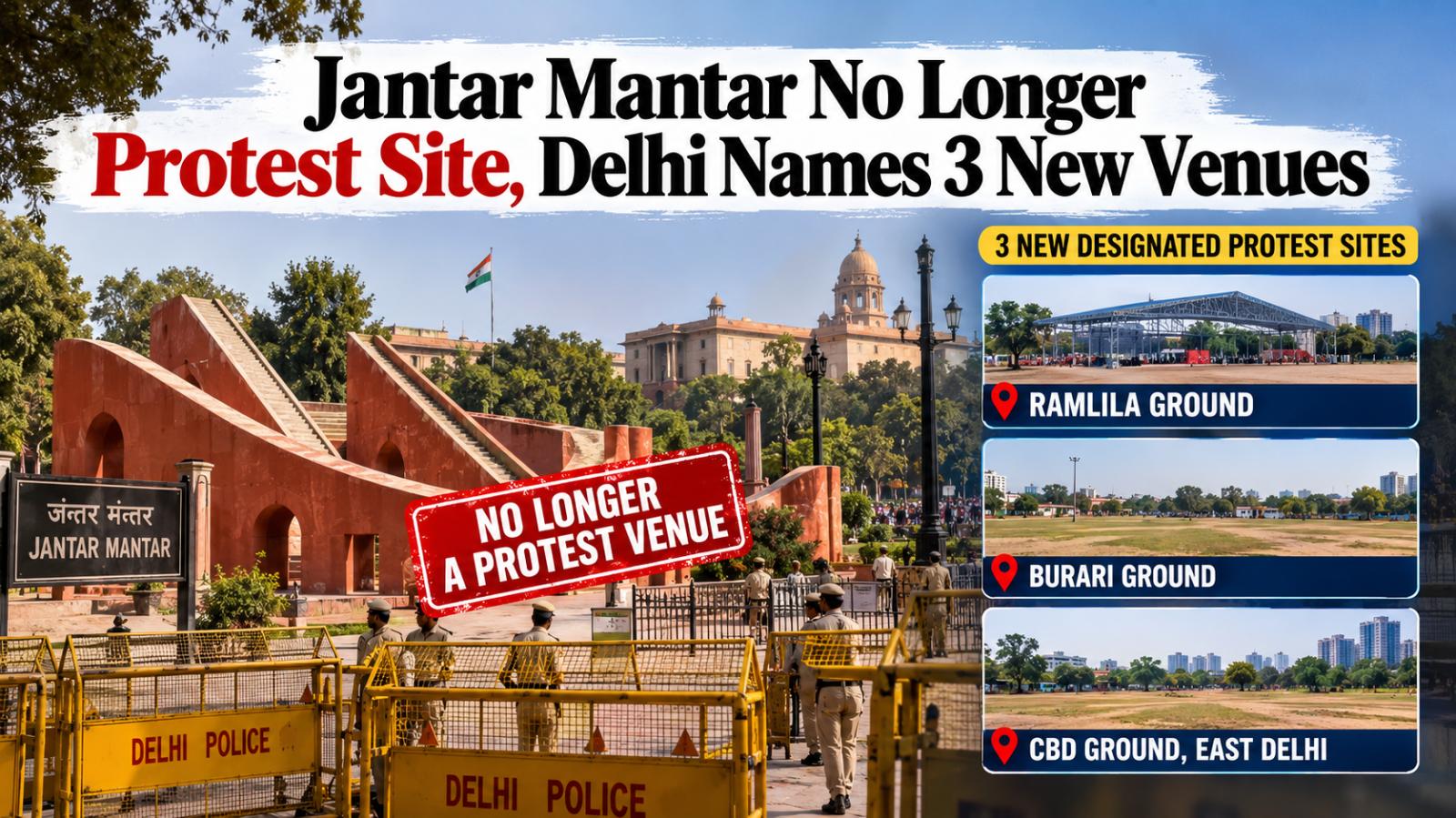
Jantar Mantar, one of Delhi's most recognised locations for public demonstrations, will no longer serve as an officially designated protest venue. Delhi Police has announced three alternative locations for protests and sit-ins, marking a significant change in how public gatherings will be organised in the national capital.
The decision was formalised through a standing order issued by Delhi Police Commissioner Anurag Kumar on October 11, 2026. Under the revised arrangement, Ramlila Ground, Burari Ground and CBD Ground in East Delhi have been designated as the new protest sites.
The announcement comes amid political tensions over the Special Intensive Revision (SIR) of electoral rolls and demonstrations involving Opposition parties. It has also raised questions about public access to protest spaces, security arrangements and the right to peaceful assembly.
Why Jantar Mantar Was Removed as Delhi's Protest Venue
According to the Delhi Police order, the Union Home Ministry constituted a committee to examine alternative locations where citizens could organise protests and demonstrations. Following its recommendations, Jantar Mantar was removed from the list of officially designated protest venues.
The decision was issued under Standing Order No. L&O/48/2026, partially modifying an earlier standing order dated April 28, 2022.
Jantar Mantar has long been associated with political movements, farmers' demonstrations, workers' demands and civil society campaigns. Its location in central Delhi, close to important government institutions, made it a prominent destination for groups seeking national attention.
However, large demonstrations in the area have also raised concerns about traffic disruptions, public convenience and security management.
While relocating protests could reduce pressure on central Delhi, the official order identifies the Home Ministry committee's recommendations as the basis for the decision. It does not establish traffic congestion as the sole reason for removing Jantar Mantar's designated status.
The announcement comes amid protests by the Opposition INDIA bloc over the SIR controversy involving Chief Election Commissioner Gyanesh Kumar. The satirical political group Cockroach Janta Party has also opposed the decision, describing the removal of Jantar Mantar's protest venue status as unacceptable.
The development has renewed debate over whether shifting demonstrations away from central Delhi could reduce their visibility and political impact.
The legal background is also significant. In July 2018, the Supreme Court, while hearing the Mazdoor Kisan Shakti Sangathan case, addressed restrictions on demonstrations at Jantar Mantar.
The court recognised the importance of peaceful assembly while emphasising the need to balance protesters' rights with public order and the interests of residents.
Importantly, removing Jantar Mantar's official designation does not, by itself, establish that every form of peaceful assembly at the location is permanently prohibited. The practical restrictions will depend on the applicable legal framework and police directions.
Delhi's 3 New Protest Sites and Upcoming Police Guidelines
Under the revised Delhi Police arrangement, Ramlila Ground, Burari Ground and CBD Ground in East Delhi will serve as designated venues for demonstrations.
Ramlila Ground has historically hosted major political rallies and public gatherings. Burari Ground offers another location for organised demonstrations, while CBD Ground provides a designated protest space in East Delhi.
Delhi Police has confirmed that detailed and revised standard operating procedures (SOPs) will be issued separately for the three venues.
These guidelines are expected to clarify permission requirements, security arrangements, crowd management and other conditions for organising demonstrations. However, the specific rules for the newly designated sites had not been detailed in the announcement.
The change also comes shortly after Delhi Police reiterated the earlier permission requirements for demonstrations at Jantar Mantar, including advance approval and restrictions on gathering sizes. Those earlier conditions should not be assumed to apply automatically to the three new locations until the revised SOPs are issued.
The decision highlights an ongoing challenge for authorities: maintaining public order while protecting citizens' constitutional right to peaceful protest.
Articles 19(1)(a) and 19(1)(b) of the Indian Constitution protect freedom of expression and peaceful assembly, subject to constitutionally permitted restrictions.
For protesters, the accessibility and visibility of the new locations will be important considerations. For authorities, implementing transparent and consistent guidelines will be essential to managing demonstrations without unnecessarily restricting lawful public participation.
With Jantar Mantar losing its official protest venue status, attention will now shift to how Delhi Police implements the revised arrangements at Ramlila Ground, Burari Ground and CBD Ground.
The forthcoming guidelines will help determine how effectively the new system balances security, public convenience and the democratic right to peaceful protest.