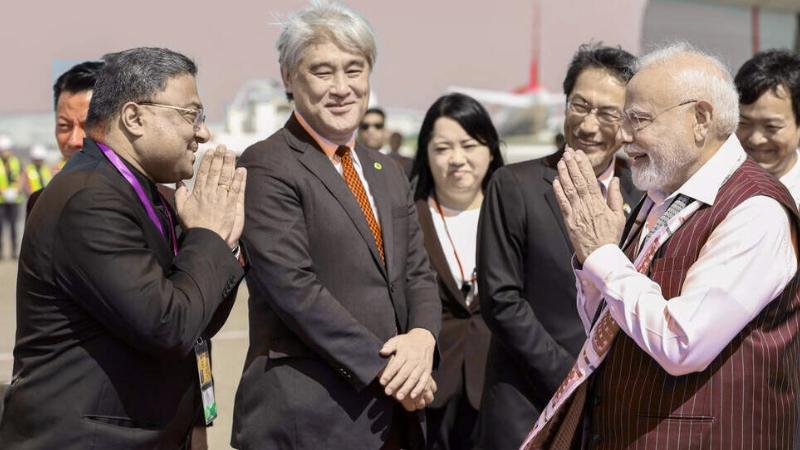
Prime Minister Narendra Modi has begun his two-day Japan visit with a packed agenda that includes strengthening economic ties, advancing technology partnerships, and reinforcing India’s role in the Quad grouping. The visit comes at a time of rising trade tensions with the United States following President Donald Trump’s imposition of a 50 per cent tariff on Indian goods. Against this backdrop, Tokyo is positioning itself as a stronger ally for New Delhi with promises of substantial investments and new opportunities for collaboration.
Japan-based media outlet Nikkei Asia has reported that Japan will invest 10 trillion Yen, nearly 68 billion US dollars, into India over the next decade. The investments are expected to cover critical sectors such as artificial intelligence, semiconductors, environment, and medicine. This move aligns with India’s push toward self-reliance in high-tech industries while offering Japan a trusted partner in Asia to counterbalance China’s growing influence. PM Modi himself posted on X that the goal is to give new wings to collaboration between the two nations, expanding both economic scope and ambition in emerging technologies.
Quad, Tariffs, And Defence Cooperation
The foreign ministry has confirmed that the Quad will be a key platform during Modi’s discussions with Japanese Prime Minister Shigeru Ishiba. The strategic grouping aims to give Indo-Pacific nations an alternative to China’s economic dominance, yet it is not without internal challenges. Relations among Quad members have been strained after President Trump’s tariff decision, while Japan’s chief trade negotiator Ryosei Akazawa abruptly cancelled a scheduled US visit. This move has placed uncertainty over a $550 billion package Japan is considering for the United States, with disagreements about profit-sharing terms still unresolved.
Bullet Train Project And Strategic Gains
Another highlight of Modi’s Japan itinerary is his scheduled visit to Tokyo’s Electron Factory and the Tohoku Shinkansen plant in Sendai, where bullet train coaches are built. Discussions with Prime Minister Ishiba are expected to advance Japan’s involvement in India’s ambitious bullet train project, a symbol of modern infrastructure cooperation between the two nations. Defence ties are also on the table, with talks underway to explore cooperation between the Indian Navy and the Japanese Maritime Self-Defense Force in ship maintenance within India.
The visit underscores India’s balancing act on the global stage, as PM Modi is also set to travel to China immediately after Japan to attend the Shanghai Cooperation Organisation Summit in Tianjin at the invitation of Chinese President Xi Jinping. By engaging with Japan on investments, technology, defence, and Quad strategy, India aims to consolidate its position as a leading force in Asia while simultaneously managing its complex ties with both the United States and China.