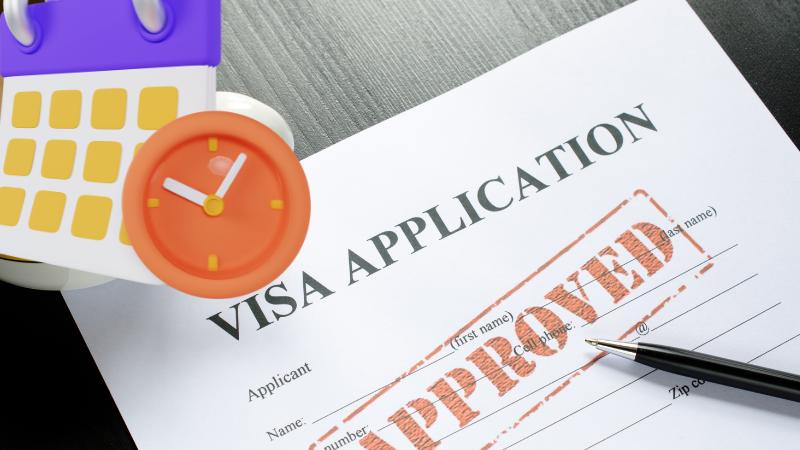
The United States has announced a new policy that could make it harder for foreign nationals, especially Indians, to secure quick non immigrant visas. Under the revised process, applicants for visas such as B1 for business and B2 for tourism will now be required to schedule their interview appointments only in their country of citizenship or legal residence. This effectively closes the option of seeking quicker interview slots abroad, a practice that many travelers from India had been relying on in recent years to avoid long delays.
The change, which forms part of the wider crackdown on immigration, was confirmed through updated instructions by the US State Department. It clarified that all applicants must now approach embassies or consulates located in their home countries, unless those countries do not offer routine visa services. While this may streamline operations from a regulatory standpoint, it leaves applicants in India facing long queues as demand continues to outpace available appointment slots.
In the past, Indian applicants would travel to nearby countries such as Thailand, Singapore, and even European cities to secure faster visa processing. This was particularly true during the period immediately after the Covid-19 pandemic, when wait times in India stretched to well over a year due to an overwhelming backlog. Some consulates in Europe had even designated special interview days exclusively for Indian applicants in order to ease the burden. That option is now largely closed.
The wait times within India remain a matter of concern. Current estimates suggest that applicants face an average delay of three and a half months in Hyderabad and Mumbai, four and a half months in Delhi, five months in Kolkata, and up to nine months in Chennai. This is far shorter than the worst delays during the pandemic era but still poses a significant challenge for those requiring urgent travel to the United States for business or personal reasons.
Travel agents recall that Indian nationals often planned entire trips abroad with the sole purpose of securing visa appointments. It was not uncommon for applicants to spend a week or more in places like Bangkok, Frankfurt, or Rio de Janeiro, waiting for interviews to be completed and passports returned. Even those applying for work-related visas such as the H-1B sometimes resorted to this practice in order to bypass the congestion at Indian missions.
The new rules also extend to younger and older applicants. The US State Department has clarified that, with limited exceptions, all non immigrant visa applicants, including children under 14 and seniors over 79, will be required to appear for in-person interviews. This reflects a broad tightening of rules across the board, signaling a policy shift that prioritizes stricter screening measures.
There are a few exceptions to the policy. For instance, applicants renewing a full validity B-1, B-2, or combined B1/B2 visa may be eligible for a waiver of the interview requirement if they apply within 12 months of their prior visa’s expiration and were over 18 at the time of its issuance. While this provides some relief for frequent travelers, it does little for first-time applicants or those whose visas expired more than a year ago.
This change is the latest in a series of immigration policies aimed at making the US visa process more controlled and rigorous. For Indian travelers, it could mean longer planning cycles, higher costs, and fewer options for urgent travel. For students, business professionals, and families alike, the policy marks a significant hurdle, as the flexibility of scheduling interviews abroad had been a crucial workaround.
As global travel demand rises post-pandemic, these new rules are expected to add to the strain on US consulates in India. Many applicants may now have to factor in delays of several months, leading to rescheduled trips, missed opportunities, and increased frustration. For the US, the policy may achieve a streamlined system, but for Indians eager to travel, it presents yet another challenge in navigating an already complex visa landscape.