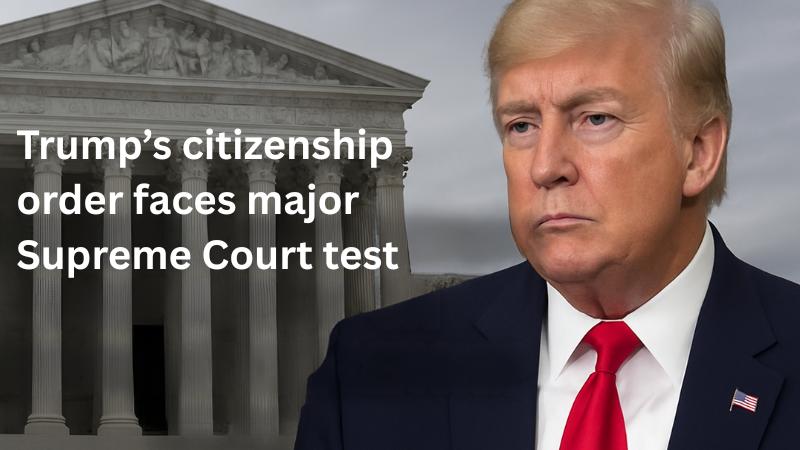
The Supreme Court is preparing for a closed-door conference on Friday to consider whether it will take up a major dispute over President Donald Trump’s birthright citizenship order. The order, issued on the first day of his second term, declares that children born in the United States to parents who are in the country illegally or temporarily are not entitled to American citizenship. Federal courts across the country have uniformly blocked the order, preventing it from taking effect in any state.
A decision on whether the justices will hear the case could come as early as Monday. If the court agrees to consider the matter, oral arguments would likely be scheduled for the spring, with a definitive ruling expected by early summer. The case marks the first time one of Trump’s major immigration policies has reached the court for a final judgment during his second term.
The birthright citizenship directive is one pillar of the administration’s broader immigration strategy, which also includes enforcement surges in several cities and the unprecedented peacetime use of the 18th-century Alien Enemies Act. These actions have triggered multiple legal challenges, and the Supreme Court has issued mixed signals through its emergency orders. In one instance, the justices halted the use of the Alien Enemies Act to quickly deport individuals alleged to be Venezuelan gang members without hearings. In another, they allowed the reinstatement of wide-ranging immigration stops in the Los Angeles area after a lower court blocked the practice of targeting individuals based solely on factors such as race, language or location.
The court is also considering the administration’s emergency request to deploy National Guard troops in the Chicago area to support immigration enforcement operations. A lower court previously barred the deployment indefinitely, prompting the government’s appeal.
Lower courts have consistently ruled against the birthright citizenship order, determining that it violates or is likely to violate the 14th Amendment. That amendment, adopted after the Civil War, ensures citizenship for nearly all individuals born on U.S. soil, with limited exceptions such as the children of foreign diplomats. Judges have rejected the administration’s argument that children of noncitizens are not “subject to the jurisdiction” of the United States and therefore do not qualify for citizenship.
In July, the U.S. Court of Appeals for the 9th Circuit upheld a nationwide injunction sought by a coalition of states, concluding that inconsistent enforcement across states would create significant legal and practical problems. That same month, a federal judge in New Hampshire blocked the policy in a class-action case covering all children who would be affected. The legal team leading the New Hampshire case urged the Supreme Court to decline the administration’s appeal, arguing that the government’s position lacks constitutional foundation.
Despite a recent Supreme Court decision limiting the use of nationwide injunctions, the justices left open the possibility of other forms of judicial relief with nationwide impact, particularly in class-action cases or lawsuits brought by states. They did not weigh in on the constitutionality of the citizenship order itself, leaving that question for a future case — potentially this one.
Solicitor General D. John Sauer argued in the government’s filing that the lower court decisions undermine border security and improperly extend U.S. citizenship to individuals he described as unqualified. The administration insists that the long-standing interpretation of the 14th Amendment is overly broad and that the president has the authority to redefine eligibility.
As the justices consider whether to intervene, the future of the administration’s most controversial citizenship initiative hangs on their decision. A ruling to hear the case would set up one of the most significant constitutional debates of the term, while a refusal would leave the lower court decisions in place and the birthright citizenship order unenforceable nationwide.