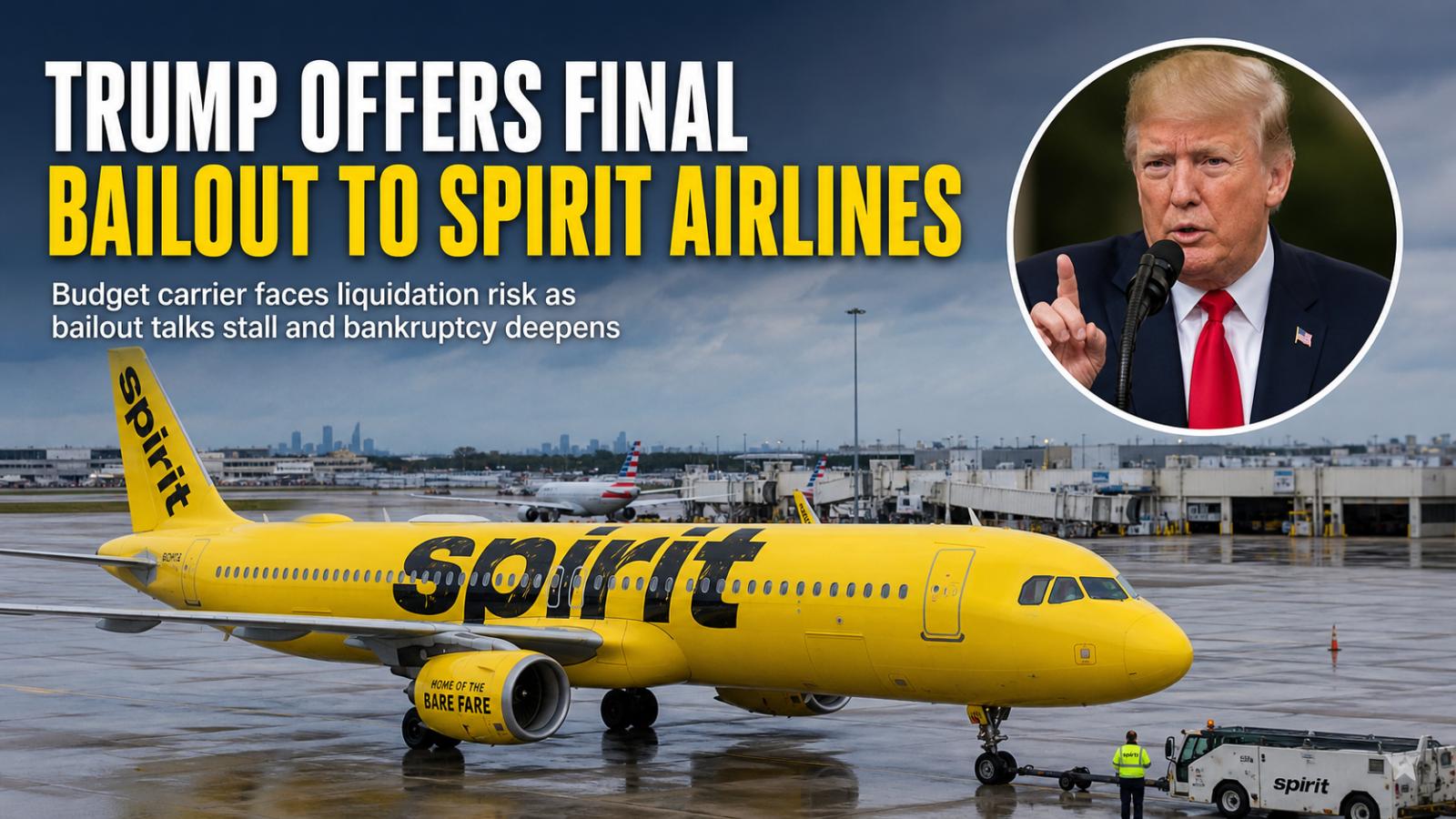
President Donald Trump said on Friday, May 1, 2026, that his administration had delivered a “final” bailout proposal to Spirit Airlines as the budget airline faces the possibility of liquidation without immediate financial support. Speaking to reporters at the White House, Trump emphasized that any agreement would depend on whether it represents a viable deal, signaling urgency as negotiations continue.
Negotiations stall amid mounting financial pressure
Talks between the administration and the airline’s bondholders during the week leading up to Friday, May 1, 2026, failed to produce an agreement. The administration had previously proposed a $500 million loan that could have given the federal government as much as a 90% ownership stake in the Florida-based carrier. Sources familiar with the discussions indicated that negotiations have been complicated by disagreements over terms and valuation.
Officials from the White House, the Department of Transportation, and the Commerce Department did not immediately respond to requests for comment, adding to uncertainty surrounding the airline’s future.
Bankruptcy concerns deepen as cash reserves shrink
Spirit Airlines declined to comment on potential liquidation scenarios. However, during a hearing on Wednesday, April 23, 2026, in a New York bankruptcy court, the airline’s attorney, Marshall Huebner, warned that the company’s available cash is rapidly diminishing and may not sustain operations for long.
The airline is navigating its second bankruptcy filing in less than a year, further complicated by rising jet fuel prices linked to geopolitical tensions in the Middle East. These cost pressures have intensified the financial strain on the low-cost carrier.
Airlines prepare contingency plans for disruptions
Major U.S. carriers are preparing for potential fallout if Spirit ceases operations. United Airlines said it is ready to assist affected passengers and employees, while American Airlines has introduced fare caps on routes where it competes directly with Spirit to accommodate displaced travelers. JetBlue Airways also indicated it would offer alternative travel options for impacted customers and crews.
Long-term challenges erode market position
Spirit Airlines, once a pioneer in the ultra-low-cost travel model, has struggled with rising operational costs, shifting consumer preferences, and technical setbacks such as engine recalls. A previously planned acquisition by JetBlue Airways was blocked by the Biden administration two years earlier, removing a potential path to stability.
According to aviation data firm Cirium, Spirit carried approximately 1.7 million domestic passengers in February 2026, representing a 3.9% share of the U.S. market. This marks a decline from 5.1% a year earlier, reflecting reduced flight capacity as the airline attempted to cut costs amid ongoing financial challenges.