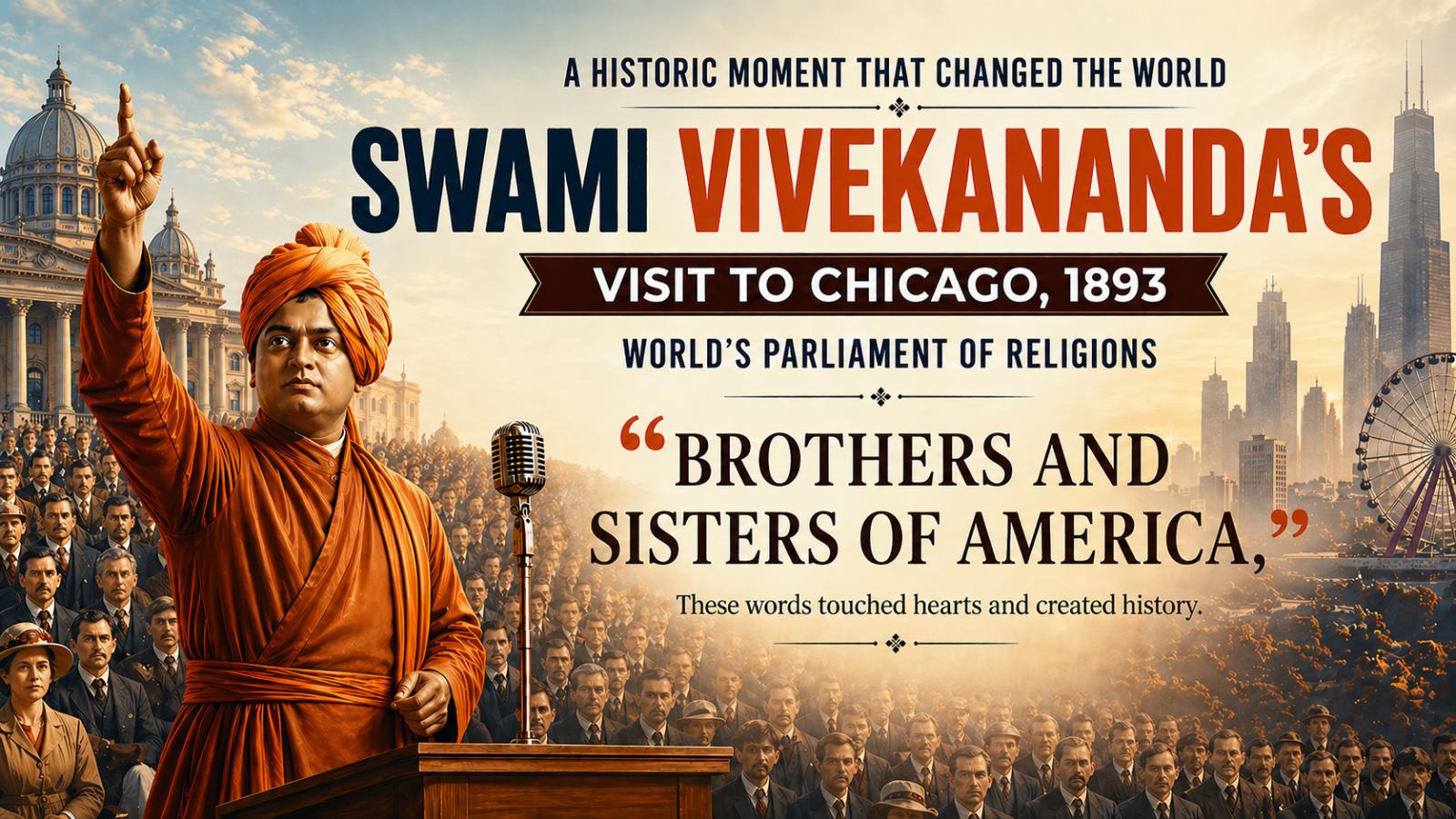
Swami Vivekananda’s visit to Chicago in 1893 remains a defining moment in the global exchange of spiritual and cultural ideas. He traveled to the United States to participate in the World’s Parliament of Religions, an international gathering held as part of the Columbian Exposition. His address on September 11, 1893, is widely remembered for its message of unity and universal acceptance.
Opening his speech with the now-famous greeting, “Brothers and Sisters of America,” Vivekananda immediately connected with the audience, receiving a prolonged standing ovation. His remarks emphasized the shared essence of all religions and advocated for tolerance, mutual respect, and compassion. He presented the principles of Vedanta and Yoga as paths toward understanding humanity’s deeper spiritual nature, highlighting that true religion transcends rigid doctrines.
The impact of his speech extended far beyond the event itself. Vivekananda’s ideas resonated strongly with American audiences, introducing many to Indian philosophical traditions for the first time. His teachings contributed to a broader awareness of Hinduism and helped establish a foundation for ongoing cultural and intellectual dialogue between India and the West.
In India, his legacy continues to inspire generations, particularly through the observance of National Youth Day on January 12, his birth anniversary. Declared by the Government of India in 1984, the day is marked by educational and cultural activities across schools and institutions. These events reflect Vivekananda’s enduring message of self-confidence, service, and the transformative power of knowledge.
Through his writings and lectures, inspired by his guru Ramakrishna Paramahansa, Vivekananda encouraged young people to pursue both personal growth and social responsibility. His influence remains significant today, as his vision of harmony and spiritual awareness continues to shape conversations on global unity and cultural understanding.


 Joyful
0%
Joyful
0%
 Cool
0%
Cool
0%
 Thrilled
0%
Thrilled
0%
 Upset
0%
Upset
0%
 Unhappy
0%
Unhappy
0%