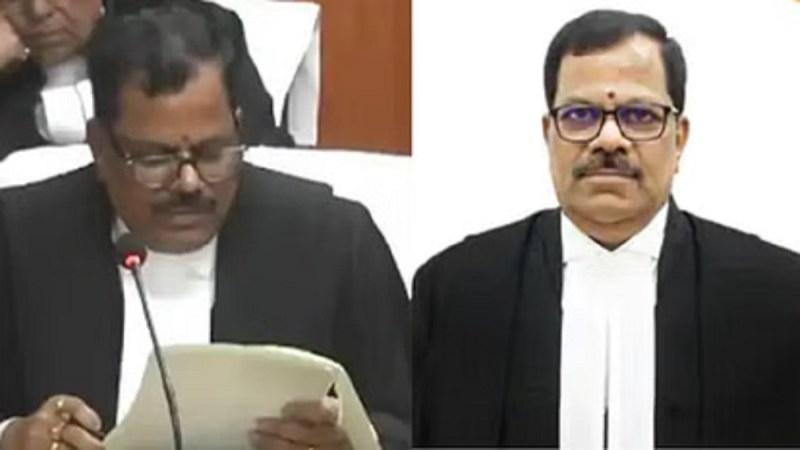
In a rare and deeply emotional farewell speech, Justice Duppala Venkata Ramana of the Madhya Pradesh High Court turned what is usually a moment of gratitude and closure into a powerful critique of India’s judicial system. As he demitted office on Tuesday, Justice Ramana delivered a speech marked by disillusionment, pain, and disappointment sentiments rarely voiced so publicly from the bench.
Referring to his controversial transfer from the Andhra Pradesh High Court to Madhya Pradesh, Justice Ramana stated that he was moved without justification and in disregard of his personal and family circumstances. He revealed that he had explicitly requested a transfer to Karnataka, citing his wife's severe neurological condition Paroxysmal Non-Epileptic Seizures (PNES) which required treatment available only at Bengaluru’s National Institute of Mental Health and Neurosciences (NIMHANS). Despite his repeated appeals submitted on July 19 and August 28, 2024, to the Supreme Court, his request was neither accepted nor rejected, leading to what he described as months of emotional and professional anguish.
“I was disheartened and deeply pained,” said Justice Ramana. “A judge like me expected at least humane consideration. But I received no response.” Though he acknowledged that the current Chief Justice of India B R Gavai may have been more receptive, Justice Ramana said that sympathy came "too late in the day."
Perhaps the most striking statement from his speech came when he said, “God does not forgive nor forget. They will also suffer in another mode,” alluding to those in the system who, in his view, deliberately caused him harm. He accused the system of "ill intention" and "harassment," suggesting that his transfer was part of a targeted effort against him. “I am happy to satisfy their ego. Now they are retired,” he added pointedly.
Despite the bitterness, his farewell remarks were not without reflection or dignity. A first-generation lawyer who began his career as a judicial second-class magistrate in 1994, Justice Ramana recalled the challenges he faced as he rose through the judiciary. He spoke about his life’s journey with humility, noting that “except hard work, there is no shortcut to success.” Quoting Martin Luther King Jr., he emphasized, “The ultimate measure of a man is not where he stands in moments of comfort, but where he stands at times of challenge and controversy.”
While Justice Ramana accused the system of overlooking compassion and fairness, he expressed gratitude for the support he received in Madhya Pradesh. He specifically mentioned the love and cooperation of his colleagues and the bar at Jabalpur and Indore.
“What was meant to rattle me did not. I did the opposite,” he said, affirming that he made lasting contributions in both Andhra Pradesh and Madhya Pradesh. He also celebrated his opportunity to serve in the culturally and historically rich regions of Amravati, Krishna, Godavari, and Narmada, saying he felt “blessed” for the experiences.
Justice Ramana reiterated that his judicial path had been filled with "struggles and bitter experiences" but insisted that “Satyamev Jayate truth always prevails.” His farewell, though deeply personal, raises broader questions about the opacity and perceived arbitrariness of judicial transfers in India. His speech is now resonating beyond the court, sparking public discourse on transparency, empathy, and accountability within the Indian judiciary. As Justice Ramana steps away from the bench, his parting message — one of injustice endured and dignity maintained lingers as both a personal testament and an institutional challenge.