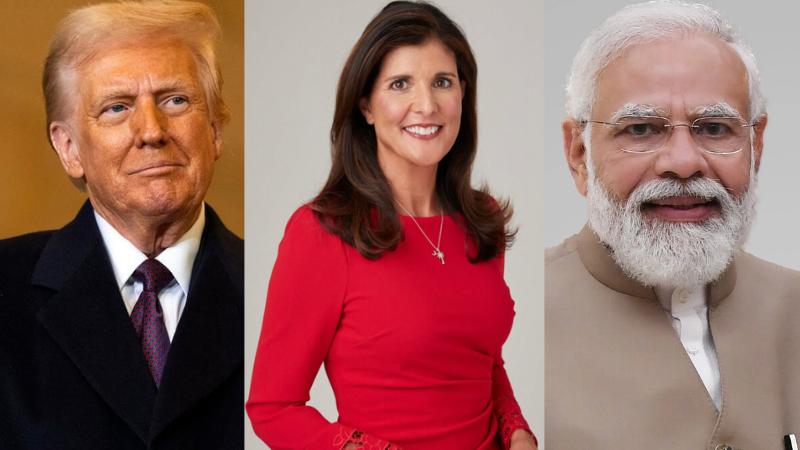
As tensions rise between India and the United States over trade and tariff disputes, former US Ambassador to the United Nations Nikki Haley has urged Washington not to jeopardize its long-standing relationship with New Delhi. Her comments followed President Donald Trump’s announcement of a 25 percent reciprocal tariff on Indian imports along with an additional 25 percent penalty tied to India’s continued energy trade with Russia. Haley emphasized that India must be treated as a friend and essential ally, particularly in countering what she referred to as the growing threat from Communist-led China.
Haley, who has long advocated for a stronger US-India partnership, cautioned against allowing short-term trade disputes to undermine decades of progress in bilateral ties. She recalled that for more than twenty-five years, both nations have invested significant political, economic, and security capital into building a relationship based on shared democratic values. According to her, reversing this progress would be a strategic blunder at a time when China continues to expand its influence across Asia and beyond.
In her remarks, Haley highlighted the imbalance in US foreign policy, where China continues to avoid meaningful sanctions despite being one of the largest buyers of Russian oil. She noted that pressuring India, a democratic country with transparent institutions, while exempting China only weakens the credibility of Washington’s global stance. She stressed that India is not a danger to the free world and instead serves as a critical pillar of stability in Asia, unlike China, which she described as authoritarian and expansionist in nature.
Haley also urged New Delhi to recognize President Trump’s concerns and work toward a middle ground on the Russian oil issue. She suggested that Trump should personally engage with Indian Prime Minister Narendra Modi to resolve differences through direct dialogue rather than punitive measures. Such talks, she argued, could not only de-escalate current tensions but also pave the way for deeper cooperation in energy security, defense, and trade.
The former ambassador underscored that India’s rapid economic growth makes it an indispensable partner in shaping the future global order. India is now the fastest-growing major economy in the world and is projected to surpass Japan in the coming years. This rise, Haley observed, poses a direct challenge to China’s ambitions of dominating the international system. She stated that as India gains more influence, it naturally curbs China’s ability to unilaterally dictate global trade and political trends.
Haley called on the United States to dedicate more resources and strategic focus to its relationship with India, similar to the level of attention given to partnerships with China and Israel. She described closer ties with New Delhi as a “no-brainer” for any American administration seeking to balance China’s growing assertiveness. Ignoring India or alienating it through tariffs and penalties, she warned, would only open the door for Beijing to strengthen its position at the expense of democratic allies.
Her statements also came amid broader criticism of the Trump administration’s trade policies toward India. Several officials within Washington had offered conflicting justifications for the tariffs, with some accusing New Delhi of aligning too closely with Beijing while others pointed to the Russia oil imports. Haley took a different stance, insisting that such double standards erode trust and risk creating divisions that adversaries like China can exploit.
On July 31, President Trump had declared a national emergency and imposed a new set of tariffs, including a 25 percent levy on Indian imports. This was in addition to another 25 percent penalty specifically targeting India for its Russian energy purchases. The measures were introduced after a pause that gave countries ninety days to negotiate alternative trade deals with Washington. India responded cautiously, with its Ministry of External Affairs stating that energy imports were necessary to ensure affordability and stability in global market conditions.
Haley concluded her remarks by cautioning both sides against letting the dispute escalate further. She said that the US-India partnership has far too much strategic significance to be derailed by disagreements over trade and energy policy. For Washington, she argued, India represents not only a reliable economic partner but also a powerful ally in the global effort to contain China’s influence. For New Delhi, closer ties with the United States provide security and economic benefits that are vital for sustaining its growth trajectory.
The ongoing tariff war, however, continues to cast uncertainty over the relationship. Haley’s intervention has added weight to the argument that both sides must step back from confrontation and instead engage in constructive dialogue. With India emerging as a global economic powerhouse and China positioning itself as America’s primary competitor, the stakes for both nations remain extremely high. In Haley’s view, the only sensible path forward lies in strengthening, not straining, the US-India partnership.