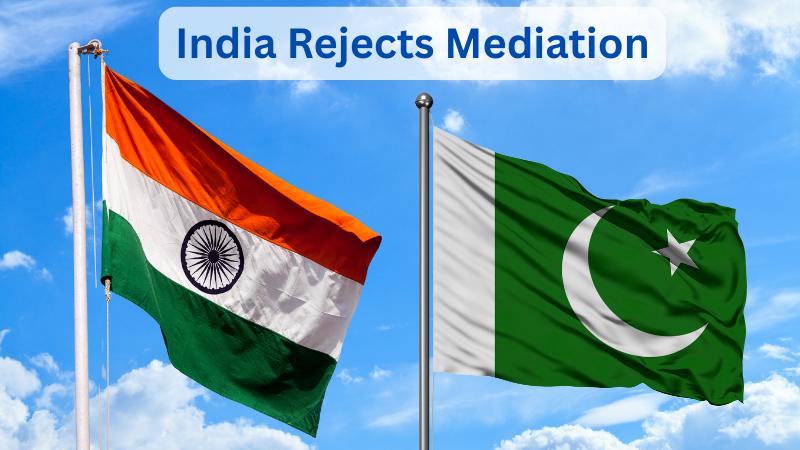
In a rare and significant admission, Pakistan’s Foreign Minister Ishaq Dar has publicly stated that India has never agreed to third-party mediation on bilateral disputes, reaffirming New Delhi’s long-standing position that issues between the two countries must be addressed directly. His comments, made during an interview, come at a time when US President Donald Trump has repeatedly claimed credit for mediating a ceasefire between India and Pakistan following Operation Sindoor, an operation launched by India in response to the Pahalgam terror attack.
Dar’s remarks carry weight because they highlight a divergence between Islamabad’s public statements in the past and the reality conveyed in diplomatic conversations. According to Dar, during his meeting with US Secretary of State Marco Rubio in Washington on July 25, he was clearly told that India insists on treating all matters — whether concerning Jammu and Kashmir, terrorism, trade, economy, or even the Indus Waters Treaty — as bilateral issues. Dar admitted that while Pakistan remains open to both bilateral and third-party dialogue, India has categorically stated it will only engage bilaterally.
This admission directly undermines claims by Trump that he personally brokered peace between the two nations by using trade pressure. Dar himself confirmed that after Operation Sindoor heightened tensions in May, it was the Pakistani Director General of Military Operations (DGMO) who contacted his Indian counterpart to request a ceasefire. The ceasefire understanding, according to Dar, was therefore reached at the DGMO level between the two countries themselves. “It takes two to tango. Unless India wishes to have a dialogue, we cannot force it,” Dar said, underscoring Pakistan’s limitations in pushing forward any talks without New Delhi’s willingness.
Operation Sindoor was launched by India after terrorists carried out an attack in Pahalgam, Jammu and Kashmir, leading to significant casualties. In retaliation, India targeted multiple terror camps across the border, reportedly eliminating around 100 militants. The strikes escalated tensions sharply between the two nuclear-armed neighbors. For two days, hostilities flared, raising fears of a larger conflict. However, communication at the DGMO level eventually helped restore a fragile ceasefire. India has consistently maintained that this understanding was purely bilateral, achieved without any external mediation.
Trump, on multiple occasions, asserted that he stepped in to convince India and Pakistan to halt hostilities, even suggesting that his intervention prevented a potential nuclear confrontation. He claimed that trade negotiations and leverage were used to pressurize the sides into peace. Yet, both India and now Pakistan have made clear that his claims do not reflect the reality of events. India’s Ministry of External Affairs categorically rejected the idea of US mediation, insisting that while calls were indeed received from US Vice President JD Vance and Secretary of State Rubio, Washington was informed that any ceasefire request must originate from Islamabad. It was only after this that the Pakistani DGMO initiated contact with the Indian DGMO.
Dar’s acknowledgment, therefore, strengthens India’s position that all outcomes following Operation Sindoor were the result of direct engagement between the two countries. The statement also carries implications for broader issues such as the Indus Waters Treaty, which India has long maintained must be handled through established bilateral mechanisms without third-party interference. By conceding that India has never shifted from this position, Pakistan’s foreign minister has inadvertently reaffirmed India’s diplomatic consistency on the matter.
For Pakistan, the admission also reflects a pragmatic acceptance of geopolitical realities. While Islamabad has historically sought international intervention, particularly regarding Jammu and Kashmir, repeated refusals from India and lack of tangible results have pushed Pakistani officials to acknowledge the limits of such an approach. Dar’s statement that Pakistan does not mind bilateral talks but that India has refused to respond highlights the ongoing stalemate. He also reiterated Pakistan’s openness to dialogue on all issues, but stressed that Islamabad cannot impose negotiations unilaterally.
The larger backdrop to this episode remains the fragile security environment in South Asia, where frequent escalations threaten regional peace. The Pahalgam attack and India’s response through Operation Sindoor are reminders of how quickly violence can spiral. The subsequent diplomatic exchanges also underscore the sensitivity surrounding narratives of mediation and the political stakes attached to claims of credit. Trump’s repeated assertions may have been aimed at showcasing his global influence, but both India and Pakistan’s positions now stand aligned in rejecting the idea of US mediation in that particular crisis.
Going forward, the admission by Dar may reset expectations in Pakistan regarding future engagement with India. With both countries maintaining hardened stances, the prospects of comprehensive dialogue remain uncertain. For India, the episode validates its consistent diplomatic position that external involvement is unnecessary and counterproductive. For Pakistan, it reflects the challenge of balancing internal expectations with external realities.
Ultimately, the events around Operation Sindoor and its aftermath reaffirm the entrenched positions of both nations. While temporary ceasefires and crisis management may succeed at the military-to-military level, the larger disputes remain unresolved. Dar’s admission that India never accepted third-party mediation reinforces a truth long emphasized by New Delhi and now reluctantly echoed by Islamabad itself, placing the onus squarely on both sides to find their way forward bilaterally, should they ever choose to engage again.