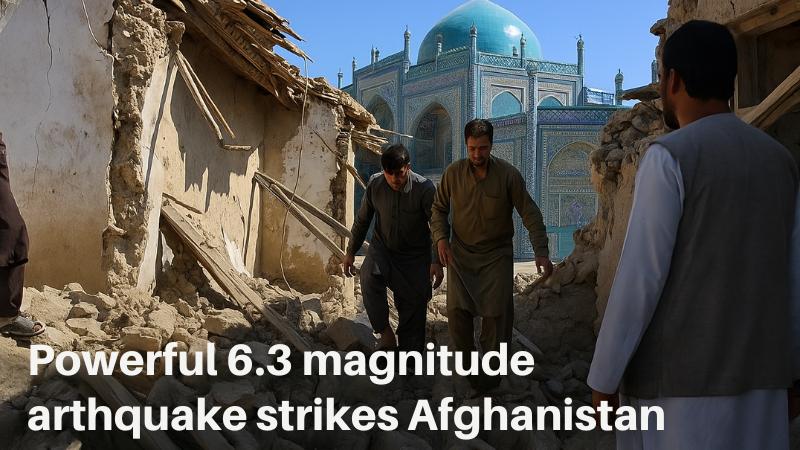
At least seven people have been confirmed dead and more than 150 injured after a powerful earthquake measuring 6.3 on the Richter scale struck northern Afghanistan on Monday. The tremor, which originated near Mazar-e-Sharif, caused significant structural damage and panic among residents, highlighting once again the country's extreme vulnerability to seismic disasters.
According to the United States Geological Survey (USGS), the earthquake occurred at a depth of 28 kilometers beneath the surface, with its epicenter located near Mazar-e-Sharif, one of Afghanistan’s largest and most populous cities. Home to over half a million people, the city witnessed widespread tremors that shook homes, markets, and public buildings. Several residents ran into the streets in fear as aftershocks continued to rattle the region in the hours following the initial quake.
Provincial officials confirmed the scale of the tragedy early Tuesday. “A total of 150 people injured and seven martyred have been reported and transferred to health centers as of this morning,” said Samim Joyanda, spokesperson for the health department in Samangan province, which borders the quake-hit region. Emergency medical teams were dispatched to remote areas to assist victims who could not reach hospitals on their own.
Among the affected sites was one of Afghanistan’s most revered landmarks — the holy shrine of Mazar-i-Sharif, also known as the Blue Mosque. Haji Zaid, a spokesperson for the Balkh provincial administration, said parts of the structure were damaged during the quake. The shrine, known for its striking blue-tiled dome and centuries-old Islamic architecture, draws thousands of pilgrims and tourists every year. Local authorities have begun an assessment to determine the extent of the structural damage to the site.
Rescue and relief operations are ongoing, with provincial and national emergency teams coordinating efforts to reach the affected communities. Hospitals in Mazar-e-Sharif and neighboring provinces have been placed on high alert to accommodate the influx of casualties. While initial reports indicate that most injuries were caused by falling debris, some rural villages closer to the epicenter may have suffered heavier losses that have yet to be documented.
The quake’s impact adds to a long list of devastating seismic events that have struck Afghanistan in recent years. The country sits atop several major fault lines, making it one of the most earthquake-prone regions in Asia. Its mountainous northern and eastern areas, where tectonic plates converge, are particularly susceptible to tremors that often lead to extensive loss of life and property.
In August 2025, a magnitude 6.0 earthquake struck eastern Afghanistan near the Pakistan border, killing more than 2,200 people, according to official figures. Another major quake of similar magnitude in October 2023 left more than 4,000 people dead and thousands homeless. Humanitarian agencies have repeatedly warned that Afghanistan’s fragile infrastructure, coupled with limited emergency response resources, leaves millions of residents at heightened risk whenever such natural disasters occur.
The Afghan Red Crescent Society, which continues to provide assistance in areas still recovering from earlier earthquakes, has appealed for additional international support to manage the latest crisis. Preliminary reports from the agency suggest that temporary shelters, food supplies, and medical aid are urgently needed, especially in rural parts of Balkh and Samangan provinces where access remains difficult due to damaged roads.
Seismologists have warned that aftershocks may continue over the next few days, urging residents to remain cautious and avoid unstable structures. Authorities have also initiated a review of building safety measures in the northern provinces to reduce future risks. Despite these efforts, Afghanistan’s ongoing economic challenges and limited infrastructure funding remain significant obstacles to effective disaster preparedness.
The Monday earthquake stands as yet another reminder of the persistent seismic threat facing Afghanistan, where decades of conflict and poverty have left much of the population vulnerable. As emergency teams race to provide aid and restore stability, the focus now turns to rebuilding not just damaged structures, but also the resilience of communities repeatedly tested by nature’s destructive force.