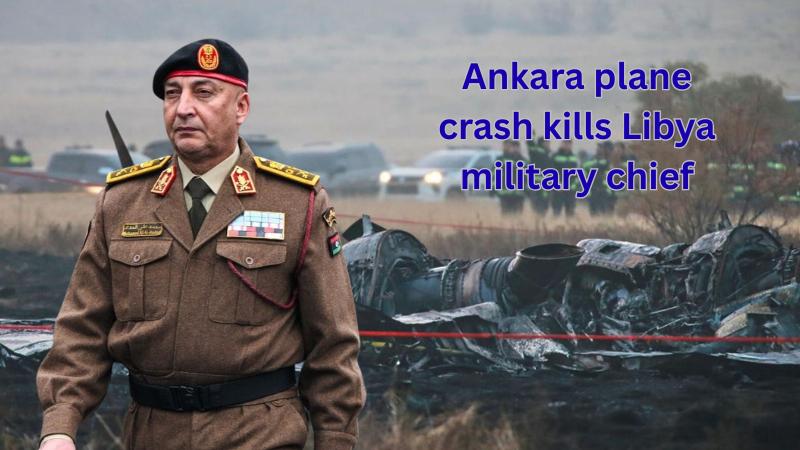
A tragic aviation accident in Turkey has claimed the lives of Libya’s top military commander and seven others after a private jet crashed shortly after taking off from the capital city, Ankara. The incident occurred soon after the aircraft departed Esenboga Airport, bringing a sudden and devastating end to a diplomatic visit aimed at strengthening defence cooperation between Libya and Turkey.
Libyan officials confirmed that the deceased included Gen. Muhammad Ali Ahmad al-Haddad, the country’s Chief of the General Staff, along with four senior military officers and three crew members. The aircraft, identified as a Falcon 50 business jet, reportedly suffered a technical malfunction during the early phase of its flight. Contact with air traffic control was lost roughly 30 to 40 minutes after takeoff, prompting immediate concern and emergency response measures.
According to Turkish authorities, the jet took off at approximately 8:30 pm local time. Moments later, the crew issued an emergency signal indicating a potential landing attempt near Haymana, a district located south of Ankara. Shortly thereafter, all communication with the aircraft ceased. Security camera footage aired on Turkish television later showed a sudden flash lighting up the night sky, suggesting a possible mid-air explosion or catastrophic failure before impact.
The Libyan delegation had been in Ankara for high-level defence talks focused on enhancing military coordination and cooperation between the two countries. During the visit, Gen. al-Haddad met senior Turkish officials, including Defence Minister Yasar Guler. The meetings were part of ongoing diplomatic and military engagements between Libya and Turkey, which has played a key role in supporting Libya’s western-based authorities.
Libya’s Prime Minister Abdul-Hamid Dbeibah confirmed the deaths in a statement, describing the crash as a tragic accident and a profound loss for the nation. He paid tribute to Gen. al-Haddad’s role in leading Libya’s military in the west and his contributions to United Nations-backed efforts to reunify the country’s fractured armed forces after years of conflict.
Details of those killed alongside al-Haddad were also released by Libyan officials. They included Gen. Al-Fitouri Ghraibil, head of Libya’s ground forces, Brig. Gen. Mahmoud Al-Qatawi, who led the military manufacturing authority, Mohammed Al-Asawi Diab, an adviser to the chief of staff, and Mohammed Omar Ahmed Mahjoub, a military photographer attached to the chief of staff’s office. The identities of the three crew members were not immediately disclosed.
Rescue teams from Turkey were deployed swiftly after the crash, and wreckage of the aircraft was later located in a remote area south of Ankara. While authorities initially refrained from officially confirming fatalities, the absence of survivors became clear as the investigation progressed. Ankara’s airport operations were temporarily disrupted following the incident, with several flights diverted as a precaution.
Turkey’s Justice Ministry announced that four prosecutors have been appointed to investigate the crash, following standard aviation accident procedures. Interior Minister Ali Yerlikaya confirmed that authorities are examining technical, mechanical, and operational factors to determine the exact cause of the disaster. Libyan officials have indicated that early assessments point to a technical malfunction, though investigators have not ruled out other possibilities.
The death of Gen. al-Haddad marks a significant blow to Libya’s military leadership and comes at a sensitive time for the country’s political and security landscape. As investigations continue, both Libyan and Turkish authorities have pledged full cooperation to establish the circumstances behind the crash. The incident has drawn international attention, highlighting the risks associated with high-level diplomatic travel and the ongoing challenges in ensuring aviation safety amid increasingly complex air traffic environments.