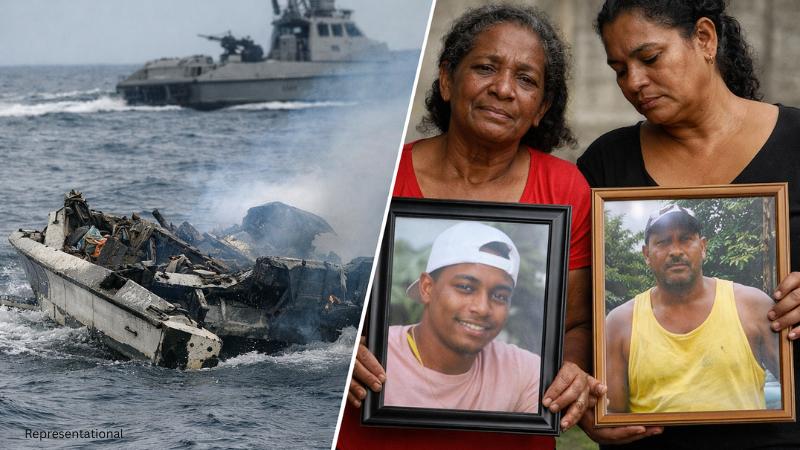
Family members of two Trinidadian men killed during a U.S. military strike on a boat in the Caribbean Sea have filed a federal lawsuit accusing the United States government of wrongful death and unlawful killings. The legal action, submitted Tuesday, challenges the legality of the strike and marks the first known case brought against the current administration over its expanded military campaign targeting suspected drug-smuggling vessels in the region.
The lawsuit centers on the deaths of Chad Joseph, 26, and Rishi Samaroo, 41, who were killed on Oct. 14 when a U.S. strike hit a boat traveling from Venezuela toward Trinidad and Tobago. According to court filings, the men had been working and fishing in Venezuela and were attempting to return home to the coastal community of Las Cuevas when the vessel was attacked. Family members maintain that neither man was involved in drug trafficking or any armed activity.
U.S. officials publicly stated after the operation that all six individuals on board were killed and described them as narcotics traffickers connected to a designated terrorist organization. The administration has said the strike was part of a broader campaign aimed at disrupting transnational drug smuggling routes in the Caribbean Sea and eastern Pacific Ocean. Defense officials have acknowledged that since early September, dozens of boats have been targeted, resulting in more than 100 fatalities.
Relatives of Joseph and Samaroo dispute the government’s account, arguing that the men were civilians engaged in lawful work and travel. The lawsuit states that neither family received official notification of the deaths and that both only learned of the incident after their relatives stopped making contact. Memorial services were later held after it became clear the men would not return.
The legal filing was submitted on behalf of Joseph’s mother and Samaroo’s sister, representing surviving family members. Attorneys involved argue that the Oct. 14 strike violated both U.S. and international law. The complaint cites the Death on the High Seas Act, which allows families to seek damages for wrongful deaths occurring beyond U.S. territorial waters, as well as the Alien Tort Statute, which permits foreign nationals to bring claims in U.S. courts for serious violations of international law.
Central to the case is the administration’s assertion that the United States is engaged in a non-international armed conflict with drug cartels, a position it has cited to justify the use of lethal military force against suspected smuggling boats. The lawsuit directly challenges that claim, arguing that no such armed conflict exists and that the laws of war do not apply to the operation that killed the two men.
The complaint characterizes the strike as a premeditated use of lethal force without legal justification and alleges that senior government officials authorized actions that resulted in the unlawful deaths of civilians. It further references statements from the government of Trinidad and Tobago indicating that authorities there had no information linking Joseph or Samaroo to illegal drugs, weapons, or organized criminal activity.
According to the lawsuit, both men were primary financial providers for their families. Joseph lived with his partner and three young children and frequently traveled between Trinidad and Venezuela for work. In the months before his death, he reportedly struggled to secure safe passage home and expressed fear following reports of U.S. strikes on boats in the region. His last contact with family came two days before the strike, when he said he had found a ride back to Trinidad.
Samaroo, who had previously worked in construction and farming, also traveled regularly to Venezuela for employment. Court filings acknowledge his past criminal conviction but state that he had completed his sentence and was attempting to rebuild his life through lawful work. His family says he remained in close contact until he suddenly disappeared.
Family members argue that if U.S. authorities believed either man had committed a crime, they should have pursued arrest and prosecution rather than lethal force. The lawsuit seeks accountability, transparency, and recognition of the men’s civilian status, while raising broader questions about the scope and oversight of U.S. military operations targeting suspected drug smuggling in international waters.