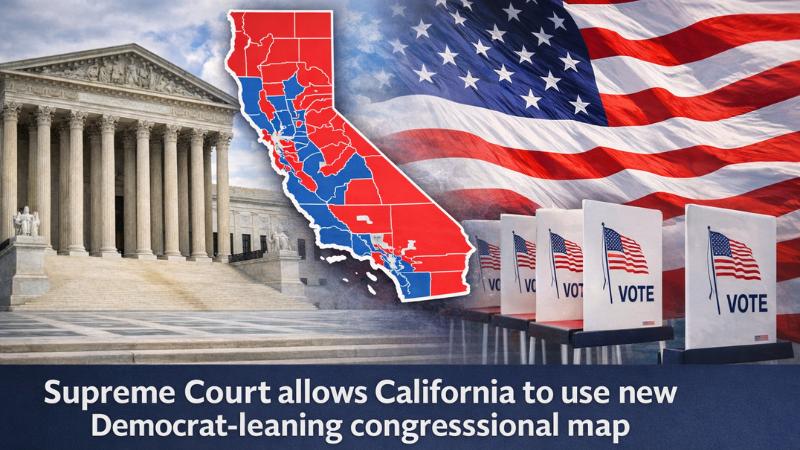
The Supreme Court has cleared the way for California to use a newly approved congressional map that is expected to benefit Democrats in upcoming elections, rejecting an emergency appeal filed by state Republicans and backed by the Trump administration. The unsigned order, issued without explanation and with no noted dissents, leaves intact district boundaries that could alter the balance of power in several closely contested House races as the country moves toward high-stakes midterm contests.
The decision allows California’s voter-approved redistricting plan to take effect immediately, just days before the state begins accepting candidate filings for congressional primaries. Political analysts say the revised map could shift as many as five seats currently held by Republicans, potentially strengthening Democratic prospects in a state that already leans heavily blue. The ruling comes amid an intensifying national redistricting fight, with both major parties seeking advantages through the once-a-decade process of redrawing congressional districts.
Governor Gavin Newsom, a Democrat widely viewed as a potential national contender in future elections, welcomed the outcome and framed it as a response to earlier partisan moves by Republicans in other states. In public remarks and social media posts, Newsom said the decision underscores California’s commitment to a map that reflects voter intent rather than political maneuvering. He argued that attempts to challenge the districts were part of a broader effort to undermine reforms aimed at fair representation, adding that the electorate, not legislative tactics alone, would determine the state’s political direction.
Republicans, however, contended that the California redistricting plan improperly relied on racial considerations when drawing boundaries, an argument they said violated federal protections. A lower court rejected those claims in a split ruling, concluding that the evidence did not demonstrate unlawful discrimination. The Supreme Court’s refusal to intervene leaves that decision in place and effectively ends the legal challenge for the current election cycle. The state party did not immediately issue a formal response following the order, though some Republican strategists warned the new lines could further shrink their already limited presence in the state’s congressional delegation.
The justices’ action also follows earlier litigation in Texas, where a Republican-favored map was permitted to proceed despite questions raised by a lower court about possible racial bias. In a prior opinion, Justice Samuel Alito observed that both states appeared to pursue political advantage through redistricting, a practice the court has generally said does not provide grounds for federal lawsuits. That reasoning has shaped recent disputes nationwide, where partisan mapmaking has become a defining feature of the political landscape.
As a result, California voters will head into the next election under new districts that could reshape local campaigns and national outcomes alike. Control of Congress remains closely divided, and even a handful of seats from a populous state such as California could prove decisive. The case highlights how redistricting, elections, and voting rules continue to influence the broader struggle between Democrats and Republicans, with each party seeking to maximize its chances in competitive districts.
With filing deadlines approaching and campaigns accelerating, candidates are adjusting their strategies to match the revised map. The Supreme Court’s decision ensures that those preparations will move forward without further legal uncertainty, setting the stage for a closely watched contest that could carry implications well beyond the state’s borders.