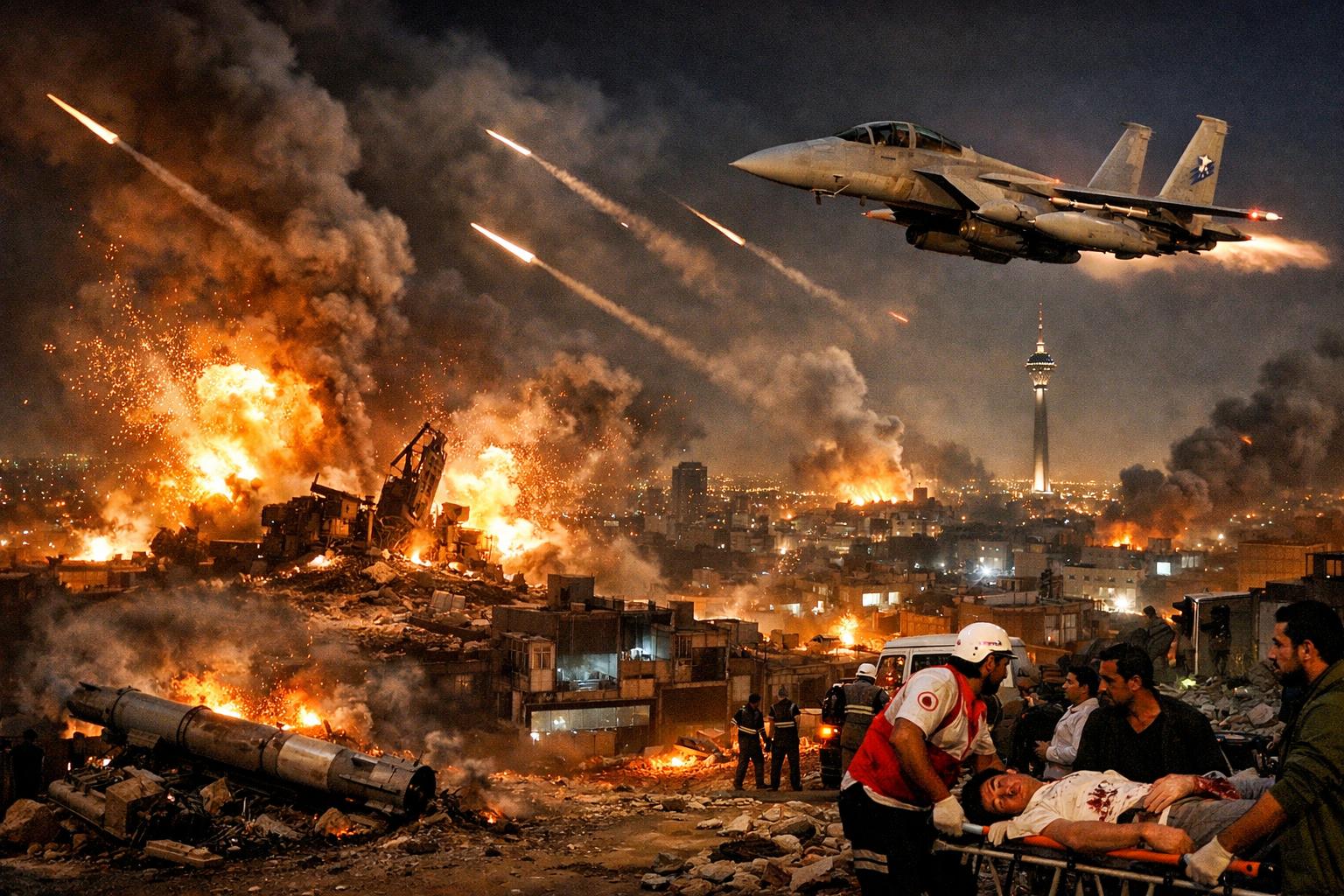
Israel has intensified its military campaign against Iran, announcing that more than 5,000 bombs have been dropped on targets across the country since the conflict began. The Israeli military said the operations are continuing to expand, with a strong focus on establishing and maintaining air superiority, particularly over the Tehran region. The announcement marks a significant escalation in hostilities, as the confrontation between the two regional powers enters its fifth day with mounting casualties and growing international concern.
In a statement posted on social media, the Israeli military said its fighter jets are deepening their operational reach across Iran, emphasizing strikes in and around the capital. It also released video footage that it claimed shows a targeted strike on an Iranian air defence system in the Tehran area. The visuals, circulated widely online, appear to show precision-guided munitions hitting what the military described as a strategic defensive installation. The move to publish footage is seen as part of a broader effort to demonstrate operational effectiveness and reinforce deterrence amid intensifying missile exchanges.
Military sources indicated that as of Tuesday, approximately 4,000 bombs had been deployed over four days, a figure that matched the total used during the entire 12-day conflict between the two sides in June 2025. By Wednesday, the number had surpassed 5,000, suggesting that Israeli forces are continuing to identify and engage high-value targets inside Iranian territory. Officials signaled that the pace of operations reflects both strategic intent and sufficient munitions capacity, countering speculation about potential supply constraints.
Earlier in the campaign, the Israel Defense Forces said it had destroyed Ghadr-class ballistic missiles and their launch platforms in Isfahan. The Ghadr 110, described as the most advanced variant in the Ghadr missile family, is a two-stage ballistic missile equipped with a solid-fuel engine. The use of solid fuel significantly reduces launch preparation time, making the system harder to detect and neutralize before firing. By targeting these missile systems, Israel appears to be aiming to degrade Iran’s medium-range strike capabilities and limit retaliatory fire toward Israeli territory.
Iran, meanwhile, reported heavy casualties as the fighting continues. Authorities in Tehran said that 1,045 people have been killed across the country since Saturday as a result of the ongoing hostilities. The figures have not been independently verified, but they underscore the scale of destruction resulting from the sustained air campaign. Civilian infrastructure in several regions has reportedly been damaged, adding to humanitarian concerns as emergency services struggle to respond amid continued strikes.
On the Israeli side, the country’s national emergency service confirmed that at least 10 people have been killed by Iranian missile attacks. Air raid sirens have repeatedly sounded across multiple cities, sending residents into shelters as missile exchanges intensify. The conflict has disrupted daily life, forced temporary closures of schools and businesses, and placed additional strain on emergency response systems.
The joint US-Israeli military operation against Iran, now in its fifth day, has triggered a sharp escalation across West Asia. The sustained exchange of air and missile strikes has heightened fears of a broader regional conflict involving additional state and non-state actors. Political leaders across the region are closely monitoring developments, while global markets have reacted nervously to the prospect of prolonged instability in a strategically vital area for energy supplies and international trade.
As both sides continue to trade strikes, diplomatic efforts to de-escalate the situation appear limited. The expanding scale of military operations, rising death tolls, and the targeting of advanced missile systems point to a confrontation that is becoming increasingly entrenched. With air superiority battles unfolding over key Iranian cities and missile defenses tested across Israel, the conflict shows little immediate sign of slowing, raising concerns about the long-term security and humanitarian consequences for the wider region.
In a statement posted on social media, the Israeli military said its fighter jets are deepening their operational reach across Iran, emphasizing strikes in and around the capital. It also released video footage that it claimed shows a targeted strike on an Iranian air defence system in the Tehran area. The visuals, circulated widely online, appear to show precision-guided munitions hitting what the military described as a strategic defensive installation. The move to publish footage is seen as part of a broader effort to demonstrate operational effectiveness and reinforce deterrence amid intensifying missile exchanges.
Military sources indicated that as of Tuesday, approximately 4,000 bombs had been deployed over four days, a figure that matched the total used during the entire 12-day conflict between the two sides in June 2025. By Wednesday, the number had surpassed 5,000, suggesting that Israeli forces are continuing to identify and engage high-value targets inside Iranian territory. Officials signaled that the pace of operations reflects both strategic intent and sufficient munitions capacity, countering speculation about potential supply constraints.
Earlier in the campaign, the Israel Defense Forces said it had destroyed Ghadr-class ballistic missiles and their launch platforms in Isfahan. The Ghadr 110, described as the most advanced variant in the Ghadr missile family, is a two-stage ballistic missile equipped with a solid-fuel engine. The use of solid fuel significantly reduces launch preparation time, making the system harder to detect and neutralize before firing. By targeting these missile systems, Israel appears to be aiming to degrade Iran’s medium-range strike capabilities and limit retaliatory fire toward Israeli territory.
Iran, meanwhile, reported heavy casualties as the fighting continues. Authorities in Tehran said that 1,045 people have been killed across the country since Saturday as a result of the ongoing hostilities. The figures have not been independently verified, but they underscore the scale of destruction resulting from the sustained air campaign. Civilian infrastructure in several regions has reportedly been damaged, adding to humanitarian concerns as emergency services struggle to respond amid continued strikes.
On the Israeli side, the country’s national emergency service confirmed that at least 10 people have been killed by Iranian missile attacks. Air raid sirens have repeatedly sounded across multiple cities, sending residents into shelters as missile exchanges intensify. The conflict has disrupted daily life, forced temporary closures of schools and businesses, and placed additional strain on emergency response systems.
The joint US-Israeli military operation against Iran, now in its fifth day, has triggered a sharp escalation across West Asia. The sustained exchange of air and missile strikes has heightened fears of a broader regional conflict involving additional state and non-state actors. Political leaders across the region are closely monitoring developments, while global markets have reacted nervously to the prospect of prolonged instability in a strategically vital area for energy supplies and international trade.
As both sides continue to trade strikes, diplomatic efforts to de-escalate the situation appear limited. The expanding scale of military operations, rising death tolls, and the targeting of advanced missile systems point to a confrontation that is becoming increasingly entrenched. With air superiority battles unfolding over key Iranian cities and missile defenses tested across Israel, the conflict shows little immediate sign of slowing, raising concerns about the long-term security and humanitarian consequences for the wider region.