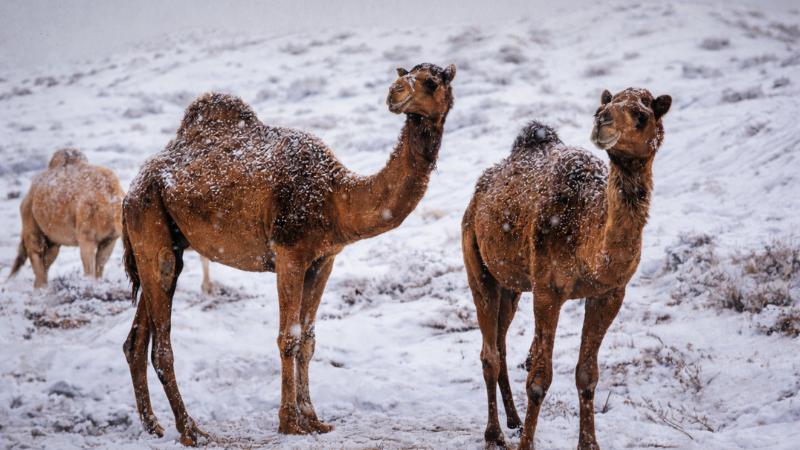
Snowfall in Saudi Arabia is an exceptionally rare event, but what unfolded this winter across parts of the kingdom’s northern desert regions has raised global concern. Areas such as Tabuk and nearby mountainous zones witnessed temperatures plunge below normal, desert hills coated in snow, and official weather alerts issued for conditions usually associated with colder climates. While the visuals of camels walking across snow-covered sands captured global attention, the deeper message behind the phenomenon is far more serious.
The snowfall was not merely an isolated weather oddity. Scientists and climate experts view it as another sign that the Earth’s climate system is undergoing fundamental and destabilising changes. As global temperatures rise, atmospheric patterns are becoming more erratic, leading to extreme weather events in places where they were historically unheard of. The Saudi desert snowfall underscores how climate change is no longer a distant forecast but a present-day reality unfolding in unpredictable ways.
A common misconception about climate change is that it simply means rising temperatures everywhere. In reality, global warming disrupts long-established weather systems by increasing the amount of heat and moisture the atmosphere can hold. This added energy destabilises jet streams, alters wind patterns, and increases the likelihood of sudden and severe weather swings.
This explains why the world is witnessing intense heatwaves, extreme rainfall, flash floods, and unexpected cold spells in regions unaccustomed to such conditions. India has experienced these changes first-hand. The country saw record-breaking heatwaves across northern and central regions, followed by destructive cloudbursts in states such as Uttarakhand, Himachal Pradesh, and Sikkim. Erratic monsoon behaviour caused drought-like conditions in some areas while triggering deadly floods in others. These events are not random; they are symptoms of a climate system under growing stress.
For India, the snowfall in Saudi Arabia is not about fearing snowstorms in deserts but recognising the broader implications of a rapidly changing climate. India’s agriculture, water resources, urban infrastructure, and energy demand are all deeply dependent on predictable seasonal patterns. When these patterns break down, the consequences cascade across the economy and society.
Crop failures, urban flooding, heat-related illnesses, power shortages, and water scarcity are becoming more frequent as climate volatility increases. The need for adaptation is now urgent. This includes climate-resilient urban planning, stronger early warning systems, flood-resistant infrastructure, improved water management, and climate-smart farming practices. While reducing emissions remains essential, adapting to inevitable climate impacts has become unavoidable.
Saudi Arabia’s rare snowfall should not be dismissed as a viral curiosity. It is part of a broader pattern affecting much of the Global South, where dense populations, fragile infrastructure, and climate-dependent livelihoods make societies especially vulnerable. From flooding in Southeast Asia to droughts and erratic rainfall in Africa and temperature extremes in South America, developing regions are increasingly on the frontlines of the climate crisis. The message is clear and increasingly urgent. Climate change is no longer a future threat waiting on the horizon. It is already reshaping lives, economies, and ecosystems, and countries like India must act decisively to prepare for a more volatile and unforgiving climate reality.