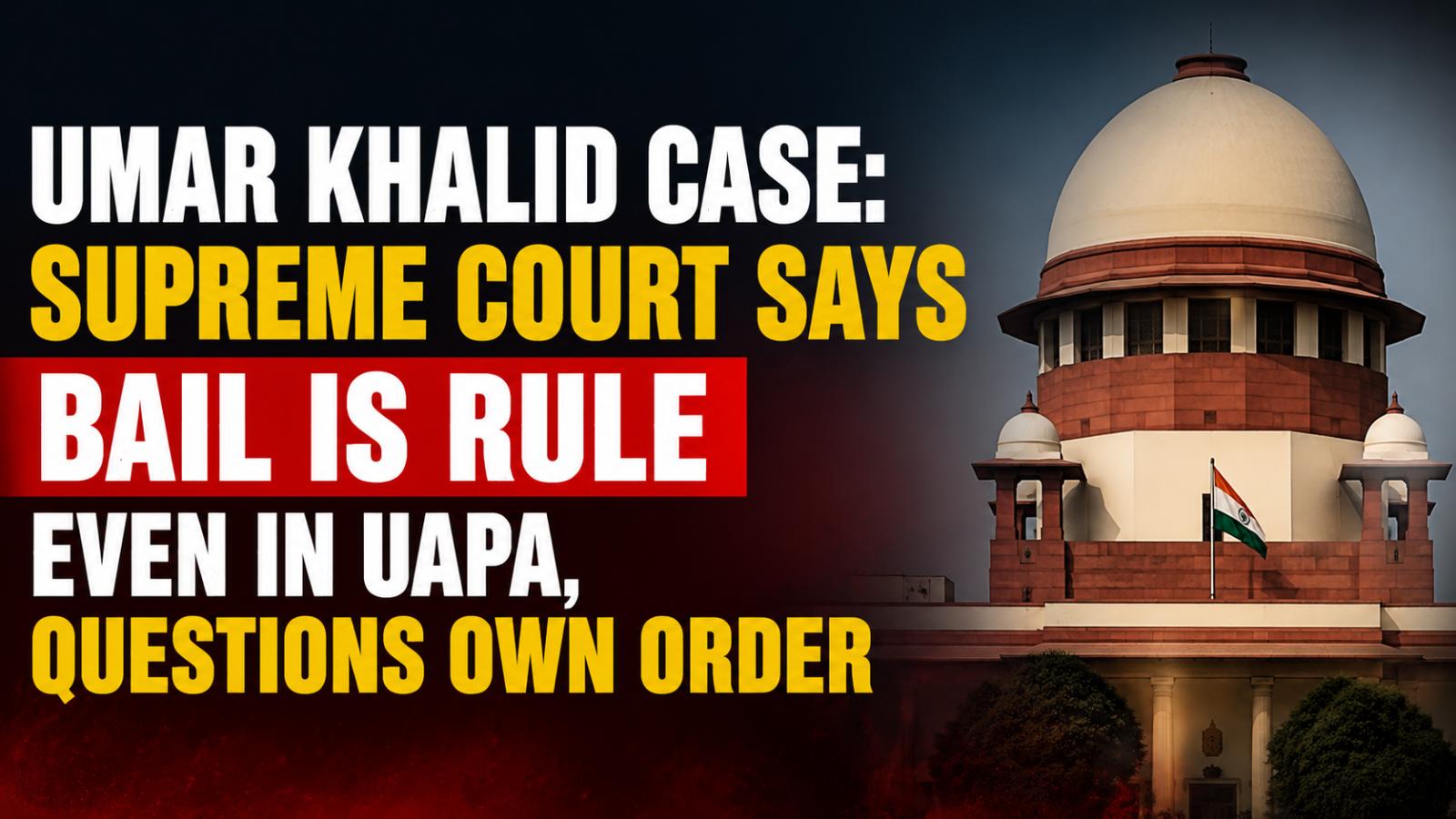
Supreme Court Questions Umar Khalid Bail Order in Major UAPA Observation
In a significant legal development with potential nationwide implications, the Supreme Court on Monday observed that the long-established legal principle of “bail is the rule and jail is the exception” remains applicable even in cases registered under the stringent Unlawful Activities (Prevention) Act (UAPA). The court also raised serious concerns over its own earlier order denying bail to former Jawaharlal Nehru University student leader Umar Khalid in the 2020 Delhi riots conspiracy case.
The observations came during a hearing involving another UAPA accused, Syed Iftikhar Andrabi, who has spent more than six years in jail in a terror funding case linked to narcotics trafficking. While granting bail to Andrabi, a bench comprising Justice BV Nagarathna and Justice Bhuyan underlined that constitutional protections under Article 21 cannot be ignored merely because a case falls under anti-terror laws.
The Supreme Court’s remarks are being viewed as a major shift in the ongoing debate surrounding prolonged incarceration under the UAPA, especially in cases where trials continue for years without conclusion. Legal experts believe the latest observations could influence several pending bail petitions in high-profile cases connected to the 2020 Delhi riots conspiracy investigation.
The court noted that a landmark 2021 ruling in Union of India vs KA Najeeb had already established that prolonged pre-trial detention and denial of speedy trial can justify granting bail even under the UAPA. However, the bench said this precedent was not properly applied while rejecting Umar Khalid’s bail plea earlier this year.
Justice Bhuyan observed that judicial discipline requires smaller benches to follow decisions delivered by larger benches of the Supreme Court. He stated that if any disagreement exists, the matter must be referred to a larger bench instead of bypassing or diluting the earlier ruling. The court specifically referred to the January 2026 order in which a two-judge bench denied bail to Umar Khalid and activist Sharjeel Imam.
The bench stated that it found it difficult to accept the legal reasoning adopted in both the Umar Khalid case and another UAPA matter involving Gurwinder Singh. According to the court, those judgments interpreted bail provisions in a way that departed from the constitutional principles recognised in the 2021 KA Najeeb ruling.
Supreme Court Reaffirms Article 21 Protections
The Supreme Court strongly emphasised that stringent provisions under Section 43D(5) of the UAPA cannot automatically override the constitutional right to personal liberty guaranteed under Article 21. The bench clarified that courts should not mechanically deny bail simply because charges have been framed under anti-terror legislation.
The judges warned against approaches that could effectively convert pre-trial detention into punishment without conviction. Referring to the “two-prong test” used in earlier cases, the court criticised the idea that bail can only be granted if an accused first proves that the prosecution’s case lacks merit at a preliminary stage.
According to the bench, such a framework would create a dangerous precedent where the State only needs to establish a low threshold of prima facie evidence while the accused remains imprisoned for years during trial proceedings. The court said this would defeat the constitutional purpose of bail jurisprudence and weaken the principle of personal liberty.
The observations are expected to trigger wider legal discussions on how courts interpret UAPA bail provisions across India. Civil rights groups and legal experts have repeatedly argued that prolonged incarceration without trial has become a serious concern in many anti-terror cases.
Umar Khalid was arrested in September 2020 in connection with the alleged larger conspiracy behind the February 2020 Delhi riots. Delhi Police accused him of delivering provocative speeches during anti-CAA protests and alleged that he played a role in planning violence that erupted in northeast Delhi.
The riots left more than 50 people dead and hundreds injured, making it one of the most violent communal episodes in the national capital in recent years. Khalid has consistently denied all allegations against him and maintained that he was not present in Delhi when the violence broke out.
Political and Legal Implications Grow
The Supreme Court had denied bail to Umar Khalid and Sharjeel Imam in January 2026 while granting relief to five other accused individuals, including Gulfisha Fatima and Meeran Haider. The earlier bench held that Khalid and Imam stood on a “qualitatively different footing” due to allegations describing them as key conspirators.
However, Monday’s observations have now cast fresh attention on that ruling and reopened debate over the balance between national security laws and individual constitutional freedoms. Legal analysts say the court’s remarks could significantly impact future bail hearings involving UAPA charges and may encourage lower courts to examine prolonged detention more carefully.
The judgment also sends a broader message regarding judicial consistency and the importance of adhering to precedents established by larger constitutional benches. Lawyers tracking the matter believe the latest observations may eventually influence appeals and review petitions in several pending terror-related cases.
With the Supreme Court reaffirming that constitutional protections remain applicable even under stringent anti-terror laws, the ruling is likely to become a landmark reference point in future UAPA litigation across the country.