As India and Pakistan edge closer to full-scale military confrontation, United States Vice-President J.D. Vance has made it clear that Washington will not get directly involved, calling the conflict “fundamentally none of our business.” The comment has sparked strong reactions internationally, especially amid a sharp escalation in cross-border exchanges, drone attacks, and retaliatory strikes between the two nuclear-armed neighbors.
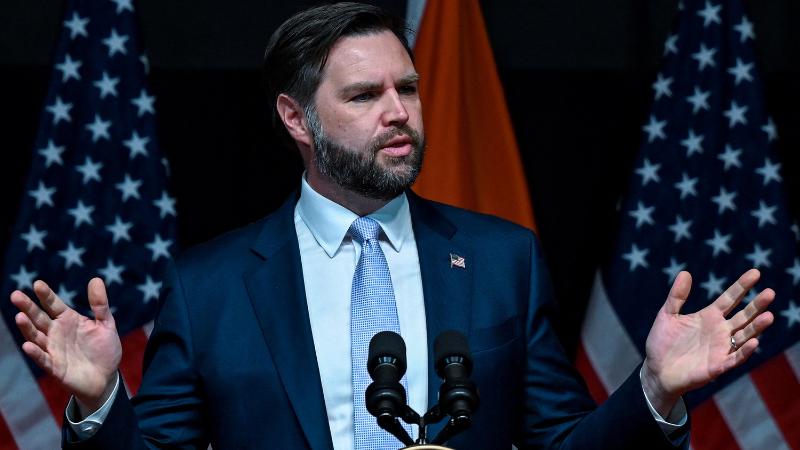
Speaking in an interview with Fox News, Vance stated that while the U.S. administration is hopeful for a de-escalation between India and Pakistan, America has no plans to intervene militarily or diplomatically beyond encouragement. “What we can do is try to encourage these folks to de-escalate a little bit,” said Vance. “But we’re not going to get involved in the middle of war that’s fundamentally none of our business and has nothing to do with America’s ability to control it.” This stance marks a continuation of Vance’s broader foreign policy philosophy advocating U.S. disengagement from conflicts where core American interests are not directly at stake. He added, “America can’t tell the Indians to lay down their arms. We can’t tell the Pakistanis to lay down their arms. And so, we’re going to continue to pursue this thing through diplomatic channels.”
Vance emphasized that the primary goal of the U.S. is to ensure that the situation does not spiral out of control. “Our hope and our expectation is that this is not going to spiral into a broader regional war or, God forbid, a nuclear conflict. Right now, we don’t think that’s going to happen,” he said.
U.S. President Donald Trump echoed similar sentiments but took a more conciliatory tone. Speaking at a press event, Trump said he hopes India and Pakistan can “stop” the current hostilities and offered to help mediate if needed. “Oh it’s so terrible. My position is I get along with both. I know both very well and I want to see them work it out,” he said. “They have gone tit for tat, so hopefully they can stop now. If I can do anything to help, I will be there.”
Trump’s comments came shortly after India launched Operation Sindoor, a high-intensity retaliation mission targeting nine terror infrastructure sites located in Pakistan-occupied Kashmir (PoK) and Pakistan’s Punjab province. These air and ground strikes were carried out in response to a deadly terror attack in Pahalgam, Jammu and Kashmir on April 22, which claimed 26 civilian lives. According to Indian military sources, Operation Sindoor was launched early Wednesday and included precision airstrikes and surface-to-surface missile engagements. As a result of these attacks, significant infrastructure used by terror groups reportedly supported by Pakistan was destroyed.
Simultaneously, Pakistan retaliated with artillery and mortar shelling along the Line of Control (LoC), particularly targeting forward villages and military posts in Jammu and Kashmir. This came alongside attempted drone and missile attacks on Indian military bases in Jammu, Pathankot, and other cities, all of which were intercepted and neutralised by Indian air defences. India’s Ministry of Defence confirmed that at least eight incoming missiles were shot down and multiple drones were intercepted. No casualties were reported in India during this phase of escalation.
The U.S. has so far remained firm on its position of non-involvement despite being urged by global observers and some domestic voices to play a larger role in conflict resolution. Historically, the U.S. has acted as an occasional mediator during past India-Pakistan flare-ups, particularly during the Kargil conflict in 1999 and after the 2008 Mumbai attacks. However, the current administration under Trump and Vance appears to be prioritizing a non-interventionist approach.
India, on its part, has maintained that its actions are defensive and retaliatory in nature, aimed solely at eliminating threats to national security emanating from across the border. The government has so far not responded officially to the remarks made by Vice-President Vance, but sources within the Ministry of External Affairs suggest that India is not seeking external mediation at this stage. The evolving situation continues to cause concern among international agencies and peace advocacy groups. With tensions high and no clear signal of de-escalation yet, all eyes remain on whether diplomatic backchannels can be activated effectively, or if further military exchanges will define the days to come.
Speaking in an interview with Fox News, Vance stated that while the U.S. administration is hopeful for a de-escalation between India and Pakistan, America has no plans to intervene militarily or diplomatically beyond encouragement. “What we can do is try to encourage these folks to de-escalate a little bit,” said Vance. “But we’re not going to get involved in the middle of war that’s fundamentally none of our business and has nothing to do with America’s ability to control it.” This stance marks a continuation of Vance’s broader foreign policy philosophy advocating U.S. disengagement from conflicts where core American interests are not directly at stake. He added, “America can’t tell the Indians to lay down their arms. We can’t tell the Pakistanis to lay down their arms. And so, we’re going to continue to pursue this thing through diplomatic channels.”
Vance emphasized that the primary goal of the U.S. is to ensure that the situation does not spiral out of control. “Our hope and our expectation is that this is not going to spiral into a broader regional war or, God forbid, a nuclear conflict. Right now, we don’t think that’s going to happen,” he said.
U.S. President Donald Trump echoed similar sentiments but took a more conciliatory tone. Speaking at a press event, Trump said he hopes India and Pakistan can “stop” the current hostilities and offered to help mediate if needed. “Oh it’s so terrible. My position is I get along with both. I know both very well and I want to see them work it out,” he said. “They have gone tit for tat, so hopefully they can stop now. If I can do anything to help, I will be there.”
Trump’s comments came shortly after India launched Operation Sindoor, a high-intensity retaliation mission targeting nine terror infrastructure sites located in Pakistan-occupied Kashmir (PoK) and Pakistan’s Punjab province. These air and ground strikes were carried out in response to a deadly terror attack in Pahalgam, Jammu and Kashmir on April 22, which claimed 26 civilian lives. According to Indian military sources, Operation Sindoor was launched early Wednesday and included precision airstrikes and surface-to-surface missile engagements. As a result of these attacks, significant infrastructure used by terror groups reportedly supported by Pakistan was destroyed.
Simultaneously, Pakistan retaliated with artillery and mortar shelling along the Line of Control (LoC), particularly targeting forward villages and military posts in Jammu and Kashmir. This came alongside attempted drone and missile attacks on Indian military bases in Jammu, Pathankot, and other cities, all of which were intercepted and neutralised by Indian air defences. India’s Ministry of Defence confirmed that at least eight incoming missiles were shot down and multiple drones were intercepted. No casualties were reported in India during this phase of escalation.
The U.S. has so far remained firm on its position of non-involvement despite being urged by global observers and some domestic voices to play a larger role in conflict resolution. Historically, the U.S. has acted as an occasional mediator during past India-Pakistan flare-ups, particularly during the Kargil conflict in 1999 and after the 2008 Mumbai attacks. However, the current administration under Trump and Vance appears to be prioritizing a non-interventionist approach.
India, on its part, has maintained that its actions are defensive and retaliatory in nature, aimed solely at eliminating threats to national security emanating from across the border. The government has so far not responded officially to the remarks made by Vice-President Vance, but sources within the Ministry of External Affairs suggest that India is not seeking external mediation at this stage. The evolving situation continues to cause concern among international agencies and peace advocacy groups. With tensions high and no clear signal of de-escalation yet, all eyes remain on whether diplomatic backchannels can be activated effectively, or if further military exchanges will define the days to come.