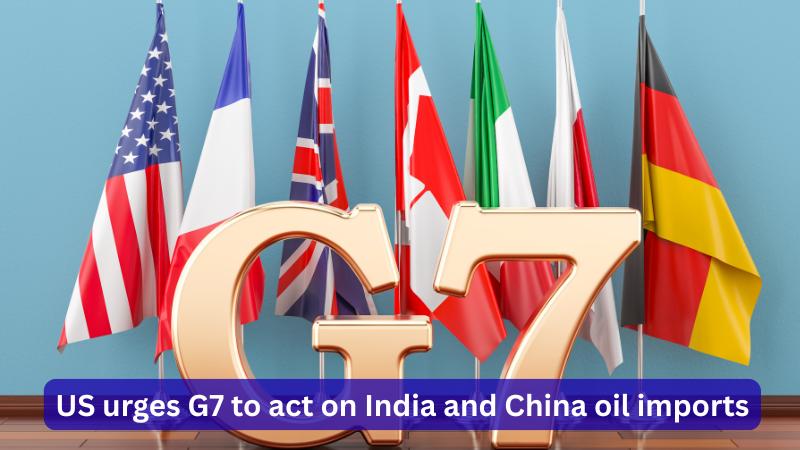
The United States has renewed its push for a tougher global stance against Russia’s energy exports, urging its Group of Seven partners to impose coordinated tariffs on countries that continue purchasing Russian oil. During a virtual call with G7 finance ministers, Treasury Secretary Scott Bessent and Trade Representative Jamieson Greer emphasized that only a unified approach targeting energy revenues could weaken Moscow’s ability to finance its war in Ukraine. They stressed that purchases by India and China were significantly undermining Western efforts, making these nations central to any effective sanction regime.
The G7 meeting, chaired by Canadian Finance Minister François-Philippe Champagne, focused on tightening restrictions on Russia and exploring ways to redirect frozen Russian assets to support Ukraine’s defense and economic recovery. Washington highlighted that meaningful tariffs on Chinese and Indian goods would apply direct economic pressure and could be lifted once the war concluded. The call underscored a deepening frustration in Washington with what it sees as loopholes in the existing sanctions framework, particularly the steady demand for discounted Russian crude in Asian markets.
President Donald Trump has already taken a unilateral step by sharply increasing duties on Indian imports. He raised tariffs by an additional 25 percent, bringing the total to 50 percent in an effort to deter New Delhi’s oil trade with Moscow. This decision has complicated ongoing trade discussions between Washington and New Delhi and sparked tension in a relationship that has otherwise been marked by growing strategic and defense cooperation. In a recent interview, Trump admitted that this move risked causing a serious rift with India but argued that it was necessary to reduce Russia’s revenues. He described the step as difficult but unavoidable, citing India as one of Russia’s largest oil customers.
Interestingly, Trump has refrained from applying the same tariff escalation to China, citing the fragile balance in ongoing trade relations between Washington and Beijing. Despite China’s significant role as a buyer of Russian energy, the White House has opted to maintain a careful truce, signaling that tariffs on Chinese imports could destabilize broader economic ties. Instead, Washington is relying on diplomatic channels to pressure Beijing, with Bessent scheduled to meet Chinese Vice Premier He Lifeng in Madrid to discuss a range of issues, including trade relations, anti-money laundering cooperation, and the ongoing US demand for TikTok’s divestment.
The broader message from Washington is that Russia’s war machine is being sustained by energy revenues, and without closing loopholes through which Moscow continues to sell crude oil, Western sanctions will remain insufficient. Trump has expressed impatience with Russian President Vladimir Putin’s unwillingness to end the conflict, warning that the United States would eventually have to respond much more strongly if the situation does not change. He has hinted at the possibility of extending sanctions to Russian banks and imposing broader restrictions on oil exports, though he acknowledged that any such measures would only be effective if European allies also participated fully.
For the G7, the challenge lies in maintaining unity while also managing the economic consequences of further sanctions. Ottawa, holding the current G7 presidency, emphasized that member states are determined to keep pressure on Moscow while simultaneously supporting Ukraine’s long-term recovery. Yet the differing approaches to India and China highlight the difficulty of achieving complete alignment. India, seeking affordable energy for its growing economy, has defended its purchases of Russian crude as pragmatic, while China continues to expand its energy imports under a wider strategic partnership with Moscow.
The coming weeks will be a test of whether Washington’s push for broader tariff adoption can gain traction within the G7. With the conflict in Ukraine showing no signs of resolution and Russia continuing to benefit from energy sales to major Asian buyers, the effectiveness of sanctions remains in question. The United States is betting that coordinated tariffs will force India and China to reconsider their trade with Moscow, but it remains uncertain whether other G7 members are willing to risk further economic friction with two of the world’s largest emerging markets.