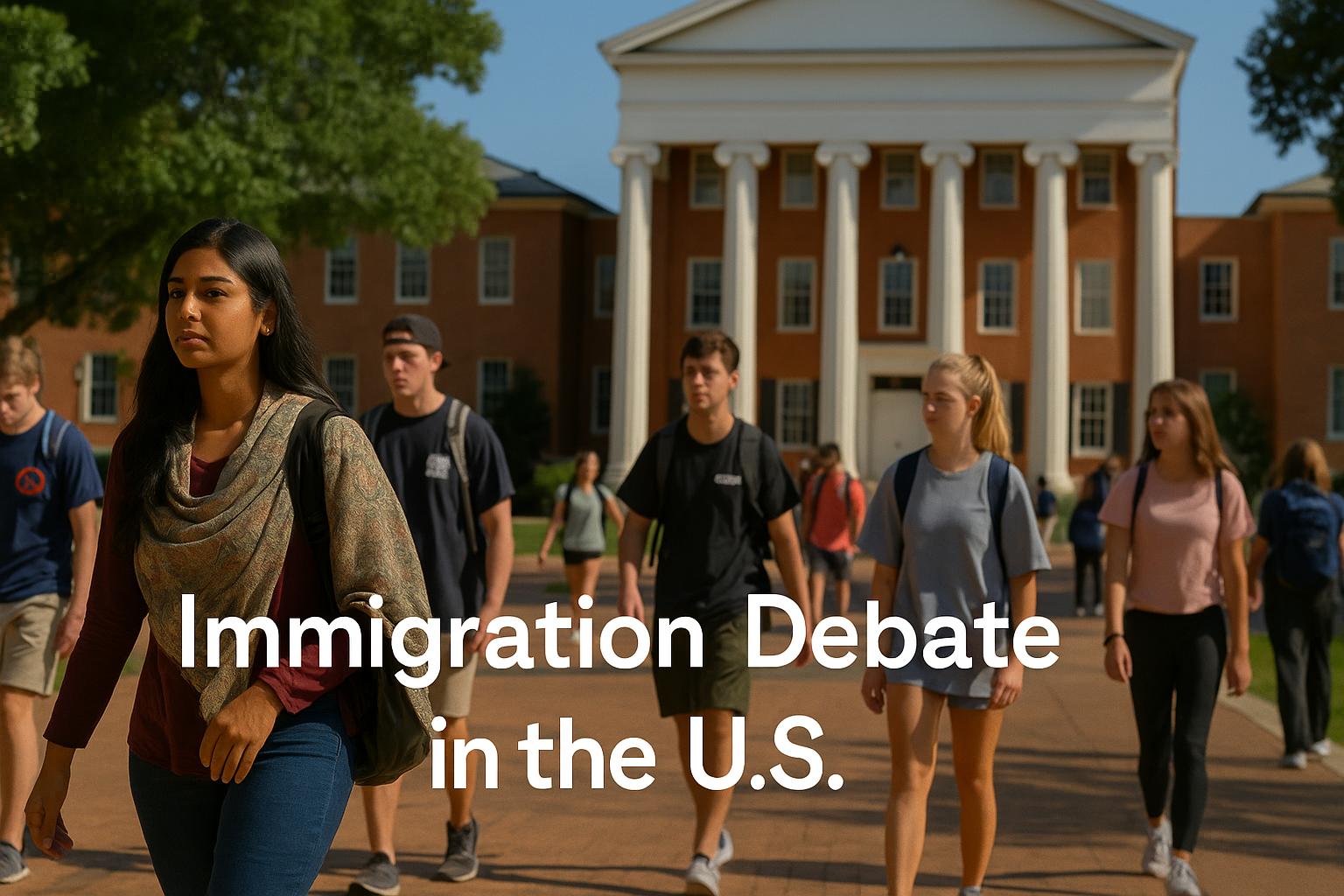
Mississippi: A charged moment unfolded at the University of Mississippi when United States Vice President JD Vance was questioned by a woman, believed to be of Indian origin, over the Trump administration’s tough immigration policies and his own interfaith household. The exchange, which was captured on video and widely shared online, has sparked conversation about America’s evolving immigration debate and the experiences of immigrant communities who feel increasingly alienated by recent political rhetoric.
Vance, addressing students during an interactive session, reiterated his support for a stricter immigration system and a tighter vetting process. Without specifying a target number for new legal immigrants, he stated that the United States should be admitting “far fewer” people than it currently does. He argued that a more limited intake would help preserve the country’s social stability and prevent strain on existing systems.
As the session opened for questions, a woman from the audience stood up to challenge Vance’s position. Draped in what appeared to be a Kashmiri pashmina shawl, she identified herself as someone who came to the United States with hope and trust in the American dream. Speaking firmly, she questioned why people like her—who had invested their youth, education, and financial resources in the country—were now being told that immigration levels were too high.
“When you talk about too many immigrants here, when did you decide that number?” she asked. “You made us spend our youth, our wealth, our time in this country and gave us a dream. You don’t owe us anything, but we’ve worked hard for it. Now how can you say we don’t belong here anymore?”
The audience applauded as the woman pressed her point further, referencing the Trump administration’s earlier restrictions on the H-1B visa system and the mass deportations of undocumented immigrants. Reports suggest that more than 6,000 student visas were revoked during that period, affecting thousands of international students—many of them Indian.
The question appeared to put Vance on the defensive. Trying to keep the tone light, he remarked, “We are not close to causing a scene. Don’t worry,” as some in the audience laughed nervously. However, Vance avoided a direct answer on how his administration planned to address the grievances of legal immigrants already in the country.
Instead, he reiterated his belief that unchecked immigration could undermine the nation’s identity. “Just because one person or a hundred people came here and contributed doesn’t mean we must let in a million more every year,” he said. “There has to be a limit.”
The woman was not finished. Drawing attention to Vance’s personal life, she asked about his wife, Usha Vance, who is of Indian origin and a practicing Hindu. “Why do I have to be Christian to prove that I love America?” she asked, referencing the broader perception that certain faiths are viewed more favorably in American politics than others.
Vance, who frequently references religion in his speeches, responded calmly. He acknowledged that his wife shares a different faith and said that while he personally believes in Christianity, faith should remain a matter of personal choice. “I honestly do hope that one day my wife is moved by the Christian gospel,” he said. “But if she doesn’t, then God has given everyone free will, and that doesn’t cause a problem for me.”
Observers at the event noted that the exchange reflected the growing tension between immigrant communities and a section of American policymakers who advocate for reduced legal immigration. The issue has been at the center of US political debate, with the Trump administration previously moving to tighten the H-1B visa process, increase scrutiny of international students, and limit family reunification pathways.
For many Indian-origin professionals and students, the comments struck a nerve. The United States has long been a preferred destination for skilled workers and international students from India, who now face growing uncertainty about their status and future. The woman’s remarks captured the sentiment of a generation that feels it has contributed to American innovation and culture but continues to face skepticism and shifting rules.
The incident has since gone viral, sparking widespread discussion across immigrant forums and social media platforms. Many praised the woman’s composure and courage, while others viewed the exchange as a reflection of the deepening divide over immigration and identity in America.
While Vance sought to frame his comments within the context of national interest and social cohesion, critics argue that such rhetoric risks alienating law-abiding immigrants who have built their lives and careers in the country. The University of Mississippi exchange may have lasted only a few minutes, but it has reignited a broader debate on what it means to belong in modern America—and who gets to define it.