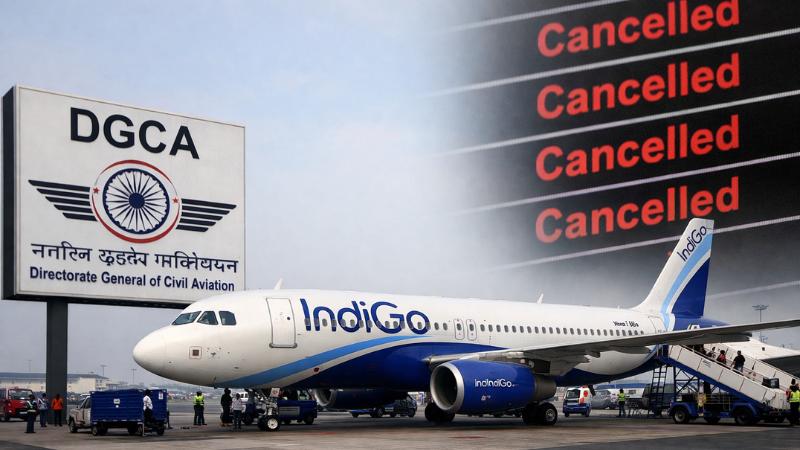
India’s aviation regulator has imposed a financial penalty of Rs 22.20 crore on IndiGo following a series of large-scale flight disruptions in early December 2025 that left more than three lakh passengers stranded across multiple airports. The action was taken after a detailed inquiry concluded that operational shortcomings within the airline significantly contributed to widespread cancellations and delays, triggering prolonged disruption across its network.
According to the findings, between December 3 and December 5, IndiGo cancelled 2,507 flights and delayed an additional 1,852 services. Although the immediate impact was concentrated over a three-day period, the knock-on effects continued for nearly two weeks, as aircraft positioning, crew availability and network recovery remained constrained. The regulator noted that the scale and duration of the disruption pointed to deeper structural issues rather than an isolated operational failure.
The inquiry highlighted that IndiGo had adopted what was described as an over-optimised operating model, aimed at maximising aircraft and crew utilisation. While such an approach can improve efficiency under normal conditions, investigators found that it left minimal buffers to absorb unexpected disruptions. As a result, even minor operational stresses quickly escalated into cascading delays and cancellations across the network, undermining overall resilience.
A key area of concern was crew rostering. The regulator found that duty schedules were designed close to prescribed limits under the revised Flight Duty Time Limitation norms, with reduced margins for recovery. Heavy reliance on practices such as dead-heading, tail swaps and extended duty periods further weakened roster integrity. When disruptions began, these constraints sharply limited the airline’s ability to reassign crews or stabilise operations in a timely manner.
The inquiry also pointed to gaps in planning and preparedness. IndiGo was found to have inadequately assessed the operational impact of the Winter Schedule 2025 alongside the implementation of revised FDTL norms. Shortcomings in system software support and contingency planning compounded the problem, resulting in network-wide instability once the disruptions set in. The regulator said these lapses reflected insufficient coordination between planning, operations and compliance functions.
Of the total penalty imposed, Rs 1.80 crore was levied as a one-time fine for six violations of Civil Aviation Requirements, including improper implementation of duty time norms and failures in accountable management oversight. An additional Rs 20.40 crore penalty was imposed for continued non-compliance over a period of 68 days, calculated at Rs 30 lakh per day from December 5, 2025 to February 10, 2026.
Regulatory action also extended to senior management. The airline’s Chief Executive Officer was cautioned for inadequate oversight and crisis management during the disruption period. The Accountable Manager and Chief Operating Officer were warned for failing to sufficiently evaluate the operational implications of the revised duty norms. The Senior Vice President in charge of the Operations Control Centre was directed to be relieved of current operational responsibilities and barred from holding any accountable position. Additional warnings were issued to senior officials in flight operations and crew planning, with the airline instructed to take corrective action against other personnel identified through its internal review.
Beyond financial penalties, the regulator directed IndiGo to furnish a Rs 50 crore bank guarantee under a newly instituted Systemic Reform Assurance Scheme. The guarantee is intended to ensure sustained corrective action and will be released in phases, subject to certified implementation of reforms covering leadership and governance, manpower planning and fatigue-risk management, digital systems, operational resilience and continued board-level oversight.
The regulator noted that IndiGo restored normal operations relatively quickly after the initial disruption and complied with applicable refund and compensation requirements. Acting on directions from the Ministry of Civil Aviation, the airline also issued a Rs 10,000 “Gesture of Care” voucher, valid for 12 months, to passengers affected by cancellations or delays exceeding three hours.
Separately, the aviation regulator has initiated an internal review to identify gaps in its own oversight mechanisms. The exercise is aimed at strengthening regulatory preparedness and reducing the likelihood of similar large-scale disruptions in the future, as passenger volumes and operational complexity in India’s aviation sector continue to grow.