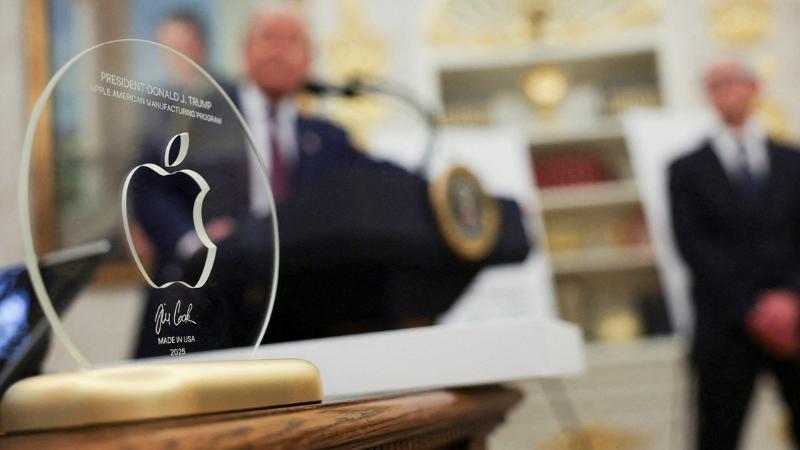
When Apple CEO Tim Cook visited the Oval Office recently, he brought more than just promises of business expansion. He arrived with a carefully crafted, symbolic gift for President Donald Trump—an elegantly designed iPhone glass disc mounted on a 24-karat gold base. This gesture, though small in size, carried significant weight in symbolism, representing both Apple’s deepening commitment to US-based manufacturing and its diplomatic finesse in dealing with trade pressures under Trump’s renewed administration.
The moment was captured during a formal meeting, where Commerce Secretary Howard Lutnick was also present. Cook presented the custom Apple keepsake to Trump while simultaneously announcing a massive new investment of $100 billion into US manufacturing. This comes on top of Apple’s earlier $500 billion pledge and highlights a strategic shift as the tech giant strengthens its domestic operations in response to political demands.
At first glance, the gift might appear simple—a circular glass slab with the Apple logo. But it carries layers of meaning. The disc was manufactured by Corning, the company known for producing the ultra-durable glass used in Apple’s iPhones. Cook explained that the gift was uniquely designed and engraved for President Trump, with the president’s name etched prominently at the top. The design itself was created by a former US Marine Corps corporal, who is now part of the Apple team, adding a patriotic touch to the craftsmanship.
What adds to the grandeur of the piece is its 24-karat gold stand. Cook shared that the gold used for the base was sourced from Utah, giving it a distinctly American identity. Beneath the disc, Cook’s signature is visible alongside the words “Made in USA” and the year 2025, a clear nod to Apple’s ongoing efforts to align with the US government’s vision of reshoring manufacturing. While the exact weight of the gold was not disclosed, its value could be substantial given current gold prices exceeding $3,300 per ounce.
The gesture comes at a time when Trump has been vocal about reducing America’s dependency on foreign manufacturing, especially for iconic products like the iPhone. The president has long criticized Apple and similar tech companies for outsourcing jobs and production to countries like China and India. During his second term, he has reiterated his expectation that Apple products sold in the US should also be made in the US.
Trump’s message was clear in a recent post, where he stated that if Apple continued to produce iPhones abroad, a 25 percent tariff would be imposed on those imports. “I have long ago informed Tim Cook that I expect their iPhones sold in the United States to be manufactured and built in the United States, not India or anyplace else,” Trump wrote. This statement underscores the ongoing pressure Apple faces to localize its supply chain and production.
In response, Apple has been scaling its US operations and strengthening its ties with policymakers. Tim Cook’s announcement of an additional $100 billion in US investments is part of this larger vision. The funds are expected to go toward expanding Apple’s manufacturing capabilities, creating American jobs, and enhancing the production of core iPhone components domestically. Cook mentioned that soon, one hundred percent of the cover glass used in iPhones and Apple Watches will be made in the United States, further reducing reliance on overseas suppliers.
Trump acknowledged this move positively, stating, “Companies like Apple, they’re coming home. They’re all coming home.” His words reflect a broader national strategy aimed at boosting domestic production and job creation while reducing foreign dependency in critical sectors.
The presentation of the custom-made iPhone glass wasn’t just a public relations move. It was a carefully planned symbol that represents the collaboration between government policy and corporate compliance. For Trump, it was a token of his administration’s influence in reshaping manufacturing priorities. For Cook and Apple, it served as a subtle yet effective way to reinforce goodwill, avoid tariff risks, and continue building a strong working relationship with the White House.
In a political and economic climate where trade policies shift rapidly, gestures like this go a long way in maintaining balance. Apple’s proactive approach not only secures its standing with the government but also signals its readiness to adapt to changing national interests. While it remains to be seen how much of Apple’s high-volume production will eventually move stateside, the gift and the $100 billion pledge clearly mark a step in that direction.
As political pressure builds and consumer demand for transparency and job creation grows, Apple’s move is timely and strategic. Whether or not it leads to every iPhone being assembled in the US, it certainly places the company on a favorable path with policymakers, investors, and the American public alike.