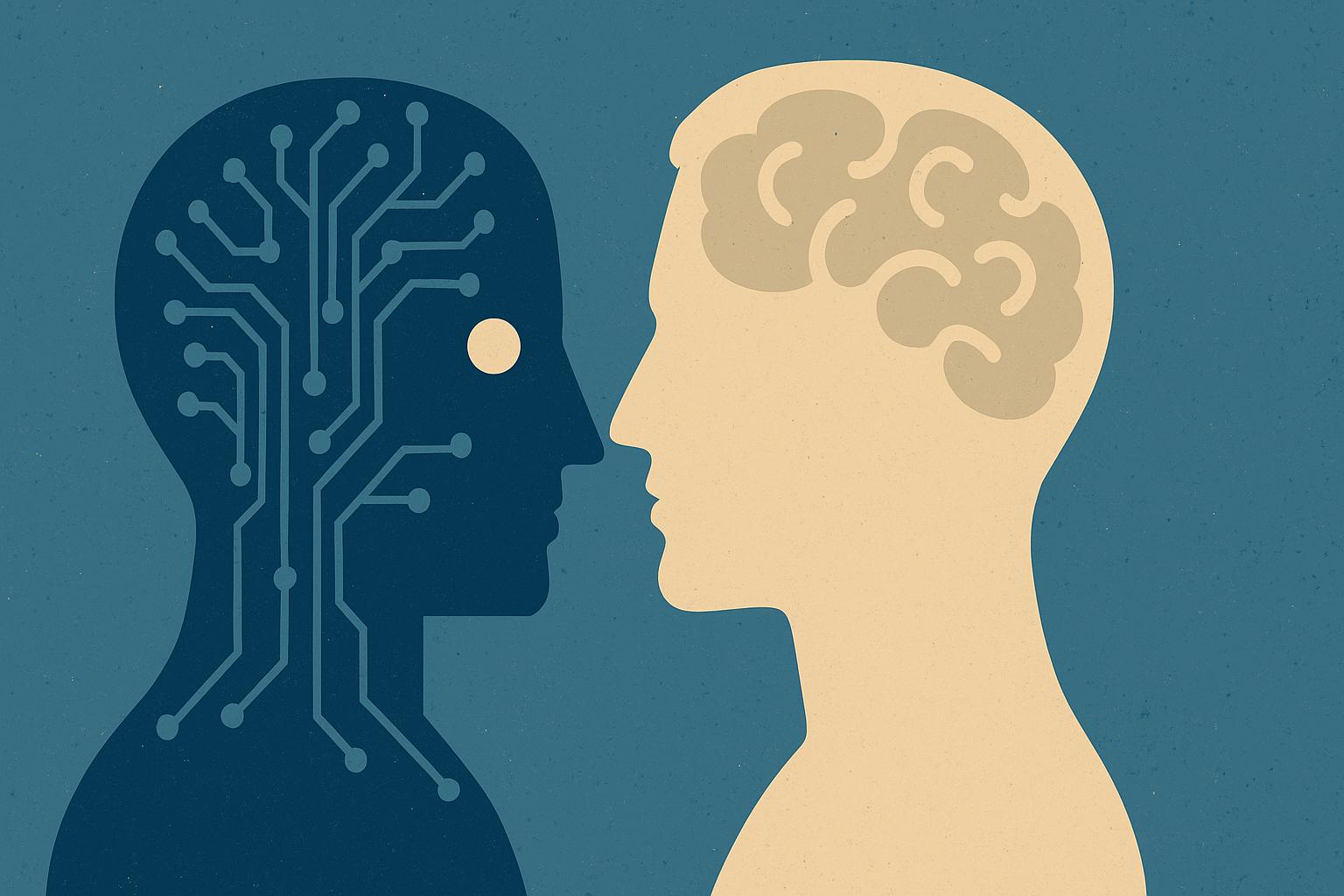
Concerns about artificial intelligence surpassing human capability have circulated for decades, but the arrival of accessible AI tools has renewed public unease about how these systems might reshape society. In Ohio, one state lawmaker has even proposed legislation to ensure that artificial intelligence systems cannot be legally recognized as people. While the idea may sound like science fiction, a researcher at Ohio State University believes it highlights an important misunderstanding of what intelligence really means.
Angus Fletcher, a professor of English and researcher at Ohio State’s Project Narrative, argues that humans hold a unique kind of intelligence that computers can never replicate. His latest book, Primal Intelligence: You Are Smarter Than You Know, explores how human intuition, imagination, emotion, and commonsense—what he calls the four “primal powers”—give people an advantage over AI’s reliance on logic and data.
According to Fletcher, artificial intelligence represents only a narrow slice of intelligence: logical reasoning. “AI takes one feature of intelligence—logic—and accelerates it,” he writes. “As long as life calls for math, AI crushes humans. But when life requires commonsense or imagination, AI tumbles off its throne.” He insists that while AI systems can process massive datasets and perform statistical analysis faster than any person, they cannot adapt to the uncertainty, creativity, and emotional complexity that define human decision-making.
Fletcher’s ideas extend beyond academic theory. The U.S. Army Special Operations Command has incorporated his research into training programs that help soldiers strengthen decision-making and mental resilience. His work earned him the Army’s Commendation Medal for programs that help personnel “see the future faster, heal quicker from trauma, and act wiser in life-and-death situations.”
A graduate of the University of Michigan in neuroscience and a holder of a PhD in literature, Fletcher combines insights from science and the humanities to explore how humans think through stories—a process he calls “narrative cognition.” He describes this as the brain’s ability to construct meaning and solve problems with limited information, relying on creativity rather than pure computation.
“Primal intelligence is about the brain’s ancient ability to act smart with limited information,” Fletcher said. “What makes humans successful is our ability to create new behaviors and new plans. It allowed our ancestors to survive predators and allows us today to innovate and adapt.”
He points to William Shakespeare as a prime historical example of “story thinking,” the ability to imagine new possibilities through narrative. Fletcher argues that literature and storytelling are not just cultural artifacts but tools for cognitive growth, enabling people to respond to novel challenges. “When faced with a completely new situation, humans can make a plan that’s never been tried before,” Fletcher explained. “That’s what primal intelligence is all about. Computers and AI can only repeat what has worked in the past.”
Fletcher’s previous works, including Wonderworks: The 25 Most Powerful Inventions in the History of Literature and Storythinking: The New Science of Narrative Intelligence, also explore how imagination and creativity shape human progress. Through his studies, Fletcher continues to make the case that no matter how advanced machines become, human intelligence—rooted in emotion, creativity, and storytelling—remains unparalleled.
His work arrives at a time when policymakers, researchers, and the public are grappling with the ethical and societal implications of artificial intelligence. Yet Fletcher’s message is ultimately optimistic: while AI may redefine how people work and interact, it cannot replace the uniquely human capacity to imagine, adapt, and tell stories that shape the future.