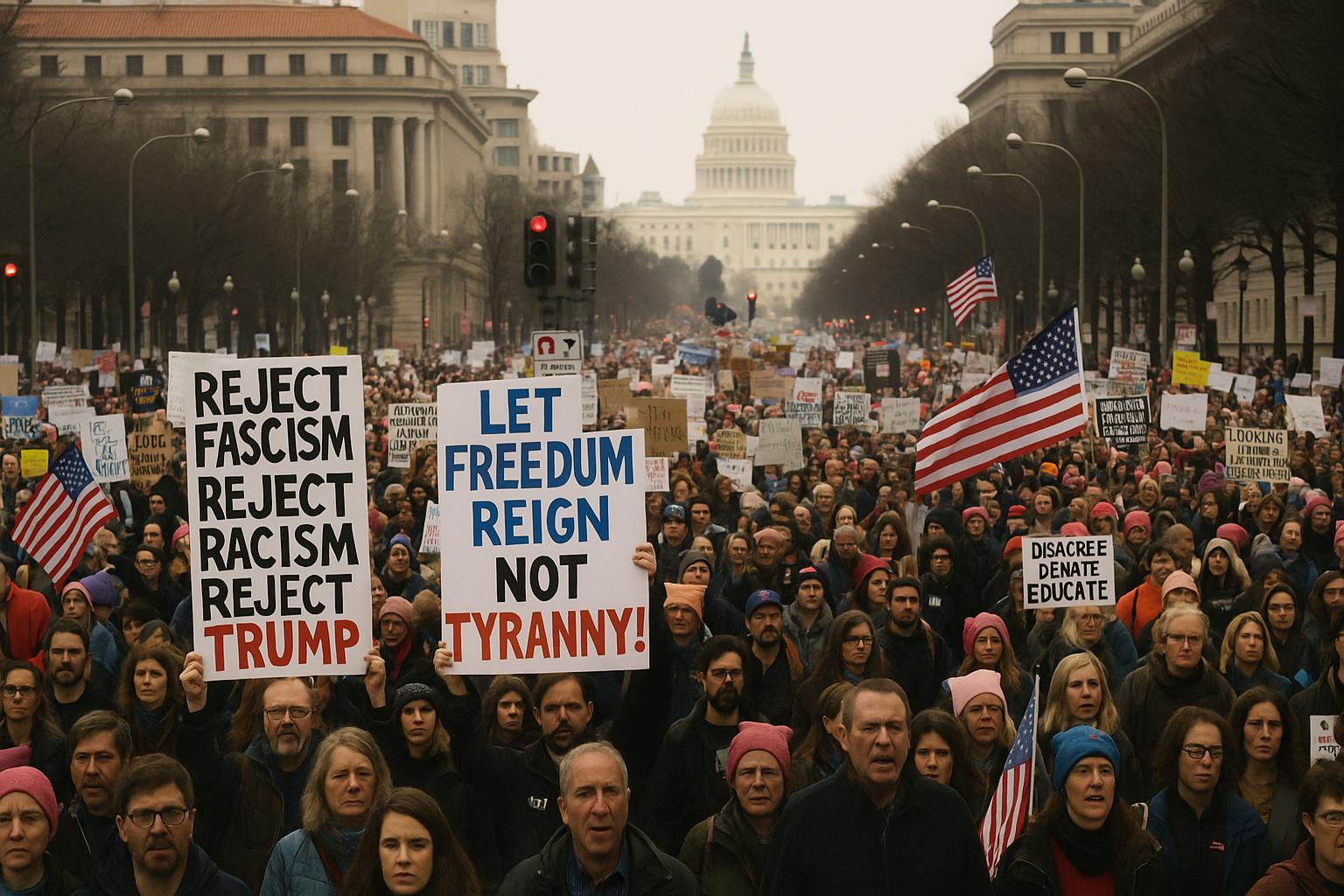
Thousands of demonstrators across the United States took to the streets on Saturday for the “No Kings” protests, a series of nationwide rallies denouncing President Donald Trump’s leadership and the ongoing government shutdown. The events brought a mix of political activism and festive energy to city squares, parks, and the nation’s capital, as participants called for accountability, the protection of democratic institutions, and an end to what they described as authoritarian tendencies in the current administration.
The “No Kings” movement, now in its third major mobilization since Trump’s return to the White House, has drawn support from a wide coalition of grassroots organizations and political leaders. Organizers said more than 2,600 rallies were planned in cities and towns across the country, with additional demonstrations taking place in several international locations. The protests coincided with the eighteenth day of a government shutdown that has disrupted federal operations, leaving thousands of workers unpaid and sparking renewed debate over the balance of power between the executive branch and Congress.
In Washington, D.C., the protests began early in the morning as crowds gathered in Arlington, Virginia, before marching across the Memorial Bridge toward the National Mall. By midday, thousands had assembled along Pennsylvania Avenue carrying signs that read “Reject Fascism, Reject Racism, Reject Trump” and “Let Freedom Reign, Not Tyranny.” The atmosphere was charged but peaceful, with demonstrators waving American flags and chanting slogans in defense of democracy. Organizers said the rally aimed to send a clear message that citizens would not tolerate the concentration of power or the undermining of constitutional checks and balances.
The timing of the protests reflected growing frustration with what many view as a deepening political crisis. The prolonged shutdown has halted essential services and raised concerns about the president’s confrontations with both Congress and the judiciary. Critics argue that Trump’s approach to governance has become increasingly unilateral, straining democratic norms. “There is no greater threat to an authoritarian regime than patriotic people-power,” said Ezra Levin, co-founder of the advocacy group Indivisible, one of the event’s organizers. Levin described the protests as a show of unity against policies that have, in his view, eroded public trust in government institutions.
Republican leaders, however, dismissed the “No Kings” demonstrations as politically motivated attacks designed to discredit the administration. House Speaker Mike Johnson referred to the rallies as “Hate America events,” accusing participants of promoting radical ideologies and obstructing bipartisan progress. The White House also criticized Democratic leaders for supporting the protests rather than negotiating an end to the shutdown. “Let’s see who shows up,” Johnson said. “It will be antifa types, people who hate capitalism, and Marxists in full display.”
In contrast, Democratic figures, including Senate Majority Leader Chuck Schumer and Senator Bernie Sanders, defended the demonstrations as expressions of patriotism and civic duty. “It’s a love America rally,” Sanders said in a public statement. “It’s millions of people who believe in the Constitution and won’t let Donald Trump turn this country into an authoritarian society.” Schumer and other Democrats have argued that standing up to the administration is necessary to restore balance and ensure that the presidency remains accountable to the people.
Across New Jersey, at least five towns hosted parallel rallies, joining hundreds of others nationwide. In cities from Chicago to Los Angeles, marchers carried signs supporting freedom, civil rights, and equality. Many protesters said they viewed the demonstrations as a continuation of America’s long tradition of civic engagement. “This isn’t about partisanship,” said a protester from Trenton. “It’s about protecting democracy itself.”
Despite the sharp political divide, the protests unfolded peacefully under tightened security. Police closed several major streets around downtown Washington, including sections of Pennsylvania Avenue, to accommodate the march. Participants reported occasional tensions but no major incidents. Some expressed concern over the deployment of National Guard units in the capital, viewing the measure as an intimidation tactic.
The government shutdown remained a focal point of anger. Democrats have refused to pass legislation to reopen the government without addressing healthcare funding, while Republicans insist on resolving that issue later. The deadlock has become a symbol of the broader struggle over governance and accountability. For many protesters, the shutdown represents a failure of leadership and a disregard for the public’s welfare.
Saturday’s events also highlighted a shift in momentum within the Democratic Party, which has become more unified in its opposition to the administration. Organizers noted that participation has grown significantly since earlier protests, with attendance nearly doubling since the first “No Kings” rally held in June. “What we are seeing from the Democrats is some spine,” Levin said. “The worst thing they could do right now is surrender.”
As evening fell, thousands remained on the National Mall holding candles and singing patriotic songs. For many, the day symbolized both frustration and hope — frustration with political dysfunction, and hope that collective civic action could restore faith in democracy. The “No Kings” movement, organizers said, will continue to push for transparency, accountability, and equality in the weeks ahead.