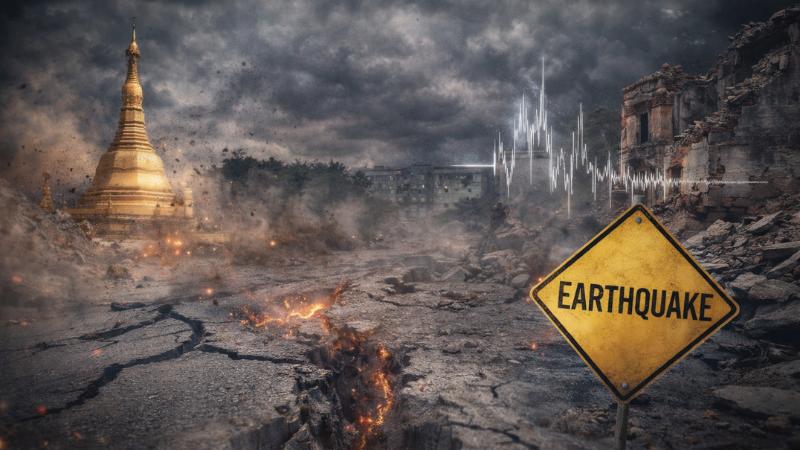
A moderate earthquake measuring 5.9 on the Richter scale struck Myanmar late Tuesday evening, sending noticeable tremors across parts of eastern India and neighbouring Bangladesh. The seismic activity, recorded by international monitoring agencies, caused brief panic among residents but did not result in any immediate reports of damage or injuries.
According to data released by the European-Mediterranean Seismological Centre (EMSC), the epicentre of the Myanmar quake was located approximately 70 miles east of Akyab. The German Research Centre for Geosciences (GFZ) reported that the earthquake occurred at a shallow depth of 10 kilometres, a factor that often increases the intensity of shaking felt at the surface. The tremors were strong enough to be experienced in several areas of West Bengal, including Kolkata, as well as multiple regions across Bangladesh.
Residents living in high-rise buildings and office complexes in Kolkata said they felt buildings sway for a few seconds shortly after 9 pm. Many people temporarily evacuated their homes and workplaces as a precaution. The shaking subsided quickly, and normalcy returned soon after. Authorities confirmed that no structural damage or casualties had been reported at the time of writing.
Seismologists noted that this was the third felt earthquake in Myanmar within the past 71 hours, highlighting a period of heightened seismic activity in the region. Experts continue to monitor the situation for possible aftershocks, though no significant follow-up events have been recorded so far.
Bangladesh also experienced another tremor earlier the same day. The National Centre for Seismology stated that a separate earthquake of magnitude 4.1 struck the country at a depth of about 150 kilometres. While deeper earthquakes generally produce less surface impact, residents in some districts still reported mild shaking.
Scientists explain that earthquakes occur frequently around the globe, with minor seismic events happening roughly every 30 seconds. Most are too weak to be detected without instruments. However, the energy released increases sharply with each step on the logarithmic Richter scale, meaning a 5.9 magnitude quake releases substantially more energy than lower-intensity events.
Officials have advised residents to remain alert and follow basic safety protocols during any future tremors. Disaster management teams continue to assess the situation while reassuring the public that there is currently no cause for alarm.